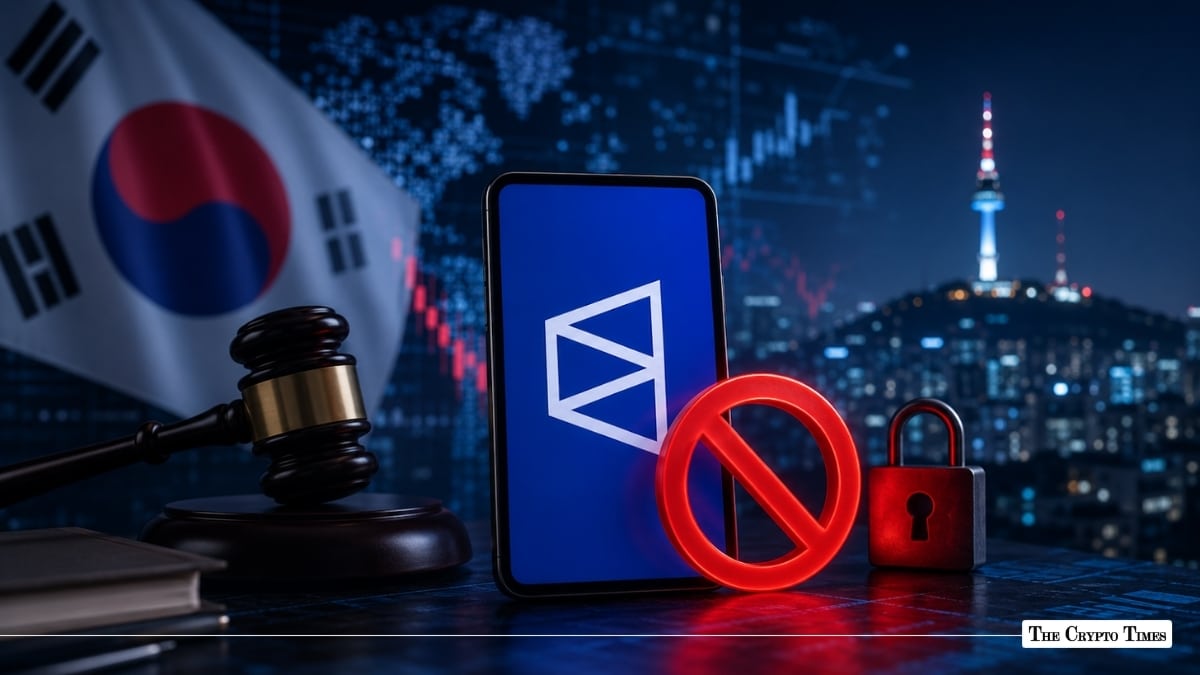
South Korea’s communications authority has instructed domestic internet service providers to cut off public access to Polymarket, closing the country’s access to one of the largest decentralized prediction platforms. The move is the latest in a series of administrative and criminal enforcement actions by sovereign regulators against crypto-based event wagering.
According to a report by News1, the corrective action, issued by the Korea Communications Standards Commission (KCSC), finalized a formal administrative review into Polymarket’s operational structure. The regulator concluded that the platform’s binary event contracts constitute an illegal gambling environment under South Korean criminal law.
The domain-level block follows an active criminal probe launched by South Korean law enforcement into domestic residents who traded tens of millions of dollars on local election outcomes on the platform earlier this year.
South Korea’s decision reflects a broader global crackdown. As prediction markets attract billions of dollars in institutional capital and seek venture valuations exceeding $20 billion, sovereign governments are increasingly treating Web3 event contracts not as novel financial derivatives, but as unlicensed, borderless gambling operations.
Polymarket, which relies on USD Coin (USDC) stablecoins running on the Polygon blockchain, is now formally banned, geofenced, or subject to access restrictions in 39 countries worldwide, according to Polymarket’s Geographic Restrictions disclosure. The website has not added South Korea to the list so far.
The South Korean Administrative Block and Legal Rationale
The administrative order issued on August 18 requires South Korea’s primary telecommunications operators, SK Telecom, KT, and LG Uplus, to block domain name system (DNS) lookups and IP access to Polymarket’s primary web interfaces. The ruling concluded a three-month administrative review initiated by the KCSC on May 21.
During the review, regulators focused on the core mechanics of Polymarket’s event contracts. Users buy “YES” or “NO” shares priced between $0.00 and $1.00, which settle at $1.00 if a specified outcome occurs and $0.00 if it does not. The KCSC determined that these binary contracts function on a winner-takes-all model where financial gains and losses depend entirely on real-world events outside the participant’s control, a core legal definition of gambling under South Korea’s Criminal Act.
In defense filings submitted during a July review window, representatives for Polymarket argued that the platform operates as a non-custodial, peer-to-peer decentralized protocol that does not hold user funds directly or process South Korean won payments. Polymarket also noted that it had removed Korean-language user interface support.
The KCSC rejected these arguments. The commission ruled that Polymarket’s administrative team actively creates market topics, establishes trading and resolution rules, maintains digital asset deposit and withdrawal interfaces, and collects protocol transaction fees. The commission concluded that these operational functions constitute the active management and facilitation of a gambling enterprise, rendering its smart-contract architecture irrelevant under domestic statutes.
Under South Korean law, state-sanctioned gambling is strictly limited. General sports wagering is restricted to Sports Toto, a state monopoly operated by the Korea Sports Promotion Foundation where individual wagers are capped at 100,000 won (approximately $65). Casino gambling for domestic residents is illegal across the country, with a single geographic exception at Kangwon Land, located in a former mining district in Gangwon Province.
Criminal Investigations Target On-Chain Traders
The administrative domain block arrives alongside unprecedented criminal enforcement aimed directly at individual retail traders. On June 5, the Gangwon Provincial Police Agency opened a criminal investigation into domestic Polymarket users at the direct request of South Korea’s National Police Agency, as reported by The Crypto Times.
The criminal probe was triggered by trading volume tied to South Korea’s June 3 local elections. On-chain transaction records show South Korean traders wagered on political outcome contracts, including high-volume markets predicting the Seoul mayoral election and whether President Lee Jae-myung would remain in office.
Police are investigating users under Article 246 of South Korea’s Criminal Act. The statute penalizes general gambling with fines up to 10 million won ($6,500) and habitual gambling with prison sentences up to three years or fines up to 20 million won ($13,000).
South Korea’s legal framework applies extraterritorially to its citizens. South Korean nationals can be prosecuted for engaging in unauthorized gambling regardless of whether the hosting servers, operating company, or underlying smart contracts reside overseas. Legal observers in Seoul note that the KCSC’s formal classification of Polymarket as an illegal gambling venue gives prosecutors clear statutory backing to file criminal charges against individual traders identified through on-chain tracking.
A Broadening Global Regulatory Dragnet
South Korea is not an isolated case. Over the past 20 months, gaming authorities, financial market regulators, and communications ministries across major economies have taken action against permissionless event markets.
Singapore
In January 2025, Singapore’s Gambling Regulatory Authority (GRA) blacklisted Polymarket under Section 20 of the Gambling Control Act 2022. The GRA ruled that offering speculative event contracts to residents without a remote gambling license violates federal law, which carries fines up to S$10,000 and six-month prison terms for individual participants. Internet service providers were ordered to implement domain redirects blocking local IP addresses.
France
France’s gambling regulator, the Autorité Nationale des Jeux (ANJ), initiated proceedings to ban Polymarket after a single French national traded more than $45 million on the outcome of the U.S. presidential election. French gambling statutes restrict remote betting to licensed sportsbooks and horse racing operators. The ANJ concluded that wagering financial assets on political or real-world events constitutes unauthorized gambling under national law, leading to access restrictions.
Portugal
In January 2026, Portugal’s gaming regulator, the Serviço de Regulação e Inspeção de Jogos (SRIJ), issued a 48-hour directive ordering Polymarket to cease serving Portuguese users. The enforcement followed trading volume exceeding €103 million on markets tied to Portugal’s presidential elections.
Indonesia
Indonesia’s Ministry of Communication and Information Technology (Kominfo) issued domain blocks against Polymarket after local traders opened speculative contracts on domestic political developments, including presidential term lengths.
The United States
In the U.S., Polymarket settled enforcement proceedings with the Commodity Futures Trading Commission (CFTC) in January 2022, paying a $1.4 million penalty for operating an unregistered facility for swap transactions. Under the terms of the settlement, Polymarket agreed to block U.S. residents from trading on its platform.
To re-enter the U.S. market legally, Polymarket acquired QCEX LLC, an entity holding CFTC registrations as a Designated Contract Market (DCM) and Derivatives Clearing Organization (DCO).
However, federal scrutiny remains active. The Federal Bureau of Investigation and the Department of Justice have investigated whether the platform continued to allow U.S. users to trade via virtual private networks (VPNs). Meanwhile, state gaming commissions in Nevada, Wisconsin, and Minnesota have issued cease-and-desist notices, asserting that event contracts violate state-level gaming monopolies.
Polymarket’s public documentation shows the platform now enforces geofencing or access restrictions in 39 jurisdictions, including Germany, Italy, Poland, Belgium, the Netherlands, Brazil, Australia, and Argentina. At the time of this writing, the website has not listed South Korea.
Commercial Growth vs. Shrinking Geographic Footprint
The expansion of regulatory bans creates a stark contrast between Polymarket’s business metrics and its legal status across global markets.
Earlier this month, financial reports indicated that Polymarket was in discussions with venture investors to raise new equity capital at a valuation exceeding $20 billion, following statements that its annualized revenues had surpassed $1 billion, as reported by Bloomberg.
The fundraising discussions follow major institutional investments:
- Intercontinental Exchange (ICE): In late 2025, ICE, the parent company of the New York Stock Exchange (NYSE), made a $2 billion strategic investment into Polymarket, valuing the platform at $8 billion. The arrangement included data distribution agreements to feed Polymarket’s real-time event probabilities into ICE’s global financial terminals.
- Venture Backing: Previous investment rounds brought in institutional capital from Founders Fund and hedge fund D.E. Shaw & Co.
- Volume Metrics: Monthly trading volume peaked at $10.57 billion, driven by macroeconomic, geopolitical, and sports contracts, including over $4.25 billion traded on FIFA World Cup markets, according to a previous CryptoTimes report dated July 15.
This institutional adoption creates compliance challenges for Polymarket’s backers. Mainstream financial institutions like ICE operate under oversight from the U.S. Securities and Exchange Commission (SEC), the CFTC, and European regulators, requiring strict adherence to Anti-Money Laundering (AML) and sanctions frameworks.
As sovereign states issue formal bans, operating a platform reliant on permissionless Web3 wallets creates regulatory friction between institutional compliance requirements and decentralized retail liquidity.
Technical Mechanics: ISP Filtering vs. On-Chain Forensics
South Korea’s enforcement strategy illustrates how government authorities address decentralized protocols operating on public blockchains.
Domain Sinkholing and App Geofencing
When a national regulator orders network-level blocking, domestic telecommunications providers configure their primary DNS servers to intercept requests for polymarket.com. Users attempting to load the site are redirected to a landing page managed by Korea’s internet watchdog, indicating that the domain host contains illegal materials.
Simultaneously, Polymarket updates its web application frontend to enforce geofencing. Visitors detected with South Korean IP addresses are placed into a “close-only” operating mode. Under this restriction, existing positions can be closed and USDC collateral withdrawn, but users are blocked from opening new positions or supplying liquidity to existing pools.
Smart Contract Resilience
Network domain blocks do not alter or delete smart contracts deployed on the Polygon blockchain. Polymarket’s core trading infrastructure consists of non-custodial conditional token contracts that process order matches, hold USDC collateral, and execute settlements on-chain.
Traders possess multiple technical avenues to bypass web-level domain blocks:
- Virtual Private Networks (VPNs): Encrypting internet traffic and routing requests through servers located in non-restricted jurisdictions.
- InterPlanetary File System (IPFS): Mirroring the frontend interface on decentralized storage networks that lack centralized domain name servers.
- Direct Smart Contract Calls: Interacting directly with underlying Polygon smart contract addresses via custom scripts or developer block explorers like Polygonscan, bypassing web frontends entirely.
On-Chain Ledger Analysis
Because domain blocks cannot prevent direct smart contract interaction, law enforcement agencies have shifted their focus to on-chain forensic tracking to identify and prosecute individual traders.
Public blockchains like Polygon operate as open, immutable ledgers. While wallet addresses are pseudonymous, movements of funds into and out of those wallets are public. In South Korea, centralized cryptocurrency exchanges, including Upbit, Bithumb, and Coinone, are legally required to enforce strict identity verification (KYC) and comply with the Financial Action Task Force (FATF) Travel Rule.
When a user transfers USDC from a KYC-verified domestic exchange account to a self-custodial Polygon wallet, and that wallet subsequently deposits funds into Polymarket smart contracts, law enforcement agencies can link the on-chain activity directly to a verified citizen. The Gangwon Provincial Police Agency is using these transaction trails to build evidentiary files under domestic gambling statutes.
Market Integrity, Oracles, and Real-World Controversies
Beyond regulatory classification, prediction markets face heightened scrutiny over market integrity, oracle security, and real-world manipulation incentives.
The UMA Oracle and Governance Risks
Polymarket relies primarily on UMA’s Universal Market Access optimistic oracle to resolve event outcomes. When a market expires, a proposed answer is submitted with a financial bond. If no participant disputes the answer within a specified liveness window, the result is confirmed on-chain and smart contracts distribute collateral to winning token holders.
If a dispute occurs, resolution escalates to a vote among holders of the UMA governance token.
This decentralized voting mechanism contains structural vulnerabilities. A Bloomberg analysis of on-chain UMA governance holdings revealed that voting power is highly concentrated, with just nine digital wallets controlling nearly 50 percent of all circulating UMA voting tokens.
This concentration introduces economic risks. If the total capital staked in a Polymarket event pool exceeds the market capitalization and liquidity required to acquire a voting majority in UMA, actors could acquire a controlling stake in the governance token to force an inaccurate resolution, profiting from the market payout at the expense of oracle integrity.
To reduce reliance on human voting for standardized markets, Polymarket has increasingly integrated automated Chainlink price feeds and Time-Weighted Average Price (TWAP) calculation models for cryptocurrency and financial derivative markets.
Real-World Manipulation and Ethics Concerns
The expansion of event contracts into military conflicts, geopolitical crises, and criminal proceedings has drawn ethical criticism and regulatory pushback:
- War and Military Operations: During military actions in the Middle East, active-duty personnel faced interrogation and indictments for allegedly placing trades on prediction markets using advance knowledge of military strike timing.
- Journalist Harassment: Traders holding large positions on Iranian missile strike timing targeted Israeli journalists with threats in attempts to alter public reporting and influence market resolution outcomes.
- Insider Trading on Geopolitics: In early 2026, newly created accounts earned hundreds of thousands of dollars betting on U.S. military actions in Venezuela shortly before official public announcements, prompting federal law enforcement investigations into insider information leaks.
These incidents have led lawmakers in multiple jurisdictions to introduce legislation restricting event contracts on armed conflict, acts of terrorism, and severe real-world harm.
Unlicensed DeFi Protocols vs. Regulated Derivatives Venues
The pressure on Polymarket shows a growing split in the prediction market industry between permissionless Web3 protocols and fully licensed financial exchanges.
Regulated platforms such as Kalshi and Interactive Brokers’ ForecastEx operate as Designated Contract Markets under CFTC oversight in the United States. These venues enforce identity verification, connect directly to traditional fiat banking rails, maintain surveillance departments to detect insider trading, and report transaction data to tax authorities.
While regulated platforms face slower market listing processes and higher operational overhead, their licensed status protects them from domain sinkholing, ISP blocks, and police probes.
In contrast, Polymarket’s borderless liquidity structure allows for rapid market creation and high trading volumes during major global news events. However, as major economies block access and target retail traders, the platform faces a fragmented global user base and ongoing legal uncertainty.
What’s Next for Prediction Markets
South Korea’s decision to block Polymarket and launch criminal investigations into domestic traders represents a turning point in the regulation of prediction markets. Government authorities are moving beyond warning notices to deploy active network filtering and on-chain forensic tracking.
As sovereign nations act to enforce gambling laws, defend state betting monopolies, and protect election integrity, prediction market operators face two distinct strategic choices:
- The Licensed Derivative Path: Fully adopting regional licensing frameworks, requiring identity verification across all interfaces, and strictly excluding users in non-licensed jurisdictions. This approach satisfies institutional investors and banking partners but limits borderless participation.
- The Decentralized Protocol Path: Fully decentralizing frontend hosting, order routing, and governance infrastructure to operate entirely as open-source code. While this model makes platforms resistant to administrative shutdown, it shifts legal risks directly onto individual retail users participating in restricted jurisdictions.
How prediction market operators navigate this environment will determine whether event contracts mature into institutional financial instruments or remain restricted to unregulated, offshore trading venues.
Also Read: From FIFA Bets to Courtrooms: Why Prediction Markets Face a Regulatory Reckoning
Disclaimer:
Some elements of this content may have been enhanced with the help of our artificial intelligence (AI) assistants for purposes such as basic refinement, review, image generation, and translation to deliver high-quality news in a shorter time frame. However, all AI-assisted content is reviewed and approved by our team to ensure accuracy, fairness, and editorial integrity.