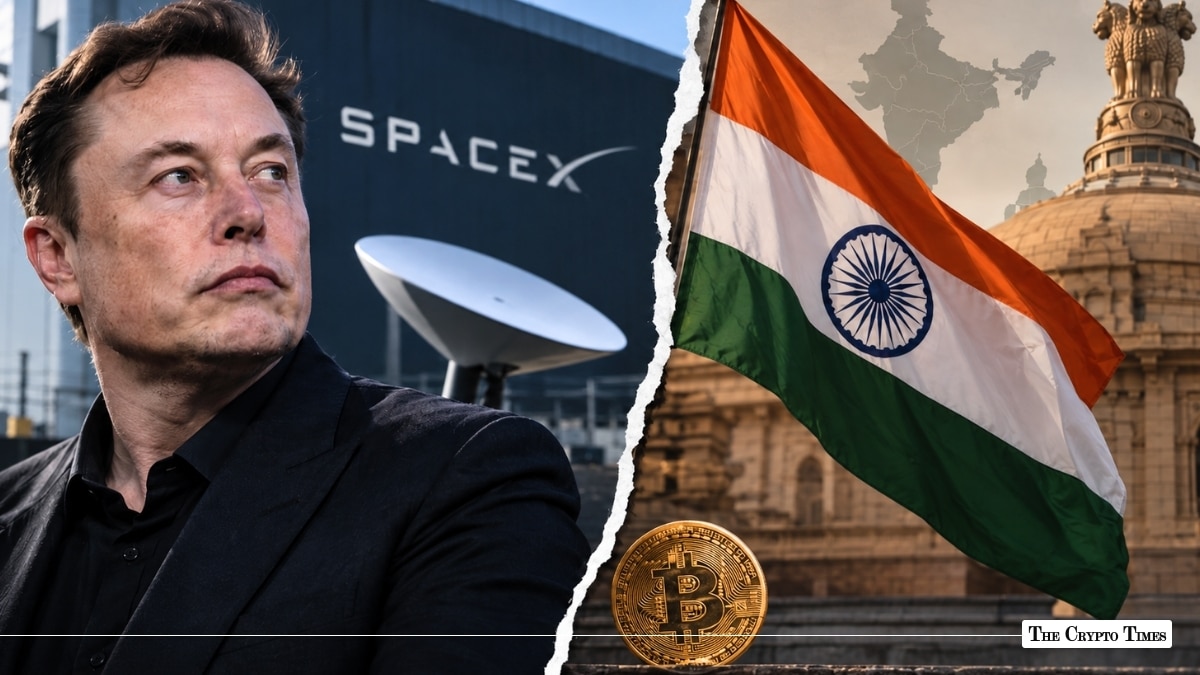
When Elon Musk accused unnamed “oligarchs” of keeping Starlink out of India this week, New Delhi’s response was blunt: the allegation was “baseless and misconceived.”
But step back from the India dispute and a broader pattern emerges. Starlink, Musk’s satellite-internet network, has encountered regulatory, security and ownership barriers across multiple countries. The reasons vary, but they often involve the same questions: who controls critical communications infrastructure, where user data sits, and how much authority a government has over a network operated by a private company headquartered abroad.
For a crypto audience, that makes the Starlink story more than a telecom dispute. It offers a useful lens on a similar problem in digital assets: how governments respond when technology operates across borders while remaining under the control of private infrastructure providers.
The India Trigger
On October 7, Musk posted on X in response to data showing that 11,256 Indian villages still lacked 4G connectivity as of May 2026. He wrote that “we are being blocked by certain oligarchs to maintain their monopolistic chokehold on the Indian people,” adding, “You can guess who they are …” He did not identify anyone.
India’s Ministry of Communications responded the following day through the Press Information Bureau in a statement titled “India’s regulatory framework for satellite communication services is fair and non-discriminatory.” The government called Musk’s suggestion of unfair treatment “baseless and misconceived,” said licenses had been granted to three GMPCS satellite licensees, and said security assessments were under way for all three. It added that “all the three entities are at broadly the same regulatory stage.” India also said spectrum would be assigned only after a licensee completes the required security process.
The two sides are therefore presenting sharply different accounts of the delay. Starlink has spent years seeking a commercial launch in India, while Starlink executive Lauren Dreyer told media on October 7 that the company had built 20 gateway sites in the country and planned to keep Indian user data within India.
The regulatory process, however, is not unique to Starlink. India’s government says the same security framework applies to the other GMPCS licensees. Musk did not identify the “oligarchs” he accused of blocking Starlink, and speculation about domestic telecom incumbents remains just that — speculation, not an established fact.
A Global Patchwork of Restrictions
India is far from the only market where Starlink has faced regulatory resistance. Across several regions, governments have restricted, rejected, or refused to license the service over concerns involving national security, local ownership, regulatory compliance, or sovereignty.
China does not license Starlink and has treated the use of foreign satellite communications equipment as a security concern. In December 2025, Chinese authorities issued what was reported as the country’s first penalty against a foreign-owned vessel for using Starlink while operating in Chinese waters.
Russia has also moved against foreign satellite communications equipment. A Russian government decree issued in April 2026 prohibited the import of certain foreign satellite communications radio equipment without the required frequency-allocation approval, a measure that covers Starlink terminals. Russian authorities have also said Starlink is not authorized for use in the country. Deutsche Welle reported that the April decree specifically affects Starlink terminals.
Iran has never granted a license for Starlink service within its territory. The International Telecommunication Union’s Radio Regulations Board has documented Iran’s repeated complaints about unauthorized Starlink terminals operating inside the country and noted that Iran had not granted a license for the service. The ITU has also recorded Iran’s position that some terminals were illegally imported. Separately, reports have estimated that tens of thousands of terminals entered Iran through unofficial channels; Reuters reported in June 2026 that former Israeli Prime Minister Naftali Bennett said Israel had helped smuggle tens of thousands of Starlink receivers into Iran.
In Afghanistan, Taliban authorities have treated unauthorized Starlink use as illegal and have seized equipment. In April 2026, authorities shut down and seized two Starlink receivers in Bamiyan, saying they were operating without licenses. Afghanistan’s Ministry of Communications has also previously reported the seizure and shutdown of an unauthorized Starlink device in Kunduz.
Africa has produced a particularly fluid regulatory picture. In Namibia, the Communications Regulatory Authority of Namibia rejected Starlink’s license application in March 2026. The regulator said Starlink failed three of six statutory criteria, including ownership and control, national defense, and public security, and compliance history. CRAN’s decision was reported by Namibia’s news agency, while the regulator’s decision was also reported by Reuters. The regulator had previously issued a cease-and-desist order after finding Starlink operating without a license.
Elsewhere, authorities have taken enforcement action against unauthorized Starlink equipment. In Cameroon, customs authorities seized 10 Starlink modems in December 2025, saying Starlink had been technically prohibited in the country since April 2024 and citing national security and telecommunications-regulation concerns. In Senegal, police arrested two people in August 2026 following a complaint over the unauthorized distribution of Starlink services, according to Seneweb’s report.
Mali has also repeatedly restricted unauthorized Starlink equipment. The Malian government initially ordered the dismantling and prohibition of Starlink terminals nationwide in 2024, citing security and regulatory concerns. Although the government later temporarily lifted a suspension on imports and sales while examining a legal framework, Mali’s telecom regulator was still reminding traders in March 2026 that the import, sale and use of unauthorized Starlink equipment remained prohibited. This makes Mali another example of a regulatory process that has changed over time rather than a simple permanent ban.
The African picture is therefore not static. Several countries that previously restricted Starlink or had not licensed it have subsequently authorized the service. The Democratic Republic of Congo, for example, granted Starlink a license in May 2025 after previously banning the service. Liberia’s telecom regulator says it granted Starlink a provisional license and later allowed it to operate as a nationwide retailer. Zimbabwe also approved Starlink’s license in 2024.
Starlink’s own authorized-retailer list currently includes markets such as Botswana, the Democratic Republic of Congo, Ghana, and Zimbabwe, illustrating how quickly the regulatory map can change. The original list should not, however, describe Côte d’Ivoire as a country that currently prohibits Starlink: the Ivorian government announced in June 2026 that it had granted Starlink authorization to provide fixed satellite internet services from July.
That distinction matters. Starlink’s regulatory map is not a fixed list of bans. It is a moving collection of licences, restrictions, enforcement actions and negotiations that can change as governments and SpaceX reach new arrangements.
Ukraine is another important exception. It is sometimes grouped into discussions about Starlink restrictions, but some of the most consequential limitations there have come from SpaceX itself rather than a Ukrainian government ban. Reuters reported that SpaceX has worked with Kyiv to block unauthorized Russian use of Starlink, and in February 2026 Ukraine said Russian Starlink terminals had been deactivated following cooperation with SpaceX. It was reported that only terminals on Ukraine’s authorized “white list” remained operational.
The history around Crimea requires particular care. Walter Isaacson’s 2023 biography of Musk said he had ordered Starlink coverage disabled around Crimea, but Musk disputed that account, saying Starlink had never been activated there and that he had rejected a Ukrainian request to provide coverage for an attack. Isaacson later acknowledged that his account was flawed. Reuters has documented the conflicting accounts while also reporting a separate 2022 shutdown of Starlink coverage in areas of Ukraine during a counteroffensive.
The distinction is significant: in some cases, access to communications infrastructure can be influenced by a private operator’s technical or commercial decisions rather than solely by a government regulator.
Ukraine is another important exception. It is sometimes grouped into discussions about Starlink restrictions, but some of the most consequential limitations there have come from SpaceX itself rather than a government ban. Musk has used geofencing to restrict Starlink coverage in sensitive areas and declined in 2023 to extend service near Crimea. In February 2025, reports also emerged that Ukrainian officials had been warned about a possible Starlink shutdown.
The distinction is significant: in such cases, access to communications infrastructure can be influenced by a private operator’s technical decisions rather than solely by a government regulator.
The Crypto Thread
This is where the Starlink story intersects directly with crypto. The same borderless connectivity that makes satellite internet valuable has also made Starlink equipment useful to criminal networks operating outside authorized telecommunications systems. In Southeast Asia, Starlink terminals have been found around scam compounds involved in cyber-enabled fraud, including cryptocurrency investment and romance scams.
In a joint operation announced on June 3, 2026, Starlink worked with Coinbase, Meta, Microsoft, the U.S. Department of Justice, the FBI, and the Royal Thai Police, among other partners. The operation resulted in 63 arrests, thousands of Starlink terminals disabled, 1.4 million scam-linked Facebook and Instagram accounts removed by Meta, and roughly 20,000 fraudulent Microsoft accounts suspended.
Coinbase separately said it had frozen more than $3 million in cryptocurrency linked to criminal networks. The U.S. Department of Justice reported that private-sector partners had frozen more than $3.8 million in cryptocurrency connected to funds stolen from Americans.
The Starlink component was equally significant. SpaceX said it had disabled more than 2,500 Starlink kits around suspected scam centers in Myanmar, where the service was not licensed. Because the terminals were being used outside authorized service territory, SpaceX used geofencing to terminate their connectivity.
Many of the networks targeted in the region have links to cryptocurrency investment scams, romance scams and other forms of cyber-enabled fraud. The Crypto Times has tracked the Indian enforcement angle through cases including the CBI’s arrest of a kingpin behind crypto scam camps in Myanmar and other investigations into call-centre and “digital arrest” networks.
The episode shows how satellite connectivity and crypto enforcement can converge in the same operation. Starlink was not itself the financial system used by these criminal networks; it was the communications infrastructure authorities and SpaceX sought to disrupt, while Coinbase targeted the cryptocurrency flows.
India Adds Another Layer
The India connection makes the comparison more striking. The same government Musk is publicly challenging over Starlink has also overseen a significant expansion in the country’s regulated crypto market.
Coinbase launched in India in June 2026 with direct INR rails, spot trading and perpetual futures, following the company’s regulatory and market-entry efforts in the country. Coinbase subsequently said India would be its sole international launch focus for 12 months.
Musk’s wider business ecosystem is also moving closer to digital assets. X has reportedly been exploring the use of stablecoins such as USDC for creator payments, while Musk remains one of the most prominent public supporters of Dogecoin.
Meanwhile, SpaceX’s SPCX shares rose 20% in their Nasdaq debut, bringing another part of Musk’s corporate ecosystem into the public-market and crypto-investor conversation.
The friction between Musk’s companies and New Delhi also predates the Starlink dispute. X has previously sued the Indian government over free-speech rules.
Why It Matters
The comparison between Starlink and crypto should not be taken too literally. Starlink’s licensing disputes are telecom matters involving spectrum, security clearances, ownership, and regulatory compliance. Cryptocurrency regulation involves financial stability, consumer protection, taxation, anti-money-laundering rules, and other concerns.
But the Starlink dispute highlights a broader problem that also appears in digital assets: what happens when critical digital infrastructure crosses borders while remaining under the control of a private company outside a government’s jurisdiction?
That question sits at the centre of Starlink’s regulatory battles. Governments want the ability to enforce domestic laws, protect sensitive data and maintain control over critical infrastructure. Companies operating global networks want to provide services across borders while preserving a common technological platform. Crypto networks raise a similar tension, although with very different technologies and regulatory consequences.
The Southeast Asian scam operation provides the clearest practical connection. SpaceX used geofencing to disable unauthorized Starlink terminals, while Coinbase froze cryptocurrency associated with the criminal networks. Satellite connectivity and crypto enforcement briefly converged in the same operation.
For India, the contrast is particularly notable. New Delhi is simultaneously insisting that Starlink comply with its regulatory process and positioning India as a major growth market for global crypto companies such as Coinbase.
How that balance between openness, security and regulatory control develops will matter beyond satellite internet. For now, the India-Musk dispute is a data point in a much larger debate over who controls the infrastructure connecting an increasingly digital economy, and how governments respond when that infrastructure crosses borders.