Key Highlights
- John O’Loghlen, Managing Director for Coinbase APAC, told The Crypto Times in an exclusive interview that Coinbase “hasn’t had an international launch in the last 12 months and doesn’t have one scheduled for the next 12 months” — confirming that the June 1 India launch is the sole focus of Coinbase’s international expansion through May 2027.
- Coinbase has built bespoke India-specific INR Rails technology to comply with Indian sovereign rupee restrictions and currency controls, and has assembled a network of local Indian market makers drawn from the TradFi and fintech hedge fund space.
- O’Loghlen confirmed Coinbase is actively cooperating with Indian law enforcement agencies through its Global Intelligence Team, responding to court orders and partnering on multi-year, multi-jurisdiction cases.
- Coinbase is hiring an India Country Director as its single most important open leadership position, with O’Loghlen describing it as “an important leader who’s going to bring a bunch of skills across policy and partnerships and technology.”
The most consequential disclosure regarding Coinbase’s major international expansion was delivered almost incidentally, yet its structural implications are profound.
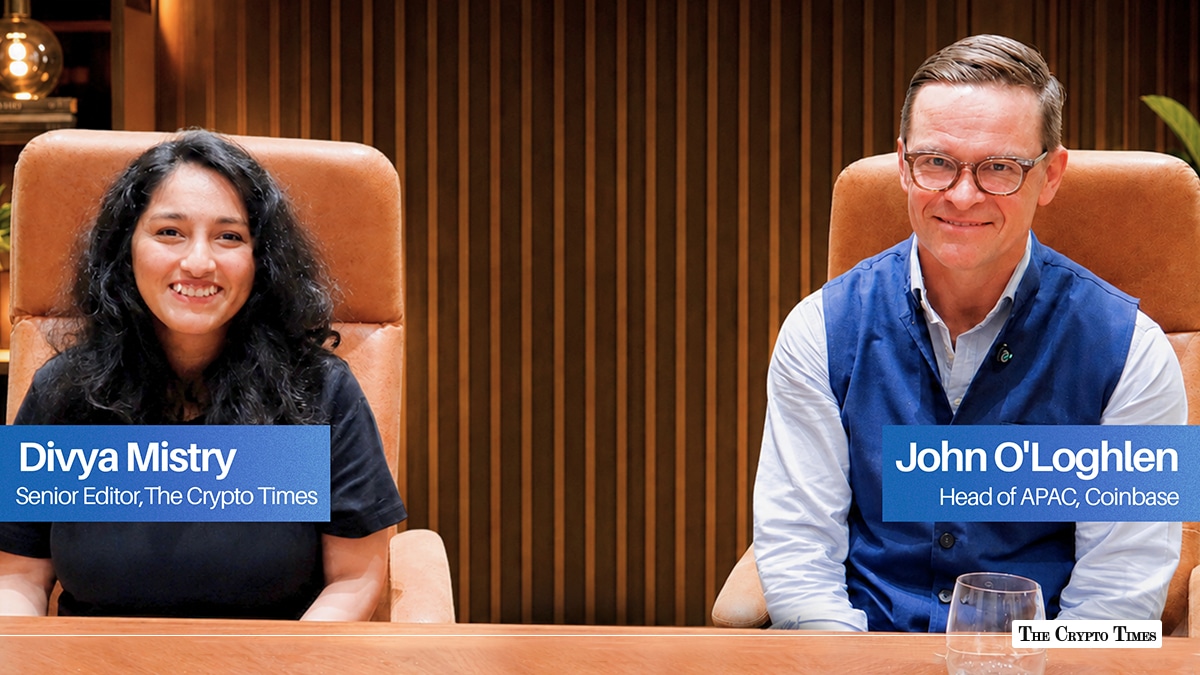
In an exclusive interview with The Crypto Times, John O’Loghlen—Managing Director for Coinbase’s Asia-Pacific (APAC) division—revealed that the NASDAQ-listed cryptocurrency exchange has concentrated its entire international expansion budget into a single geographic bet.
Asked about Coinbase’s key focus areas across APAC, O’Loghlen said: “We haven’t had an international launch in the last 12 months and we don’t have one scheduled for the next 12 months. That means the focus is really on Coinbase India.”
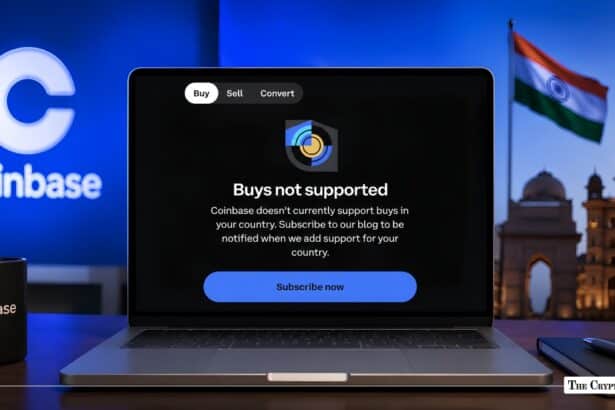
That single sentence reframes how the broader market should read the June 1 India launch. Coinbase, the S&P 500-listed, NASDAQ-traded crypto exchange with operations in dozens of countries, has formally consolidated its 2026-2027 international strategy around a single geographic bet. India is not one of several parallel international launches running in the year ahead. It is, by O’Loghlen’s account, the launch.
That posture is unusual for a publicly traded global exchange of Coinbase’s size. It is also, in O’Loghlen’s framing, deliberate.
Compliance as Foundational Architecture
Perhaps the clearest editorial throughline was Coinbase’s repeated insistence that the India entry is anchored on compliance and regulatory trust — not on aggressive feature velocity or competitive pricing.
O’Loghlen framed it directly: “Our DNA is leading in and leaning in on compliance. We want compliance, we want regulation.”
That posture shows up across multiple operational layers of the India launch:
FIU-IND registration. “The other thing that we take very seriously is our registration with the FIU,” O’Loghlen said. “That’s something that’s different from four years ago for players in the market, others as well as ourselves.” The reference to “four years ago” is to Coinbase’s 2022 India attempt, when the absence of clear regulatory architecture and the lack of formal payment-rail access ultimately forced the company to pull back.
Active regulatory engagement. “The regulatory discussion with FIU and the Ministry of Finance is ongoing,” O’Loghlen said. “We attend parliamentary committees that are talking about the future of digital assets. We’re approached by various Indian representatives who are taking a forward-looking view on this and we continue to meet all parts of Indian regulators both inside and outside India.”
A “best actor” positioning. “We’d like to be a good actor and bring kind of best in class practice to India so that regulators and bureaucrats and kind of technical leaders can understand what’s going to benefit the Indian ecosystem the most,” O’Loghlen said.
This framing is consistent with Coinbase’s broader 2026 regulatory positioning — including the company’s public backing of the CLARITY Act in the U.S. and CEO Brian Armstrong’s eight-point “jobs not done” framework that explicitly named “innovation-friendly regulation” as one of the industry’s core unfinished tasks.
Bespoke INR Rails: Built for Indian Currency Controls
A second technical thread that emerged from the interview is the extent to which Coinbase has localized its India product for the country’s specific regulatory and capital controls environment.
“While that sounds like a simple process, that’s actually a bespoke technology built for India,” O’Loghlen said of the IMPS-based INR deposit and withdrawal rails. “Our INR Rails product is localized to comply with Indian sovereign rupee restrictions around currency controls.”
The launch also required Coinbase to assemble a network of local liquidity providers. “We’ve had to build liquidity in this market with local Indian market makers who are highly nimble, highly professional people who have come out of the TradFi and fintech hedge fund space,” O’Loghlen said. “Working with a bunch of market makers — that’s something that’s a bespoke build for India that hasn’t happened in any other markets.”
This technical specificity is consistent with the broader “no other 12-month launches” framing: building bespoke localized infrastructure for India in this depth would simply not be operationally compatible with running multiple parallel international entries.
Active Cooperation With Law Enforcement
Perhaps the most underreported aspect of the interview — and a material disclosure for the Indian regulatory and law-enforcement context — was O’Loghlen’s confirmation of Coinbase’s active cooperation with enforcement agencies.
“We have a Global Intelligence Team who is the internal team at Coinbase, who interface with law enforcement agencies,” O’Loghlen said. “We’re actively working with a number of Indian parts of the police force and security services, the CBI, lots of parts of law enforcement in India, as we do all over the world.”
He continued: “We field requests from law enforcement agencies with court orders and various requests. We respond to those in a timely fashion and feed this information back to law enforcement. In some cases, we partner with them on multi-year, multi-jurisdiction cases.”
This cooperation framework is materially relevant given India’s growing crypto-related criminal investigations — including the Bengaluru and Dehradun fraud cases The Crypto Times has documented and the broader rise in pig-butchering scams targeting Indian retail users. O’Loghlen also pushed back on what he characterized as a misconception: “Criminals are six or seven times more likely to use cash than crypto. I think historically it’s been a little bit tarred with the wrong brush.”
Prediction Markets: A Deliberate Carve-Out
One of the sharpest strategic decisions of the launch involves what Coinbase is not bringing to India.
In the United States, prediction markets have become a massive driver of volume and retail engagement for the exchange. However, India’s Ministry of Electronics and Information Technology (MeitY) treats prediction platforms as a form of illegal gambling, recently issuing sweeping block orders against offshore betting applications.
Coinbase has chosen to respect this boundary completely.
“I think we’re sophisticated enough and smart enough to read the room. Prediction markets are banned in New Zealand. If there is a strong message from government that that product is not welcome, I don’t think you’re going to see Coinbase pushing that product or trying to make it available offshore to Indians or what have you.”
The reply is substantively a public commitment that Coinbase will not deploy prediction markets to Indian users, even via offshore routing. “Our DNA is leading in and leaning in on compliance,” O’Loghlen said. “I don’t think we’re going to do anything to jeopardize that.”
This positioning is significant in a market where competing platforms have at times offered Indian users indirect access to product categories that Indian regulators have flagged. By publicly excluding prediction markets from the India roadmap, Coinbase is signaling that compliance carve-outs will be enforced at the product level, not papered over via geo-routing.
The Country Director Role and the Talent Bet
Coinbase’s India hiring strategy reflects the same compliance-first orientation.
“The most important position we have which is we’re looking to fill is our Indian Country Director role,” O’Loghlen said. “That’s an important leader who’s going to bring a bunch of skills across policy and partnerships and technology and launching products to help us have a really strong position in the market and an Indian face that people have a lot of confidence in as a leader for the business.”
Coinbase has roughly 500 staff across its India operations, supporting both the India launch and global product development. The Country Director appointment will, by O’Loghlen’s framing, be the senior leadership decision that defines the next phase of the company’s India presence.
He also flagged ongoing AI investments. “We have a matrix and a rubric for hiring where you need to be employing AI during your interviewing and hiring process,” O’Loghlen said. He noted that Coinbase Ventures is actively evaluating AI investments in India alongside its existing Web3 and crypto-native portfolio.
The Tax Regime: A Cost of Domiciled Participation
Asked about India’s 30% tax on crypto gains and 1% TDS on every trade, widely cited as the primary reason for the offshore exodus of Indian crypto volume since 2022, O’Loghlen offered a notably pragmatic response.
“I think there are a few certainties in life. Death and taxes are a couple of them,” he said. “A lot of people have tried to live at an arm’s length from the law and kind of operate with VPNs and be offshore and be in and out of India. I have the same analogy and stories in Australia. We have very high capital gains tax.”
His thesis: younger Indians who view crypto as a long-duration asset class will, over time, accept the tax cost as the price of formal domiciled participation. “There’s a playoff with the tax that you’re going to pay. And people get comfortable with that over time, particularly if they want to be domiciled here and actually formally be in the economy.”
He pointed specifically to Indian familiarity with gold as a high-tax asset class: “Gold is an asset class Indians are incredibly, intimately aware of. I think they hold more gold than anyone in the world. And so smart young Indians and aspirational Indians want to have better returns over time.”
The Everything Exchange Roadmap — Coming to India
Beyond the spot and perpetual futures launch on Day 1, O’Loghlen outlined the broader product trajectory under what Coinbase internally calls its “Everything Exchange” strategy — encompassing tokenized equities, DeFi lending, equities-as-collateral products, and Bitcoin yield products.
“We’ve really got our work cut out for us,” O’Loghlen said. “We have a very, very healthy product roadmap… We’re looking to bring to life a lot of the everything exchange products, particularly those where there’s regulatory support, and we think 80 to 90% of that portfolio we can apply into the Indian market.”
The phrase “where there’s regulatory support” is the key qualifier. It is what carves prediction markets out of the India roadmap while explicitly keeping tokenized stocks, DeFi-based lending products, and Bitcoin yield mechanisms in.
The APAC Strategic Frame
On how India compares to Coinbase’s other APAC markets, O’Loghlen offered a clear strategic taxonomy.
Singapore is positioned as “a wealth hub, much like it is in the private wealth space — a very high ARPU, high assets on platform market.” The Singapore office serves as a regional center of excellence and a U.S. dollar on-ramp hub for sophisticated traders from Korea, Hong Kong, Taiwan, and New Zealand.
Australia is positioned around the company’s recently completed AFSL (Australian Financial Services License) buildout, with a particular focus on the country’s self-managed super fund sector — “a trillion-dollar of assets under management.”
India is the growth bet. “We’re very much over-indexed on that and leaning in on the Indian market,” O’Loghlen said. “The assets on platform or the ARPU is smaller but it’s a much broader base and also a very web3 native, technically native market.”
The combination of the broad-base growth thesis, the bespoke INR Rails technology, the active law-enforcement cooperation, the FIU-IND registration, the prediction-market carve-out, the Country Director search, and the 12-month international launch freeze produces a single integrated picture: Coinbase is treating India as a foundational, multi-year market commitment rather than an opportunistic entry.
What This Means for the Indian Crypto Market
Three observations emerge from the interview that matter for the broader Indian crypto landscape.
First, the 12-month no-launches commitment formally elevates India in Coinbase’s global priority stack. For Indian users, this means the depth of product, localization, market-maker liquidity, and senior-leadership attention available on the platform will likely exceed what they would receive from a global exchange running parallel multi-country expansions.
Second, the compliance-first posture and active CBI cooperation materially differentiate Coinbase from offshore platforms that Indian retail users have historically accessed via VPN. For users in a market currently flooded with counterfeit Coinbase phishing links, an FIU-IND registered domestic Coinbase access point removes a major retail safety risk.
Third, the explicit prediction-market carve-out establishes a precedent that Coinbase will exclude product categories at the regulatory level rather than route around them. That precedent will likely shape how Indian regulators evaluate the company’s broader product roadmap going forward, and may serve as a template for how global exchanges engage with India’s evolving compliance framework.
For O’Loghlen and his team, the next 12 months represent something rare in the global crypto market: a clearly stated, publicly committed, single-market strategic bet. India is the launch. India is the focus. And per the APAC head himself, there is nothing else scheduled.