On May 26, 2026, an X post from the account @Voltlx went viral across Crypto Twitter. According to public screenshots circulating that day, an OnlyFans-style creator had launched a token live on Pump.fun and overlaid a single promise on her stream.
The promise (or the bait?): when the coin hit a $100,000 market cap, she would “flash” on camera.
The Crypto Times has now independently verified the token on-chain. The coin, titled “100k I flash!” (ticker SOL, contract Byg7WmAzD47iJbVzcSUfUHJhGRw3k5ebRCQuNWDJpump), is one of four sexually framed milestone tokens deployed within the same week from a single Pump.fun wallet with zero followers. The headline number is even more telling than the stunt: none of the four coins reached more than 3.1% of the promised $100,000 market cap. At verification, the lead coin sat at $3.14K and was down 22% in six hours.
That detail is the story. This was not a single bizarre stunt; it was a serial, low-effort launch loop on a Solana-based launchpad that has turned token creation into a livestreamed attention contest — where the coin is the content, the stream is the marketing, and retail traders are the exit liquidity.
The bigger question this raises isn’t whether one creator follows through on a dare. It’s this: while serious crypto infrastructure quietly matures in the background, is the consumer-facing surface of the industry being gamified into something closer to a cam-site/casino hybrid than a financial system?
Crypto is not dying. But its public image, increasingly, is being written by Pump.fun.
Section 1: From Financial Innovation to Market-Cap Stunts
Crypto’s original sales pitch was austere: censorship-resistant money, programmable settlement, open access to global capital markets, financial rails outside the permission of any single intermediary. Bitcoin spot ETFs, tokenised treasuries, stablecoin payments, and L2 scaling are all still that story.
But that story isn’t what is breaking through to mainstream audiences in 2026. What is breaking through are screenshots: a man threatening to shoot his dog unless a token hits $1 million; another locking himself in a toilet until his coin reaches $25 million; a creator promising to undress when a chart crosses a milestone. These clips travel further on social platforms than any whitepaper.
The shift is mechanical, not philosophical. Three forces converged:
- Instant token issuance with no listing process, no audit, no liquidity requirement.
- Native livestreaming bolted onto a trading platform, so attention loops directly into price.
- A creator economy that has been trained to monetize virality, now offers a model where attention can be converted into market cap in minutes.
The result is what some on-chain analysts have begun calling “creator capital markets” — a term Pump.fun’s own ecosystem has embraced. The danger isn’t that creators are making money. It’s that the path from social-media stunt to financial product has been compressed to a few clicks, and the casualties (retail buyers, crypto’s credibility) are downstream of a system functioning exactly as designed.
Section 2: How Pump.fun Made Meme Coin Creation Instant
Pump.fun launched in January 2024 as a Solana-based launchpad with a deceptively simple pitch: anyone can create a token in seconds for a small fee, with no coding required. Trading begins immediately along a bonding curve — a mathematical pricing function where each buy pushes price up and each sell pushes it down. Once a token’s market cap reaches roughly $69,000 in liquidity, it “graduates” to a Solana DEX (originally Raydium, now also PumpSwap), where open-market trading takes over.
Explainer box: How a Pump.fun token launch works
| Step | What happens |
|---|---|
| 1. Create | Anyone pays a small SOL fee, uploads a name, ticker, and image. Token is live in seconds. |
| 2. Bonding curve | Price rises automatically with each buy; falls with each sell. No order book. |
| 3. Promotion | Creator promotes via X, Telegram, or — if eligible — a native Pump.fun livestream. |
| 4. Graduation | At ~$69,000 of accumulated liquidity, the token migrates to a Solana DEX. |
| 5. Open market | Full DEX trading. Original creator and early wallets often dominate supply. |
According to data from Dune Analytics, fewer than 1% of tokens launched on Pump.fun successfully graduate during weak market periods, with the four-week average around that threshold for an extended stretch in early 2025. Even at the platform’s November 2024 peak, only 1.67% of weekly launches graduated.
In plain English: well over 98 out of every 100 Pump.fun tokens fail to reach the minimum threshold that would let them trade outside the launchpad. Most of them are abandoned within hours.
By late 2025, Pump.fun had actually fallen behind several rivals on graduation rate.One launchpad comparison put Pump.fun at roughly 0.8% — trailing Believe (2.58%), LetsBonk (1.02%), and Raydium’s LaunchLab (0.97%) — even as it retained the largest share of raw launch volume. The competitive picture reinforces the core point that the platform optimizes for churns, not for tokens that actually survive.
The platform itself has become enormous in revenue and influence. Its native PUMP token, launched in mid-2025, crossed a $3 billion market cap in September 2025, less than two months after its public sale that raised nearly $500-$600 million in 12 minutes.
Also Read: How to create and buy Memecoins on pump.fun? A Beginner’s Guide
Section 3: The May 2026 “Flash at $100K” Case
What began as a single viral X post has now been verified on-chain. The Crypto Times has independently confirmed the token, the deployer wallet, and the launch pattern via Pump.fun’s own creator and coin pages, with a corresponding wallet on Solscan.
The token
| Field | Value |
|---|---|
| Coin name | 100k I flash! |
| Ticker | SOL |
| Contract address | Byg7WmAzD47iJbVzcSUfUHJhGRw3k5ebRCQuNWDJpump |
| Description on Pump.fun page | “360 every buy and flashing at 100K!” |
| Market cap at verification | $3.14K |
| 24h volume at verification | $18.8K |
| Price | $0.00000314 |
| 6h change | −22.34% |
| Age | ~7 days old at verification |
| Deployer wallet | bSQCWRjJ9Wxs2p2fKdvX1Ar64qYX41kCjYhuTAg9BE5 (Solscan-linked) |
| Source | pump.fun/coin/Byg7…pump |
The deployer’s pattern
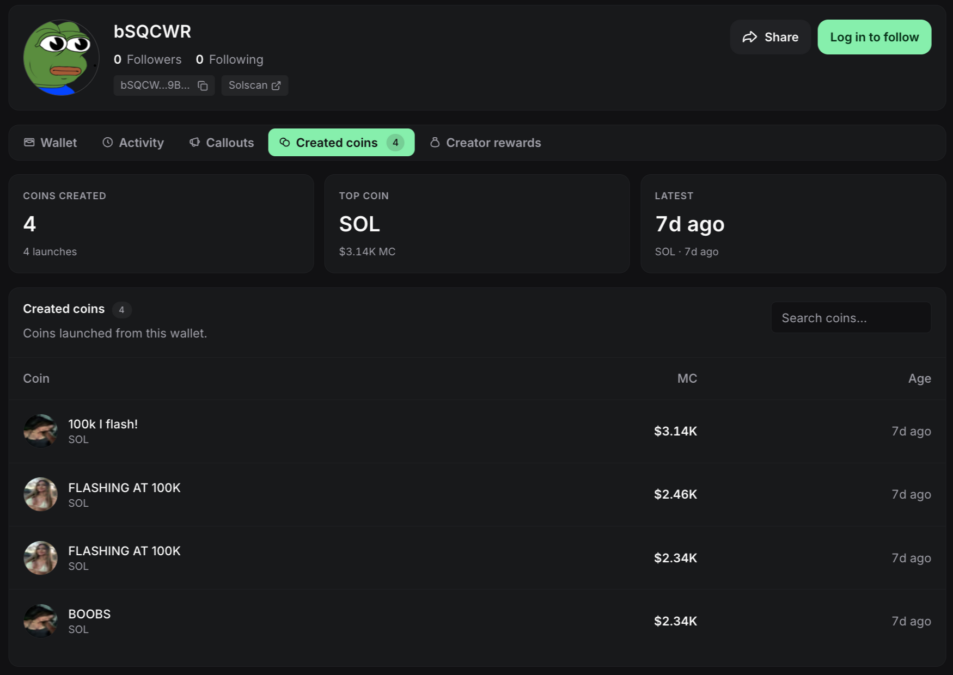
The wallet bSQCWR…9BE5 has 0 followers and 0 following on Pump.fun and, according to its public creator page, has launched four coins in total — all within the same ~7-day window, and all with effectively the same theme:
What the data actually shows
The viral framing was that a creator was promising to “flash on stream when the coin hits $100,000 market cap.” The on-chain reality, a week later, is quieter and bleaker:
- None of the four coins came close to the $100K milestone. The highest reached $3.14K — about 3.1% of the promised threshold.
- All four coins were launched by the same wallet within the same week, suggesting a serial, low-effort relaunch loop rather than a one-off creator moment.
- The coin’s six-hour change at verification was −22.34%, consistent with a typical “spike-and-fade” lifecycle.
- The platform’s own coin page carries a public Report link, indicating moderation infrastructure exists — but, at the time of verification, the coin remained live and tradeable.
What this case actually demonstrates
This is not a story about a creator who got rich. It is a story about a structural pattern. A wallet with no social following can:
- Deploy four sexually framed milestone tokens in a single week with no friction.
- Generate $18.8K of 24-hour trading volume on the most prominent of them, even at a market cap of just $3.14K — meaning real liquidity was changing hands.
- Earn creator fees on every trade under Pump.fun’s Project Ascend model, regardless of whether the headline milestone is ever reached.
In other words: the “$100K flash” promise functions less as a goal and more as a marketing hook. Under the current fee design, the deployer is paid whether or not the milestone hits — and the chart suggests it never will. The token’s audience was buying a dare. What they got was a $3.14K cap, a 22% six-hour fade, and a wallet that had already moved on to launching the next three.
Section 4: This Was Not the First Time
The May 2026 case sits inside an 18-month timeline of escalating Pump.fun livestream incidents.
Timeline: Pump.fun Livestream Controversy, 2024–2026
| Date | Event |
|---|---|
| Aug–Nov 2024 | Native livestreaming feature scales; tokens like LiveMom / MOMLIVENOW and other webcam-milestone coins go viral. |
| Nov 2024 | Multiple viral streams document a man threatening to shoot a dog at $11M market cap; another threatening self-harm at $1M; explicit content broadcasts. |
| Nov 25, 2024 | Pump.fun suspends livestreams “indefinitely” citing self-harm threats, violence, and explicit acts. |
| Dec 2024 | Hawk Tuah $HAWK launches and collapses 93–95% within hours; class action follows. |
| Feb 27, 2025 | SEC Division of Corporation Finance issues Staff Statement: most meme coins not securities; buyers lack federal securities-law protections. |
| Apr 2025 | Pump.fun relaunches livestreams to 5% of users with new moderation policy; NSFW allowed under oversight. |
| Jul–Sep 2025 | PUMP token ICO raises ~$500-$600M in 12 minutes. “Project Ascend” fee model directs 0.05–0.95% of every trade to creators. |
| Sep 2025 | “Creator capital markets” boom: stunt-tokens (lamps, marathon runners, “Dare Coin” clown character) trend; analysis shows higher creator fees at lower market caps incentivise sustained low-cap volume, not graduation. |
| Nov 2025 | Burwick Law amends HAWK class action to add Haliey Welch, alleging she was paid up to $325,000 for promotions of a token “designed to crash within minutes.” |
| May 26, 2026 | Reported “flash at $100k” Pump.fun livestream goes viral via @Voltlx. |
The November 2024 suspension was not a vague PR move. Pump.fun’s team itself wrote, in its community notice, that it would “pause the live streaming functionality on the site for an indefinite time period until the moderation infrastructure is ready.” Industry coverage from CryptoSlate, BeInCrypto, and Brave New Coin documented streams ranging from explicit content to a man pointing a gun at a dog tied to a token price target.
When the feature returned in April 2025, Pump.fun published a moderation policy that explicitly bans violence, self-harm promotion, harassment, child sexual abuse material, sexual exploitation, and “nudity without context.” NSFW content, crucially, is not banned outright — the platform reserves “discretion” to evaluate case by case. That nuance is what makes a “flash at $100k” promise possible to attempt at all.
Section 5: The Celebrity Meme Coin Parallel
The livestream stunts are the loud version of a quieter, larger phenomenon: the celebrity meme coin.
The mechanics are nearly identical to webcam-style milestone tokens:
- Borrow attention from a pre-existing audience.
- Launch on a low-friction venue (often Pump.fun).
- Let early wallets accumulate cheaply.
- Ride the attention spike.
- Watch retail buy the top.
Verified celebrity cases
Hawk Tuah ($HAWK), December 2024. According to court filings, the Solana-based token tied to Haliey Welch hit roughly a $490 million market cap within 15 minutes, then plunged ~93–95%. A class action filed in the Eastern District of New York by Burwick Law and Wolf Popper named Tuah The Moon Foundation, overHere Ltd, Clinton So, and Alex Larson Schultz. In November 2025, plaintiffs amended their filing to add Welch, alleging she was paid up to $325,000 to promote a token they say was “designed to crash within minutes.”
Mother Iggy ($MOTHER), May 2024. Rapper Iggy Azalea launched MOTHER on Pump.fun. According to CoinGecko data, MOTHER peaked near $0.23 in early June 2024 and was trading roughly 87% below that peak for most of late 2024. Bubblemaps and other on-chain analytics firms flagged insider wallet activity in MOTHER’s launch, with Azalea publicly disputing the role of promoter Sahil Arora.
Caitlyn Jenner ($JENNER), May 2024. Launched on Pump.fun and later moved to Ethereum. On-chain analytics cited by Cointelegraph showed clusters of wallets holding ~25% of supply selling early for roughly $500,000 in profit. Jenner faced a class-action lawsuit in November 2024 alleging she and her manager “fraudulently solicited financially immature investors […] to purchase unregistered securities.” Jenner has publicly blamed promoter Sahil Arora.
Jason Derulo ($JASON), Andrew Tate, Cardi B, Kanye West. All launched or were associated with tokens in the same cycle. And most are down 90%+ from launch peaks.
The story Iggy Azalea now tells about her own corner of the market is instructive. Speaking at a Florida blockchain conference in November 2025, she said she had grown “hellbent to see the demise of what I think is essentially rugpulls based on speculation,” which is why she joined a new launchpad called Thrust. That a leading celebrity-coin participant now frames the previous wave as rugpulls is itself a data point.
Section 6: The Data Behind the Damage
The numbers tell a sharper story than the screenshots.
Pump.fun by the numbers (verifiable sources)
| Metric | Value | Source / Period |
|---|---|---|
| Tokens deployed (cumulative, mid-2024) | ~1.8 million | Dune dashboard (Hashed), Aug 2024 |
| Average daily token deployments | 20,000+ | Dune (@evelyn233), 2024 |
| Graduation rate (Aug 2024) | ~1.4% historical | ChainCatcher / Dune |
| Graduation rate (Feb–Mar 2025) | <1% for 4+ weeks | FinanceFeeds / Dune Analytics |
| Best-ever weekly graduation rate | 1.67% | Nov 2024 peak |
| Wallets with >$1,000 profit | Top 3.06% of all wallets | @adam_tehc / Dune leaderboard |
| Wallets with >$10,000 profit | Top 0.48% | @adam_tehc / Dune leaderboard |
| PUMP token market cap (Sep 2025) | $3 billion+ | The Crypto Times |
| PUMP ICO raise | ~$600M in 12 min | The Crypto Times |
What this means
Combine the two lines: more than 96–99% of Pump.fun tokens fail to graduate, and only about 3% of trader wallets are even up $1,000. This is not a market that broadly rewards participation. It is a venue where the launchpad, top streamers, and a small layer of insider wallets capture most of the upside, while a long tail of retail buyers funds the difference.
The September 2025 “Project Ascend” fee redesign — which pays creators more when their market cap stays in the $88k–$300k band — has been flagged by analysts at SolanaFloor as creating an explicit incentive to keep tokens churning at low caps with high trade volume, rather than building toward sustained growth. The casino analogy isn’t a rhetorical flourish; it’s a description of how the fee mechanics work.
Section 7: Why This Devalues Crypto
The reputational cost of Pump.fun’s livestream economy is not borne by Pump.fun alone. It is socialised across the entire industry.
Serious builders get overshadowed. A team shipping a real DeFi primitive, a zk rollup, or a stablecoin payments rail competes for headlines against a livestreamed sexual milestone. The streamed dare wins the algorithm every time.
Regulators see a steady supply of consumer-harm examples. The SEC’s February 27, 2025 Staff Statement clarified that meme coins generally fall outside federal securities laws — which sounds friendly to crypto, but Commissioner Caroline Crenshaw’s published dissent warned the guidance “advances an incomplete, unsupported view of the law” and gives promoters a template for evading Howey via “disclaimers or other window dressing.” Crucially, the SEC statement also means meme-coin buyers do not get federal securities-law protections. Every viral dump becomes ammunition for stricter rules elsewhere — including under the U.S. House’s proposed MEME Act.
Institutions hesitate. A Fortune 500 treasury team considering tokenized assets must explain to their board why their counterparty’s blockchain is also where last night’s livestream went viral.
Retail users associate crypto with scams and gambling. Pew, YouGov, and other consumer surveys throughout 2024–2025 have shown a stubborn association between “crypto” and “scam” in general audiences — not because they don’t know about Bitcoin ETFs, but because they remember the livestream, the celebrity dump, the 95% chart collapse.
Mainstream media gets a steady headline supply. From BBC and Rolling Stone to Hollywood Reporter and FOX, the Hawk Tuah story alone produced months of negative coverage that traveled far outside crypto media.
“When market cap becomes a dare, trust becomes the exit liquidity.”
Section 8: Is Crypto Actually Dying?
No.
Bitcoin and Ethereum ETFs continue to take meaningful net inflows. Stablecoin settlement volumes have outgrown several traditional payment rails. Real-world asset tokenisation is moving from PowerPoint into production with major asset managers. Layer-2s, restaking, account abstraction, and verifiable compute are being built — quietly, by teams not livestreaming themselves.
What is dying, or at least being severely damaged, is the public legibility of crypto as a serious financial technology. The most viral surface of crypto in 2026 looks less like a settlement layer and more like a hybrid of a webcam site, an esports stream, and a slot machine.
What platforms can do
- Enforce existing content policies consistently, not reactively after a viral post.
- Make moderation outcomes (terminations, appeals, ban reasons) publicly auditable.
- Add friction at launch for tokens tied to livestreams that promise milestone-based behavior.
- Stop incentivising perpetual low-cap churn through fee design.
What traders should check before buying
- Open the contract on Solscan / Birdeye / DexScreener. Look at top holder concentration.
- Look up the deployer wallet’s history. Sniper bots and recycled deployers are red flags.
- Check liquidity depth, not just market cap.
- Assume the livestream is a marketing channel, not a disclosure document.
What regulators may focus on
- Whether on-chain insider-trading patterns at launch meet the threshold for unregistered-securities or fraud claims, regardless of the meme-coin label.
- Paid celebrity promotion without disclosure (the FTC has existing rules; Burwick Law’s HAWK case is testing how they apply on-chain).
- Platform liability for hosted livestream content under existing consumer-protection statutes.
What serious crypto companies must communicate better
- Make the distinction between infrastructure and meme-casino visible. “We are not Pump.fun” is not a hostile statement; it is an honest one.
- Publish institutional outcomes, audited TVL, and verified user metrics on a steady cadence — the same way fintechs do.
- Support media literacy. Most people still cannot tell a stablecoin from a stunt coin.
Crypto is not dying. But the attention casino built on top of it is loud enough that, to a casual observer, the difference is invisible. The real casualty is not Bitcoin, not Ethereum, not even Solana. It is trust — and trust, once spent, is the hardest piece of exit liquidity to recover.
FAQs
Is crypto really dying in 2026?
No. Bitcoin and Ethereum ETFs continue to take net inflows, stablecoin settlement volumes are at record highs, and tokenised real-world assets are growing. What is in trouble is crypto’s public image, dominated by meme-coin livestream culture.
Is Pump.fun illegal?
Pump.fun itself is operational and, as of the SEC’s February 27, 2025 Staff Statement, meme coins broadly described in that statement are not considered securities under federal law. That said, individual tokens, promoters and platforms can still face fraud, consumer-protection and unregistered-securities claims, as several lawsuits (including HAWK, JENNER) have demonstrated.
Do meme coin buyers have legal protections if a token crashes?
According to the SEC’s 2025 staff guidance, buyers of meme coins typically do not receive federal securities-law protections — though that guidance is not binding law, and fraud, consumer-protection, and unfair-trade-practice rules still apply. Class actions against celebrity tokens (HAWK, JENNER) are testing how far those alternative remedies go.