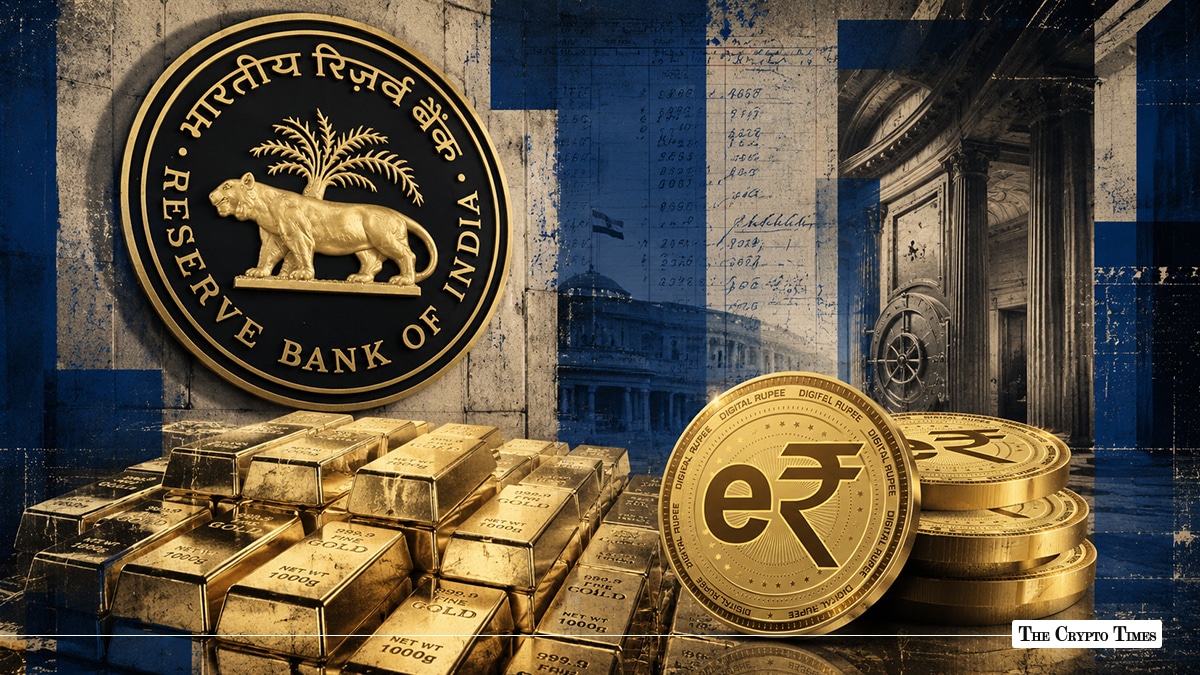
A Bloomberg Economics analysis published on June 2, 2026, suggested that the Reserve Bank of India (RBI) had quietly sold approximately ₹1.15 lakh crore (~$12 billion) worth of gold reserves over the two weeks ending May 22 to shield its foreign currency assets from the fallout of the ongoing West Asia conflict.
The claim, based on observed discrepancies in public reserve data, spread rapidly through financial markets and news desks across the country.
The response came fast. On June 3, RBI Chief General Manager Brij Rak issued an official statement confirming that the central bank’s physical gold stock remains unchanged at 880.52 tonnes. The RBI emphasised that these reports were “not correct” and directed the public to its Monthly Bulletin for verified data.
The Press Information Bureau (PIB) reinforced the denial. In a fact-check post on X, PIB labelled the Bloomberg claim “FAKE” and cited official figures showing that the share of gold in India’s foreign exchange (forex) reserves had risen from 13.92% at the end of September 2025 to 16.70% by March 31, 2026, and further to 16.85% as of May 22, 2026.
According to official RBI data cited in the PIB statement, the value of India’s gold reserves climbed from approximately ₹6.87 lakh crore (~$81.82 billion) in early May 2025 to roughly ₹10.10 lakh crore (~$120.24 billion) by late April 2026. Of the total 880.52 metric tonnes held by the RBI, 312.32 tonnes are maintained as assets of the Issue Department, while 568.20 tonnes sit under the Banking Department.
The Banking Department’s gold holdings rose 63.6% in value during FY26, driven largely by surging global gold prices and rupee depreciation against the US dollar.
The gold question stands answered. What it exposed, however, is far more consequential.
The pressure behind the headlines
India imports roughly 90% of its crude oil requirements. When conflict in West Asia pushes global crude prices above $100 a barrel, the pressure lands squarely on the rupee and, consequently, on the RBI’s reserve buffer.
The scale of that pressure over recent months is striking. India’s forex reserves declined from a peak of approximately ₹69.93 lakh crore (`$728.49 billion) in February 2026 to approximately ₹65.41 lakh crore (~$681.4 billion) for the week ending May 22, according to the RBI’s Weekly Statistical Supplement data, a drawdown of over ₹4.51 lakh crore (~$47 billion) in roughly three months.
During this period, the rupee touched a record low of ₹96.96 against the US dollar before RBI intervention helped stabilize it around the 95 mark.
Market analysts estimate the RBI has been selling between ₹7,600 crore and ₹19,200 crore (about $800 million to $2 billion) daily in recent weeks to prevent a sharper depreciation.
The RBI’s 2025-26 annual report confirmed that gains from forex transactions jumped 52% year-on-year to ₹1.69 lakh crore in FY26, reflecting the intensity of market intervention. The central bank’s balance sheet expanded 20.61% to ₹91.97 lakh crore by March 2026.
Gold, it must be stated clearly, remains central to the RBI’s reserve strategy. The central bank has been strategically repatriating holdings from overseas vaults.
Approximately 77% of India’s gold reserves are now stored domestically, up from 59.2% a year earlier. The RBI added nearly 58 tonnes of gold in FY25 alone, according to the RBI annual report data. This is a deliberate sovereignty move and reflects deep institutional conviction in the metal’s role as a long-term anchor.
But physical gold carries a structural limitation that even its strongest advocates acknowledge. In fast-moving liquidity events, it is not the quickest instrument available. Liquidating large volumes takes time, sends market signals, and creates precisely the kind of speculation that forced the RBI into issuing an emergency denial in the middle of a trading week. When oil prices spike, the rupee falls, and markets demand reassurance within hours, central bankers require instruments that can match the speed of the crisis.
That context makes the timing of the RBI’s own announcements from five days earlier difficult to overlook.
Five days earlier: The most detailed CBDC roadmap yet
On May 29, 2026, the RBI released its Annual Report for 2025-26, containing the most comprehensive roadmap the central bank has published for its Central Bank Digital Currency (CBDC), also known as the e-Rupee or digital rupee.
As Reuters reported, the RBI plans to expand the digital rupee into welfare payment systems and test its use for cross-border transactions. During FY26, the central bank conducted multiple CBDC pilots under Direct Benefit Transfer (DBT) schemes in Gujarat, Puducherry, and Chandigarh.
In these pilots, Public Distribution System (PDS) beneficiaries received food subsidies through programmable digital rupee tokens redeemable only at designated ration shops and authorized merchants.
The significance of programmability in this context cannot be overstated. It means the currency itself can be designed to function only within defined parameters, a feature that neither physical gold nor traditional cash can replicate.
In a separate set of pilots, the RBI routed portions of the country’s approximately ₹6.72 lakh crore (~$80 billion) welfare system through the e-Rupee across about 10 active programmes. In Maharashtra, farmers received programmable subsidies covering up to 80% of drip irrigation equipment costs, usable only at approved vendors. Gujarat planned to migrate food subsidies for 7.5 million eligible households to the e-Rupee system by June 2026.
For the 2026-27 fiscal year, the RBI’s annual report stated that the central bank will pursue cross-border CBDC pilots with select use cases, introduce a framework under its CBDC and Asset Tokenisation Sandbox, and deepen its participation in multilateral projects led by the Bank for International Settlements (BIS).
The central bank has already signed a digital assets pact with the Monetary Authority of Singapore (MAS) and is in active discussions with the Central Bank of the United Arab Emirates (UAE) for bilateral pilots.
The RBI also developed the Unified Markets Interface (UMI), a platform for tokenisation of financial assets that uses wholesale CBDC for settlement, signalling that the institution views its digital currency infrastructure as something considerably larger than a retail payments application.
One figure, however, adds important nuance. The value of retail digital rupee notes in circulation fell 24% to ₹771.66 crore as of March 31, 2026, down from ₹1,016.46 crore a year earlier, according to the RBI’s annual report data. Total e-Rupee transactions since the December 2022 launch stand at approximately ₹30,240 crore (~$3.6 billion), a fraction of the Unified Payments Interface (UPI), which processes roughly ₹25.20 lakh crore (~$300 billion) monthly.
These adoption numbers are modest. But they suggest the RBI is building infrastructure and proving programmability before pursuing volume, a sequencing strategy rather than a shortcoming. Whether that deliberate pace can hold under mounting real-world pressure is the central tension this piece seeks to examine.
The stablecoin dimension the RBI cannot afford to ignore
This is where the crypto thread enters the conversation, not because the RBI invited it, but because the scale of what is happening outside the regulated system makes it unavoidable.
The global stablecoin market crossed approximately ₹30.82 lakh crore (~$321 billion) in April 2026. Tether’s USDT alone accounted for roughly ₹18.24 lakh crore (~$190 billion) in market capitalization, with approximately 59% market share. Stablecoins grew by about 50% in terms of market capitalization during 2025, according to a US Federal Reserve research note.
In India specifically, over 2 crore (~20 million) citizens hold crypto assets, and stablecoin inflows hit approximately ₹84,000 crore (~$10 billion) in the first half of 2025 alone, the vast majority denominated in US dollars.
The RBI has been vocal and consistent about the risks this creates.
Governor Sanjay Malhotra, speaking at the Second V.K.R.V. Rao Memorial Lecture at the Delhi School of Economics in November 2025, stated that stablecoins and cryptocurrencies carry a “huge risk” and that the RBI is “adopting a very cautious approach.”
At the World Bank-IMF annual meeting in Washington, as The Crypto Times reported, he urged global central banks to prioritize CBDCs over stablecoins for cross-border payments, arguing that sovereign digital currencies offer stability and transparency that private tokens cannot match.
Deputy Governor T. Rabi Sankar, at the Mint Annual BFSI Conclave in December 2025, called crypto a “pure gamble” and warned that stablecoins risk driving dollarization and weakening monetary policy transmission in emerging economies.
India’s Chief Economic Adviser V. Anantha Nageswaran warned in a Reuters’ reported speech in Mumbai that the presence of dollar stablecoins “will bring with it its own challenges for monetary policy, monetary transmission and for seigniorage benefits of any country.” Seigniorage refers to the profit a government earns by issuing currency.
The connection between these warnings and the gold denial episode is not abstract.
As The Crypto Times’ own coverage detailed in May 2026, when an Indian citizen purchases Tether (USDT) with rupees on a peer-to-peer (P2P) platform, the rupee is effectively converted into synthetic dollar exposure on a blockchain. No foreign bank account is required. No Liberalised Remittance Scheme (LRS) declaration is filed. The $250,000 annual ceiling is never triggered. The RBI has no visibility into the transaction.
The BIS confirmed this dynamic in an April 2026 speech by General Manager Pablo Hernandez de Cos, citing research showing that large inflows into USD stablecoins create pricing gaps between stablecoin-based and spot foreign exchange (FX) markets, weaken local currencies, and increase capital flow volatility by bypassing regulated financial intermediaries.
The implication is structural. The RBI is spending up to ₹19,200 crore (~$2 billion) a day defending the rupee through conventional forex intervention. Simultaneously, thousands of crores worth of rupee-to-dollar conversion is flowing through stablecoin channels that exist entirely outside the regulated system. Every dollar that leaks out through USDT on a P2P platform is, in effect, a dollar the RBI must spend additional reserves to offset.
This is not a theoretical concern. It is a measurable leak in the monetary plumbing.
Connecting the dots: Gold pressure, stablecoin leakage, and digital urgency
What follows is clearly labelled as speculative analysis. It connects publicly available facts with forward-looking reasoning. The RBI has not publicly drawn these connections, and readers should weigh this section as informed opinion, not established policy direction.
The argument rests on a pattern.
Every time India faces a currency crisis driven by oil imports and capital outflows, the same structural weaknesses surface. Traditional reserve management tools, whether dollar selling, gold rebalancing, or rate adjustments, operate within constraints of speed, transparency, and market perception.
Each intervention depletes the buffer. Each depletion invites precisely the kind of speculation that Bloomberg published, and the RBI had to publicly deny.
A mature, widely adopted sovereign CBDC layer could, in theory, address several of these pressure points simultaneously.
Cross-border CBDC settlement rails, of the kind the RBI is piloting with Singapore and the UAE as outlined in its 2025-26 annual report, could reduce India’s structural dependence on dollar-denominated corridors for oil payments and trade settlement. This would not eliminate dollar demand, but it could meaningfully reduce the floor.
Programmable money features, already tested in welfare delivery across Gujarat, Maharashtra, Puducherry, and Chandigarh, could improve the efficiency of domestic fiscal transfers, reducing leakage and freeing up traditional reserves for genuine external defence rather than internal distribution loss.
Perhaps most critically for the crypto dimension, a credible sovereign digital alternative could weaken the appeal of dollar-denominated stablecoins among Indian users who currently treat USDT as a hedge against rupee depreciation. If the e-Rupee offered meaningful programmability, credible cross-border utility, and the trust that comes with central bank backing, the calculus for choosing between USDT on an unregulated P2P platform and a sovereign digital instrument would begin to shift.
India has already taken early steps in this direction. The Asset Reserve Certificate (ARC), a rupee-pegged stablecoin developed by Polygon Labs and Anq and backed 1:1 by Indian government securities, was announced for a Q1 2026 launch. ARC is designed to operate alongside the RBI’s CBDC, providing a private-sector payment layer while the e-Rupee serves as the ultimate settlement layer.
The stated purpose of ARC is to prevent liquidity outflow into dollar-backed stablecoins, retaining capital within India’s domestic financial system while generating demand for government debt instruments.
Commerce Minister Piyush Goyal, while unveiling plans for an RBI-backed digital currency as reported, drew parallels with stablecoins legalised in the United States under the Guiding and Establishing National Innovation for US Stablecoins Act (GENIUS Act), calling for a system that enables faster, safer, and transparent transactions while curbing unverifiable flows.
UPI processed 23.2 billion transactions worth ₹29.90 lakh crore in May 2026 alone, as cited in the PIB statement that accompanied the gold denial. India’s digital payments infrastructure is not a concept under development. It is the most advanced high-volume system of its kind anywhere in the world. Layering a sovereign CBDC with cross-border capability on top of that foundation is an engineering and policy challenge with a clear institutional sponsor and an existing user base numbering in the hundreds of millions.
What this analysis is not arguing
Precision is essential in opinion journalism, particularly when connecting a mainstream monetary event to the digital asset space.
This piece is not arguing that the RBI is considering adding Bitcoin (BTC) or any cryptocurrency to its official reserves. There is zero evidence of such a move. Every public statement from the central bank points firmly in the opposite direction.
Gold is not losing its position as a cornerstone of India’s reserve architecture. The RBI has been a consistent and strategic buyer of gold for years. The repatriation of 77% of holdings to domestic vaults reflects long-term institutional commitment, not retreat.
The digital rupee is not about to replace gold or traditional forex reserves. CBDCs, in their current form in any jurisdiction globally, function as payment and settlement instruments. They are not reserve assets.
What this analysis raises as a possibility
The narrower and more practical question is whether recurring episodes of forex stress, where traditional reserve tools are stretched thin and rumours of forced asset sales circulate within hours, could build an internal institutional case at the RBI for accelerating its digital infrastructure timelines.
The annual report already commits to widening domestic CBDC pilots, launching cross-border pilots with Singapore and the UAE, deepening multilateral CBDC engagement through the BIS, and building tokenization infrastructure for financial assets through the UMI platform.
These are not side experiments. They represent the early stages of a parallel financial infrastructure that could, over time, provide India’s monetary authorities with faster, more programmable, and more transparent tools for managing the exact pressures that surfaced on June 3.
The stablecoin dimension adds a layer of urgency. Every month that the e-Rupee remains a small-scale pilot while the global stablecoin market adds thousands of crores in supply, the risk of structural dollarisation through unregulated crypto rails compounds for India.
The RBI clearly understands this threat, as evidenced by its consistent public warnings. The question is whether it can build and scale a compelling sovereign alternative before the habit of using USDT becomes deeply entrenched among India’s 2 crore-plus crypto holders.
Conclusion
The RBI’s denial on June 3, 2026, closed a news cycle about gold. For those tracking the intersection of traditional monetary policy, sovereign digital currencies, and the expanding global stablecoin ecosystem, it may have opened a more consequential conversation.
Gold will remain the anchor of India’s reserve strategy. The dollar will remain the dominant global reserve currency. But the architecture of how emerging market central banks manage liquidity, defend currencies, and maintain monetary sovereignty is undergoing a generational shift. India, with its unmatched digital payments infrastructure and a central bank that has committed to a detailed CBDC roadmap, is better positioned than most to shape that shift.
Whether June 3, 2026, becomes a footnote in RBI history or a marker that accelerated the digital rupee’s journey depends entirely on what comes next. The roadmap is written. The pressures are real. The stablecoin challenge is growing. The tools are being built.
The only remaining variable, as is always the case with central banks, is pace.
Also Read: P2P Crypto TDS in India Explained: Who Pays 1%, How to File, and What to Avoid