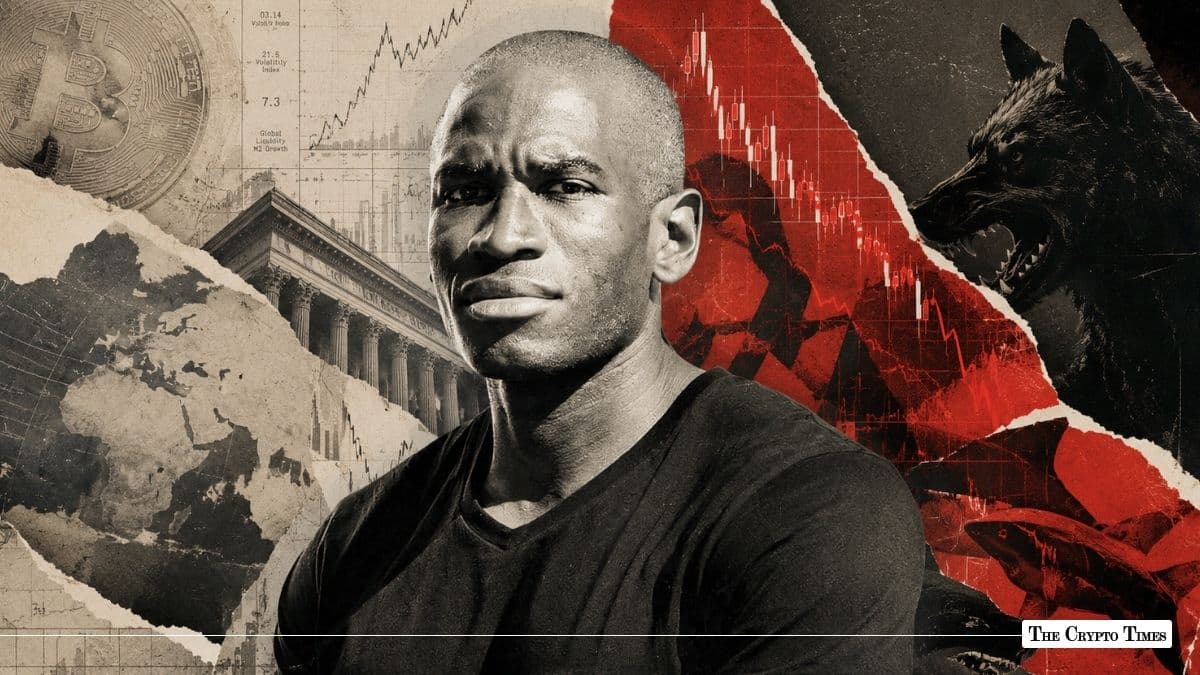
A few days ago, a crypto developer posted a viral X thread that purported to chronicle “the rise and downfall of Arthur Hayes.” It hit every familiar beat: the Hong Kong equity derivatives trader, the 2014 co-founder of BitMEX, the inventor of the perpetual swap that turned cryptocurrency into a multi-trillion-dollar derivatives casino, the 2020 U.S. charges, the guilty plea, the home detention, the multimillion-dollar fines. The thread ended on a note of lingering skepticism: Hayes, it observed, still pumps tokens like $HYPE and still sells into the hype he creates.
The replies were merciless. “What downfall?” one user shot back. “He’s still making tens of millions manipulating people into buying his bags.” Another offered a backhanded salute: “There is no such thing as Arthur Hayes’ downfall. He is the only crypto main character you can respect—a true villain.” The image attached of Hayes grinning in a nightclub, flanked by two women only amplified the vibe. This was not a man broken by consequence. He looked, for all the world, like he was winning.
That single post captured the Arthur Hayes paradox in real time. To some, he remains a cautionary tale of regulatory hubris and retail predation. To others, and to an uncomfortably large segment of Crypto Twitter, he is living proof that the game ultimately rewards the kind of operator he has always been. The truth is more uncomfortable than either caricature. Arthur Hayes is not a fallen hero or a cartoon villain. He is the purest embodiment of late-stage crypto’s central tension: visionary macroeconomic insight deployed as a precision instrument for asymmetric capital extraction in a market still largely free of traditional guardrails.
Few figures in modern finance embody the contradictions of the cryptocurrency era more completely. To his admirers, Hayes is a rare market thinker who grasped the implications of endless monetary expansion, sovereign debt spirals, and geopolitical fragmentation long before they became consensus. To his critics, he is the archetype of crypto’s “move fast and break things” ethos—brilliant at building liquidity pools, ruthless at draining them when the moment suits. The dichotomy is not a flaw in the analysis; it is the analysis itself. Hayes is both macro prophet and market opportunist, and the two roles are not in conflict. They are symbiotic.
The TradFi Crucible and the Genesis of Information Asymmetry
Arthur Hayes’ origin story is textbook elite arbitrage. A Wharton economics graduate (class of 2008), he interned at JPMorgan through the Sponsorship for Educational Opportunity (SEO) program for minority students and cold-emailed his way onto Deutsche Bank’s Hong Kong equity derivatives desk when New York would not transfer him. From 2008 to 2011 at Deutsche and 2011 to 2013 at Citigroup, he traded delta-one products: linear derivatives where the payoff mirrors the underlying asset. He learned spread capture, leverage mechanics, and the quiet power of information asymmetry on the trading floor.
A telling anecdote: as a junior intern, Hayes was tasked with ordering lunch for the desk. He added a “pretty hefty spread” to every order and pocketed hundreds weekly. When discovered, the seniors reportedly shrugged, “game respects game.” Another act of sartorial rebellion, showing up to Casual Friday in acid-washed jeans, yellow sneakers, and a pink polo, got the entire department’s dress code suspended. These were not youthful indiscretions. They were early proofs of concept: rent-seeking and defiance of institutional norms are rewarded when executed with style and precision.
Laid off from Citigroup in 2013, Hayes discovered Bitcoin at the precise moment the asset class lacked professional-grade derivatives infrastructure. In January 2014 he co-founded BitMEX with Benjamin Delo and Samuel Reed, deliberately domiciling it in the Seychelles to sidestep U.S. regulatory oversight. The stage was set for what would become one of crypto’s most consequential experiments in leverage and liquidity.
The Perpetual Swap Revolution and the Financialization of Crypto
BitMEX’s true masterstroke was the 2016 launch of the XBTUSD perpetual swap. Traditional futures expire; perpetuals do not. To keep the contract tethered to spot Bitcoin, BitMEX introduced the funding rate: periodic payments between longs and shorts every eight hours. The innovation solved the rollover problem that had fragmented liquidity across quarterly contracts. Suddenly, a single instrument concentrated global order flow. Leverage went to 100x. Retail traders with $100 could control $10,000 notional. Volume exploded. By 2018 BitMEX was doing $1 trillion notional annually. By 2025, crypto derivatives across all venues topped $92 trillion.
The intellectual pedigree traces to Nobel laureate Robert Shiller’s 1992–93 papers on perpetual futures for illiquid assets like housing. Shiller envisioned them for macroeconomic hedging. Hayes and his partners executed them for hyper-speculation. The perpetual swap did not merely add liquidity. It financialized an entire asset class and made extreme leverage the default retail experience. In doing so, it helped turn cryptocurrency from a niche store of value into a global trading arena where volatility became not just a feature but the primary wealth-transfer mechanism.
The Predator Mechanics: Liquidations, “God Access,” and Market Manipulation
Brilliance and predation were never separate features. The same 100x leverage that created liquidity also guaranteed cascading liquidations on minor price wicks. BitMEX’s Insurance Fund, ostensibly a backstop against auto-deleveraging, became, plaintiffs alleged in the Messieh v. HDR Global Trading Ltd. class action, a profit center. When positions hit maintenance margin, the liquidation engine often closed them at worse-than-bankruptcy prices, funneling residual equity straight into the fund. The fund grew fat while retail accounts bled.
Worse, the lawsuit detailed a clandestine proprietary trading desk with “God Access” to the backend; real-time visibility into every customer order, stop-loss, and exact liquidation threshold. Three employees allegedly traded against the entire user base with perfect information. Co-founder Ben Delo, architect of the liquidation engine, reportedly traded on the platform himself. In any regulated equity market this would be felony insider trading. In Seychelles-domiciled crypto, it was business as usual.
The climax came on Black Thursday, March 12, 2020. Bitcoin crashed 45% in a day. Over $750 million in long positions liquidated on BitMEX. At the worst moment—price plunging from $7,200 to $5,678 in 15 minutes—the platform went offline, citing “server problems.” Users could neither add margin nor hit stop-losses. The outage was never fully explained. Trust evaporated. Institutional capital fled to CME futures and regulated venues. BitMEX’s dominance never recovered.
Hayes’ strategy rested on the assumption that Seychelles incorporation granted total immunity from U.S. enforcement. He broadcast that belief with theatrical arrogance. The 2019 “Tangle in Taipei” debate with Nouriel Roubini crystallized it. Roubini, in a conservative suit, pressed Hayes on BitMEX’s Seychelles registration. Hayes, in ripped jeans, replied that he refused to “take an ass-fucking from the U.S. government.” Asked about regulatory costs, he quipped that bribing U.S. officials was expensive while in Seychelles it cost “a coconut.” One week later the CFTC opened an investigation.
The Bank Secrecy Act Reckoning and Executive Clemency
In October 2020, the DOJ and CFTC indicted Hayes, Delo, Reed, Dwyer, and HDR Global for willful Bank Secrecy Act violations. The platform had solicited U.S. users with nothing more than an email address while claiming it had exited the market in 2015. Hayes stepped down as CEO. He surrendered in 2021, pleaded guilty in 2022, and received two years’ probation including six months home confinement plus a $10 million civil penalty. The corporate entity paid $100 million. The message was clear: offshore incorporation is no shield when U.S. retail dollars are involved.
Then came the twist that rendered the “downfall” narrative obsolete. On March 27, 2025, President Donald Trump issued full and unconditional pardons to Hayes, Delo, Reed, Dwyer, and HDR Global Trading Ltd. The felonies vanished. Fines were remitted. Hayes posted on X, “Thank you POTUS,” and resumed public life without stigma. The pardon was part of a broader wave of clemency for crypto figures, white-collar defendants, and political allies. Critics, including California Governor Gavin Newsom, calculated that Trump’s actions wiped out nearly $2 billion in court-ordered penalties, shifting the burden to taxpayers and starving the Crime Victims Fund.
Hayes, now unencumbered, poured resources into Maelstrom, his family office, and into biohacking clinics in Mexico and Bangkok. The convicted felon became the pardoned macro oracle.
The Macro Maestro: Maelstrom, the Doom Loop, and the “Massa” Thesis
From Maelstrom, Hayes publishes long-form essays that blend monetary theory, geopolitics, and crypto strategy. His core thesis is the “quantitative doom loop”: governments run unsustainable deficits; central banks monetize the debt via QE; inflation becomes structural. He points to the Treasury General Account, the Bank Term Funding Program, the unwinding Japanese yen carry trade, and the inevitable rise in 10-year Treasury yields to 5–6%. Bitcoin, outside the fiat architecture, becomes the escape hatch. Price targets have ranged as high as $250,000 or more in certain scenarios.
Hayes’ most original contribution is the “Massa” series. He models AGI as an autonomous economic actor that consumes GPU compute and cloud storage. Such an entity has no use for fiat currencies backed by nation-state violence. It requires a digital, censorship-resistant, electricity-tied monetary primitive. Bitcoin—fixed supply, proof-of-work, purely digital—is that primitive. When AIs begin transacting with one another, Bitcoin becomes their settlement rail. The overlap of human fiat-escape mania and institutional AI mania could drive BTC toward $760,000–$1 million. He also predicts perpetual swaps will cannibalize traditional stock exchanges. DEXs offering 24/7 equity perps with high leverage and no rollover will render CME, CBOE, and SGX obsolete.
These frameworks are intellectually rigorous and draw on observable global trends. They have earned Hayes a devoted following among retail traders seeking clarity amid monetary chaos. Yet the publication timing of certain essays has occasionally invited sharper scrutiny: they have sometimes preceded large on-chain exits that appear to provide Maelstrom with liquidity at levels buoyed by the very conviction the commentary helped generate.
Manufacturing Exit Liquidity? The June 2026 Sequence
The early June 2026 events offer the clearest recent illustration. Throughout the first half of the year, Hayes aggressively promoted the “holy trinity” of Hyperliquid’s $HYPE, Zcash’s $ZEC, and NEAR Protocol’s $NEAR, while positioning Worldcoin ($WLD) as the purest high-beta proxy for the AI boom. In March he published “$HYPE Man,” forecasting the token at $150 by August—a projected 5x move—and declaring it Maelstrom’s largest liquid position after Bitcoin. The valuation model highlighted Hyperliquid’s revenue mechanics: 93% of platform revenue automatically used for token buybacks and burns, a structure likened to a public company’s share repurchase program. A $100,000 charity wager against Multicoin Capital’s Kyle Samani added theatrical conviction. Retail FOMO followed. $WLD surged 68% over three weeks even as the broader market declined 10%.
The reversal was swift and clinical. On June 4, Hayes announced the complete liquidation of Maelstrom’s $HYPE position—247,334 tokens valued at approximately $18 million—along with the NEAR holdings. On-chain data confirmed transfers to market makers such as Flowdesk, executed near local highs. $HYPE declined 11–13% in the ensuing session, triggering clusters of leveraged liquidations. NEAR fell 17.8–22%. On June 5, the entire $ZEC position was dumped after disclosure of a catastrophic vulnerability in the Orchard shielded pool—a flaw latent since 2022 that allowed theoretically unlimited minting by bypassing elliptic curve checks. Although patched via emergency hard fork on June 3, the protocol’s zero-knowledge design precluded cryptographic proof that exploitation had not already occurred. $ZEC plunged 30–40%. On June 6, $WLD was exited with the terse explanation that the chart was “going in the wrong direction.”
The sequence can be summarized as follows:
| Date (2026) | Asset | Estimated Position / Value | 24-Hour Price Impact | Primary Stated Rationale |
|---|---|---|---|---|
| June 4 | HYPE | 247,334 tokens (~$18 million) | –11% to –13% | Energy inflation, AI IPO liquidity, policy risks |
| June 4 | NEAR | Undisclosed | –17.8% to –22% | Same macro factors |
| June 5 | ZEC | Entire position | –30% to –40% | Orchard shielded-pool vulnerability |
| June 6 | WLD | Entire position | –25% to –28% | Technical chart deterioration |
The macroeconomic justifications invoked real pressures—escalating U.S.-Iran tensions driving energy inflation, liquidity absorption from three anticipated “mega AI IPOs,” and the Enhanced Supplementary Leverage Ratio adjustments effective April 1, 2026, projected to unlock up to $4 trillion in credit creation. Yet the speed of execution, occurring before several cited catalysts had materially manifested, highlighted the asymmetry. Retail enthusiasm, cultivated over preceding months, provided the necessary bid side. Meanwhile, Maelstrom’s wallets showed simultaneous accumulation in Ethereum-ecosystem protocols: roughly $1.02 million into Ethena ($ENA), additional positions in Pendle ($PENDLE), Lido ($LDO), and 1,750 ETH. The moves represented a tactical sector rotation rather than a wholesale flight to cash.
On-chain analysts, including the pseudonymous investigator ZachXBT, publicly questioned the volume of retail liquidity absorbed during the promotional phase. The pattern, sustained public conviction followed by rapid exit, echoed earlier rotations involving assets such as Worldcoin and Ethena. Hayes has on multiple occasions cautioned followers against becoming “exit liquidity” for weaker projects. The contrast between that guidance and the observed mechanics of Maelstrom’s June actions has not gone unnoticed. In an unregulated environment, the line between commentary offered for broad market education and commentary that coincidentally supports a family office’s fiduciary execution remains largely self-policed.
Narrative Arbitrage and the Mechanics of Liquidity Extraction
The June sequence exemplifies what some market observers have labeled “narrative arbitrage.” In traditional equity markets, regulations such as quiet periods and restrictions on promotional activity ahead of large dispositions are designed to prevent precisely this kind of information asymmetry. Crypto’s thinner, more fragmented order books operate without equivalent constraints. An $18 million market sell order in a mid-cap altcoin can generate substantial negative price impact unless offset by sufficient countervailing demand. Public commentary from a voice with hundreds of thousands of engaged followers can generate that demand, temporarily thickening the localized order book.
Promotion builds retail buying pressure until it approximately matches the required institutional sell volume. Exit occurs near prevailing levels with minimal slippage. Once the position is cleared, narrative support recedes and prices adjust downward. Gains accumulated during the promotional windows for $HYPE, $NEAR, $ZEC, and $WLD largely retraced in the days immediately following the announcements, reverting toward pre-narrative price levels; a pattern documented by blockchain analytics platforms. The approach is operationally rational for a family office with strict risk-management mandates and yield targets. Maelstrom’s fiduciary duty runs to its capital, not to social media followers. Yet the reliance on externally cultivated retail demand to facilitate clean exits underscores a structural feature of the current market: narrative influence can function as an informal substitute for dark-pool execution.
This dynamic is not unique to Hayes, but his proficiency in it is notable. In the 2024 essay “The Cure,” he critiqued founders who prioritized centralized-exchange listings and venture optics over genuine user alignment, labeling the behavior “CEXually Transmitted Diseases.” The juxtaposition between those observations and the mechanics of Maelstrom’s rotations, where public narrative helped generate the liquidity required for institutional exits, has prompted reflection on consistency. The tension is not necessarily one of malice but of incentives: in a zero-sum liquidity environment, one participant’s clean exit is often another’s localized loss.
Broader Implications for Market Maturation and Retail Participation
The Arthur Hayes case study illuminates a deeper characteristic of late-stage crypto markets: the concentration of narrative power among a relatively small number of well-capitalized, influential voices. When retail participants interpret high-conviction public calls as pure directional signals without adjusting for the possibility of concurrent position management, the probability of serving as exit liquidity rises. Over repeated cycles, this dynamic can erode broader confidence in narrative-driven altcoins. Capital, repeatedly harvested at the periphery, tends to migrate toward more liquid, less easily arbitraged assets such as Bitcoin—ironically reinforcing the very base-layer concentration that many macroeconomic theses predict.
Hayes’ own long-term outlook has consistently favored Bitcoin as the asset best positioned to benefit from fiat debasement, geopolitical fragmentation, and technological adoption. His actions in 2026, while tactically focused on altcoin de-risking and rotation into Ethereum DeFi protocols, appear broadly consistent with that portfolio-level view. The pattern nevertheless highlights an enduring structural tension: macroeconomic insight can be both genuinely insightful and strategically deployed to optimize executional outcomes.
As the industry continues to mature, several pathways toward greater balance may emerge. Platforms could voluntarily adopt enhanced disclosure norms for large holders or influential commentators. Cultural expectations around influencer-allocators might evolve to encourage clearer separation between analysis and trading activity. On-chain tools and blockchain analytics have already improved retail visibility into wallet movements; wider adoption could further level information asymmetries. Retail participants, through accumulated experience, may increasingly distinguish between robust macroeconomic frameworks and the timing of portfolio rotations. Until such shifts occur more broadly, the existing architecture will continue to reward those who combine intellectual foresight with operational discipline.
The perpetual swap that Hayes introduced modernized crypto trading and expanded access, yet it was also structured in a manner that exposed retail participants to elevated liquidation risk during volatility spikes. Regulatory challenges produced a guilty plea and temporary setback, yet political realignment enabled a return to prominence. Today, Maelstrom’s commentary provides substantive market insight while simultaneously supporting the liquidity needs of its venture allocations. In an unregulated frontier, such alignment is not anomalous; it is a logical consequence of the incentives at play.
Conclusion: The Pragmatist and Predator of Late-Stage Crypto
Labeling Arthur Hayes simply as a visionary prophet or a standard market opportunist fails to capture the duality of his career. He is, fundamentally, both a chillingly effective pragmatist and a systematic predator—and in the largely unregulated frontier of digital assets, those two traits are entirely symbiotic. Hayes does not just analyze market structures out of academic interest; he actively exploits the very environments he describes.
The perpetual swap remains the perfect monument to this duality. It was an undeniable engineering breakthrough that solved fragmented liquidity, yet it simultaneously functioned as a high-leverage liquidation machine engineered to extract capital from retail participants. His interaction with the legal system followed a similar pragmatic blueprint: he accepted his 2022 guilty plea as a cost of doing business, only to deftly navigate shifting political currents to secure a full presidential pardon in 2025.
This brings his current role into sharp focus. His Maelstrom essays offer genuinely sophisticated, coherent frameworks for global liquidity and technology. However, the on-chain market realities of June 2026 reveal the predatory edge of his commentary. The swift liquidation of his multi-million-dollar $HYPE and NEAR positions—occurring almost immediately after highly public, ultra-bullish endorsements—underscores a calculated operational pattern. His insights are real, but they double as narrative artillery designed to generate the exact retail volume required to cash out venture allocations at premium valuations.
Ultimately, Hayes is the logical endpoint of a financial architecture where narrative equals liquidity and volatility equals wealth transfer. He is a prophet who speaks in scripture because he understands that belief creates buyers. For retail traders, his career offers a vital, sobering lesson: the macroeconomic signal may be valuable, but forgetting that you are the intended counterparty is fatal. Hayes has spent over a decade mapping the future, precisely because he knows where to place the traps.