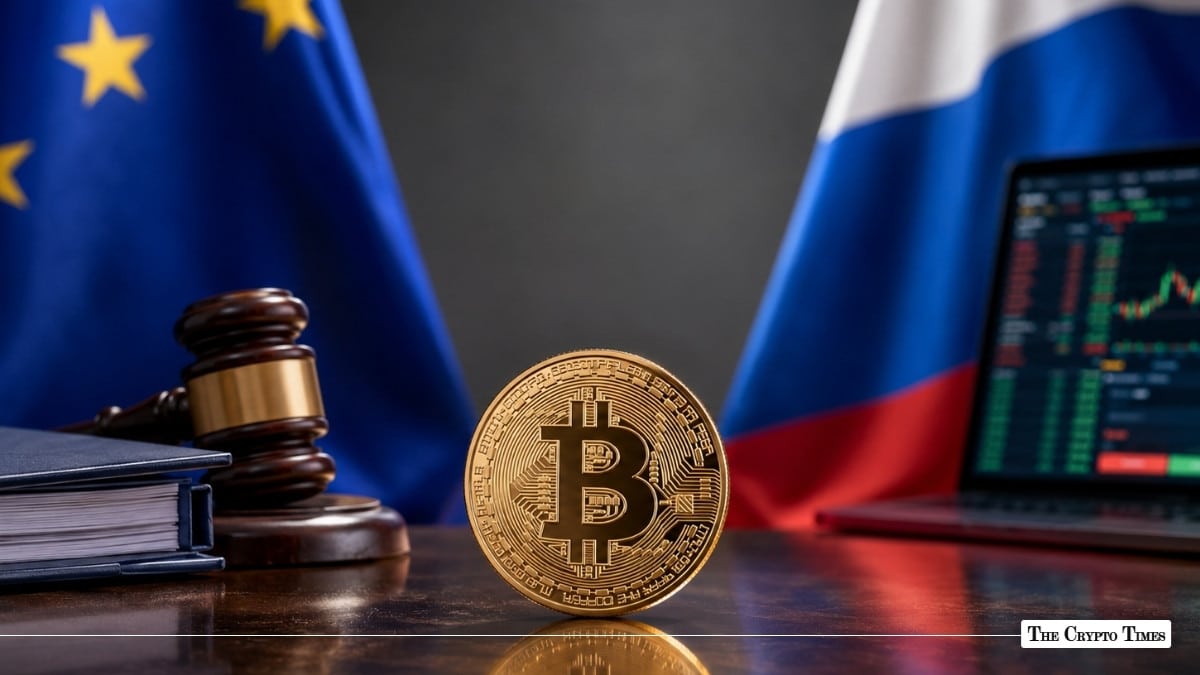
European Union member states agreed a diluted 21st sanctions package against Russia on Thursday, with crypto measures surviving a negotiation that stripped out several other proposals—two days after Russia’s parliament legalized cryptocurrency for cross-border trade.
What Made It Through
According to a Reuters report, European Council President António Costa announced the agreement, saying the new measures target energy, financial services, crypto, and trade. “Our support for Ukraine and for a just and sustainable peace remains unwavering,” he wrote.
The package targets Russia’s financial sector and crypto firms and blacklists dozens more officials, according to AFP. Its headline provision freezes the global price cap on Russian crude at $44 per barrel for 12 months, preventing an automatic increase that would have benefited Moscow amid rising oil prices.
The crypto content follows the proposal the European Commission unveiled in June, which blacklisted 11 crypto platforms outright and, for the first time, would allow the EU to ban an entire jurisdiction’s crypto-asset services if that country hosts platforms helping Moscow evade sanctions. The measures still require formal adoption before taking effect.
What Was Stripped Out
The concessions required to reach unanimity fell everywhere except digital assets.
Greece secured an exemption allowing its shipping firms to keep transporting Russian liquefied natural gas from the Arctic—the final hurdle diplomats cleared before agreement. A sweeping visa ban intended to bar Russian soldiers who fought in Ukraine from entering the bloc was deferred, with member states committing only to work toward one in the future.
Bulgaria blocked a proposal to place Russian Orthodox Patriarch Kirill on an asset-freeze and visa-ban list. Portugal and France objected successfully to a proposed ban on imports of Russian cod and Alaskan pollock.
The pattern is worth noting. After 21 rounds, diplomats warn that finding new targets commanding agreement among all 27 member states is becoming increasingly difficult — and the areas where consensus still holds are narrowing. Crypto is one of them.
Why Crypto Keeps Clearing the Bar
The digital asset measures have escalated steadily, while other instruments have stalled.
The EU’s 19th package, adopted in October 2025, marked the first time the bloc formally sanctioned a cryptocurrency, designating the rouble-pegged A7A5 stablecoin along with its issuer, developer, and affiliated platforms. The 20th package, adopted in April and effective from May 24, went further, imposing a sectoral ban that placed every Russian and Belarusian crypto service provider off-limits to EU persons, regardless of whether they were individually named.
That package also added RUBx and the digital ruble to the bloc’s list of banned crypto-assets. The digital rouble prohibition was explicitly preemptive, closing a channel before Russia’s central bank digital currency reaches mass rollout.
The scale explains the persistence. Chainalysis has tied A7A5 alone to roughly $93.3 billion in transaction volume within a year of launch, with cumulative throughput reported at nearly $120 billion, and estimated that illicit crypto addresses received about $154 billion during 2025. The Crypto Times has previously documented how Russia has used crypto rails to settle sanctioned oil sales to buyers in China and India.
Moscow Moved First This Week
The timing gives the package an unusually direct counterpart. On 21 July, Russia’s State Duma completed the second and third readings of its digital assets bill, which permits Russian companies and entrepreneurs to use cryptocurrencies for cross-border trade settlement while maintaining the ban on domestic crypto payments.
Russian officials have described that provision in plain terms. At the bill’s first reading, Kaplan Panesh, deputy chairman of the Duma’s budget and taxes committee, said the measure allows Russian companies to settle with foreign counterparties in cryptocurrency, bypassing sanctions restrictions.
The law also arrives ahead of the digital rouble’s commercial rollout, scheduled for 1 September, with systemically important banks and large retailers required to integrate support—the instrument the EU banned before it launched.
An Arms Race With Diminishing Returns on Both Sides
Neither side’s measures have proved decisive. Russia’s crypto evasion infrastructure has repeatedly reconstituted after designation: when law enforcement seized $26 million from the exchange Garantex, former employees launched the successor platform Grinex, with A7A5 serving as the bridge between them. Grinex itself halted operations in April after a $13 million hack, and A7A5’s issuer has said it no longer needs centralized exchange listings because its business runs on DeFi infrastructure.
The EU’s answer has been to move from designating entities to banning categories and now to contemplating bans on entire jurisdictions. That escalation reflects the failure of the entity-by-entity approach as much as its success.
What Thursday established is that after 21 rounds, the crypto front is one of the few where Brussels can still assemble 27 votes—at the same moment Moscow has written the workaround into law.