India’s crypto community has spent years adapting to a uniquely Indian reality—high taxes, limited formal banking rails, and a heavy reliance on peer-to-peer trading. Yet in 2025 and 2026, a quieter, more corrosive problem has taken centre stage: bank accounts freezing after perfectly ordinary P2P sales.
What begins as a routine USDT-to-INR trade on Bybit, Binance, or similar platforms can end with salaries blocked, EMIs bouncing, and months of bureaucratic struggle. I have covered a few news stories on this as a reporter. More importantly, I have lived it as my own account was frozen recently after one recent P2P trade. The experience has convinced me that the current system is not merely imperfect, rather it is actively punishing compliant citizens while failing to deliver swift justice against actual fraudsters.
The Unseen Cost of India’s Crypto Ambition
India taxed virtual digital assets at 30% plus cess and imposed 1% TDS precisely to bring the sector into the formal economy. The message from New Delhi was clear: trade if you wish, but pay your dues. Millions of Indians responded. They filed returns, deducted TDS, and treated crypto as a legitimate asset class.
At the same time, formal on-ramps remained constrained. Direct INR deposits and withdrawals on many platforms stayed limited or unavailable, pushing users toward P2P.
In that gap, an entire informal economy flourished. Liquidity is high, spreads are often competitive, and the process feels frictionless—until it is not. When a buyer’s funds later appear in a cybercrime trail, the seller’s bank account becomes collateral damage. Banks, acting on cyber-cell instructions under the Bharatiya Nagarik Suraksha Sanhita, place liens or full debit freezes. Entire balances, not merely the disputed sum, are frequently locked.
The result is a profound disconnect: the tax system treats crypto activity as legitimate, while the banking and enforcement system treats the same activity as presumptively suspicious. This is not a sustainable policy. It is a structural contradiction that hits retail users hardest.
When the Freeze Hits Home: My Own Experience
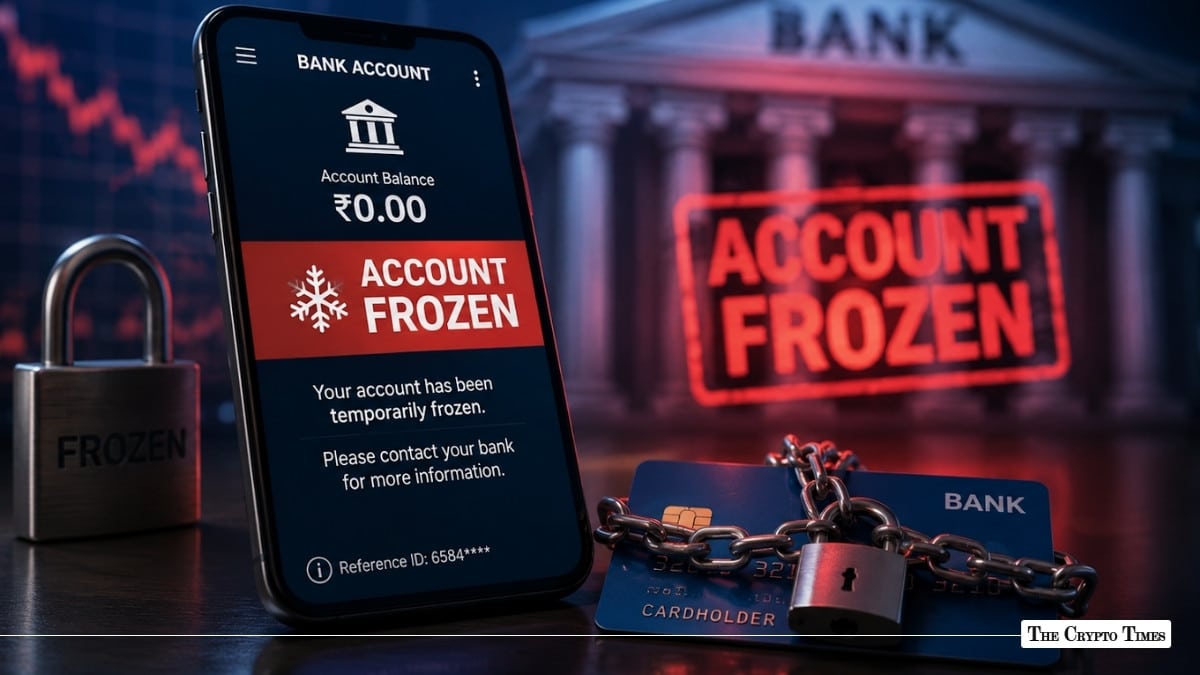
I have been thinking about freezes for months. Then it happened to me. After a single recent P2P trade, my bank account was placed under lien. The money remained visible, yet I could not withdraw, transfer, or use UPI for everyday payments.
The bank notice pointed to a cybercrime complaint. Like thousands of others, I had sold crypto to a counterparty who appeared verified on the platform. I had released the assets only after confirmation of payment. I had no knowledge, and no practical way of knowing, whether those rupees had passed through a scam victim’s account days or weeks earlier.
The practical impact was immediate and humiliating. Routine payments stalled. Explaining the situation to family and colleagues felt absurd. Gathering screenshots, chat logs, trade IDs, bank statements, and exchange confirmation letters became a full-time occupation.
Coordinating with the investigating officer across state lines added further delay. The experience is not unique; it is merely the latest data point in a pattern that has affected SBI, HDFC, and other major banks across India. What made it personal was the sudden realization that years of careful compliance offered almost no protection once a distant cyber cell issued an instruction.
How a Single Legitimate Trade Turns into a Legal Ordeal
The mechanics are now well understood. A fraud victim is tricked into transferring money. That money travels through one or more accounts before landing in a crypto seller’s bank as payment for USDT or Bitcoin. The victim files a complaint on the National Cyber Crime Reporting Portal. Investigators trace the chain. The seller’s account appears. The bank receives a request and freezes funds—often the entire balance—under provisions that allow seizure of property suspected of being linked to crime.
No proof of the seller’s knowledge or intent is required at the freezing stage. The burden then shifts entirely onto the innocent party to prove legitimacy. Users must obtain the complaint reference, identify the investigating officer, compile exhaustive documentation, and request a no-objection certificate. Many are told they may need to travel to another state.
High Court observations have repeatedly criticized blanket freezes and emphasised that only the disputed amount should ordinarily be restricted. Yet on the ground, full freezes remain common, and resolution timelines stretch from weeks into months. The system designed to recover proceeds of crime ends up collateralising the savings of ordinary taxpayers.
Courts Speak, but Ground Reality Lags
Several High Courts have recognized the problem. Rulings from Kerala, Delhi, Madras, and elsewhere have underscored that unilateral full-account freezes without proper magisterial oversight raise serious questions under the BNSS framework. Courts have directed proportional liens and faster consideration of representations by bona fide traders. The Ministry of Home Affairs has also issued guidance favouring time-bound resolution and limiting holds to disputed sums.
These interventions matter. They give affected users legal footholds. Yet enforcement remains uneven. A trader in one state may secure partial release relatively quickly; another, dealing with a different cyber cell, waits indefinitely. Banks, caught between police instructions and customer service obligations, often default to the safest bureaucratic position: keep the freeze until formal clearance arrives. ‘
The result is a postcode lottery of justice. For a country that prides itself on digital public infrastructure and UPI’s global reputation, this inconsistency is damaging. It signals that the same state that celebrates digital payments can, in the crypto context, lock citizens out of those very payments with limited due process.
The Deeper Failures in India’s Digital Finance Framework
At root, the crisis reveals three failures. First, the absence of reliable, regulated INR on- and off-ramps at scale forces reliance on P2P. Second, the information asymmetry is extreme: the seller sees a platform-verified buyer and a successful payment; the enforcement system later sees only a transaction trail. Third, inter-agency coordination between cyber cells, banks, the Financial Intelligence Unit, and the Reserve Bank remains slow and opaque for the individual citizen.
Meanwhile, the human cost accumulates. Salaries sit inaccessible. Small businesses lose working capital. Young professionals miss rent or EMI deadlines. Trust in both banking and crypto erodes. Some users migrate toward riskier, fully informal channels; others simply exit.
Neither outcome serves India’s stated goals of formalisation, tax compliance, or responsible digital asset adoption. Fighting cybercrime is non-negotiable. Freezing the accounts of people who merely sold an asset at market price, however, is a blunt and often counterproductive instrument.
Reclaiming Fairness: What Policymakers and Users Must Demand
India does not need to choose between cracking down on fraud and protecting honest traders. It needs better design. Clearer RBI guidance on proportional liens and mandatory timelines for cyber-cell responses would help.
Expanded, FIU-compliant banking partnerships for crypto platforms would reduce dependence on pure P2P. A shared verification layer or faster information exchange between exchanges and investigators could flag high-risk counterparties earlier. High Courts have already pointed the way on due process; consistent implementation across states is now essential.
For users, the immediate lessons are practical and unglamorous: maintain meticulous records, prefer highly rated and long-standing counterparties, consider segregating crypto-related banking, and treat every large P2P inflow as potentially contested until proven otherwise. Yet individual caution cannot substitute for systemic reform.
As a reporter who has documented these freezes and as a citizen who has experienced one, I am left with a simple conviction. India has successfully taxed crypto activity. It has built world-class digital payment rails. It now owes its citizens a framework in which legitimate participation does not carry the constant risk of sudden financial paralysis.
Until the freeze epidemic is addressed with the same seriousness that fraud itself receives, every P2P trade will carry an invisible asterisk: this might cost you months of your life. That is no way to build a mature digital asset market.
Also read: CLARITY Act: The Bill Exists, the Deal Does Not, Trump Has to Wait