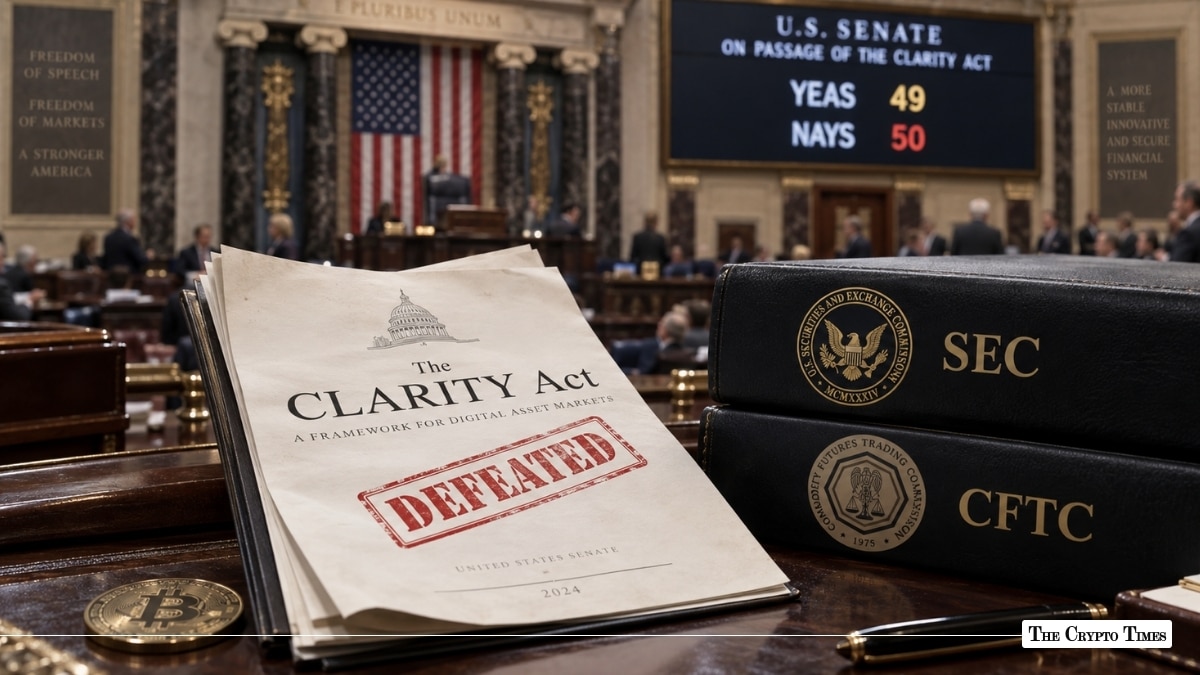
The failure of the Digital Asset Market Clarity Act to clear its first floor test in the US Senate has shifted the balance of US crypto policy from Congress to two federal agencies acting under existing authority.
Over four days, the industry watched a market structure bill collapse on a bipartisan opposition vote, a new Federal Reserve chair deliver the first rate hike in more than three years, the SEC open a five-year window for tokenized US stocks, and the CFTC send its own crypto framework to the White House for review.
The 49-50 Cloture Defeat
The Senate’s official record shows that voting on the motion to invoke cloture on the motion to proceed to Calendar Number 423, H.R. 3633, began at 2:19 p.m. Eastern Time on Tuesday, September 15, 2026. The result, announced at approximately 3:00 p.m. as 49 yeas to 50 nays, is listed as Roll Call Vote 234 under Senate Rule XXII. The tally was 11 votes short of the 60-vote three-fifths threshold and one short of a simple majority.
Cloture on the motion to proceed is a preliminary step that ends debate on whether the Senate will take up a House-passed bill. Had it succeeded, senators would have moved to amendments, further debate and, eventually, a separate vote on final passage. The failure closes the ordinary path forward without formally killing the underlying legislation, which remains on the Senate calendar and passed by the House. The Crypto Times covered the vote as it happened in a live blog.
Every Senate Democrat present voted against the motion. Four Republicans crossed the aisle to join them: Senators Susan Collins of Maine, Josh Hawley of Missouri, Jerry Moran of Kansas and Thom Tillis of North Carolina. Senator Chris Coons of Delaware did not vote. Under Senate rules, only a senator on the prevailing side of a failed cloture vote can file a motion to reconsider. Tillis switched his position from yes to no to do exactly that, keeping the bill technically eligible to return to the floor if a deal materialises.
How the CLARITY Act Reached the Senate Floor
Representative French Hill of Arkansas introduced the Digital Asset Market Clarity Act on May 29, 2025. The House passed it 294 to 134 on July 17, 2025, with 78 Democrats joining Republicans in support. The Senate Banking Committee reported the measure 15 to 9 on May 14, 2026, with Democratic Senators Angela Alsobrooks of Maryland and Ruben Gallego of Arizona the only two Democrats voting yes. The Crypto Times has tracked the CLARITY timeline since that markup.
The CLARITY Act would have divided federal oversight of digital assets between the Securities and Exchange Commission (SEC), the federal securities regulator, and the Commodity Futures Trading Commission (CFTC), the federal derivatives regulator. Digital commodities operating on mature open blockchains would fall under CFTC spot supervision; tokens deemed investment contracts would stay with the SEC.
The bill also proposed registration rules for exchanges and brokers, custody standards, treatment of certain decentralised finance (DeFi) protocols, and ethics restrictions on federal officials. Payment stablecoins are already governed by the Guiding and Establishing National Innovation for U.S. Stablecoins (GENIUS) Act, signed into law on July 18, 2025.
Senate Banking Committee Chairman Tim Scott, Agriculture Committee Chairman John Boozman and Digital Assets Subcommittee Chair Cynthia Lummis released a final substitute draft late on September 13. Sponsors described it as their “last, best and final” offer, incorporating 126 substantive changes requested by Democrats. The most contested changes concerned ethics: the final draft would have barred officials, employees and their spouses from issuing or sponsoring digital assets while in office, allowed personal crypto holdings, excluded children of officials from the issuance ban, assigned enforcement exclusively to the Department of Justice (DOJ) and set the provisions to sunset in 2029.
The Crypto Times reported on September 13 that President Donald Trump had met with advisers on the ethics text two days before the vote. Democrats sent a counterproposal in the early hours of Monday morning, which Republicans rejected.
Immediate Senate Floor Reactions
Senator Cynthia Lummis, the CLARITY Act’s chief architect in the Senate, told reporters minutes after the tally: “I think we’re done. It’s over. Because we’ve been working on this bill for over a year. And we’ve given them over 120 of their requests and that’s enough.” Asked whether the measure could return, she answered, “Nope.”
A day later, Lummis publicly challenged Alsobrooks on X to explain her vote in light of the concessions, arguing that Republicans had already accepted a “historic agreement” on ethics restrictions covering the president, vice president and their spouses.
Banking Committee Chairman Tim Scott, in an official statement, said “nearly all Senate Republicans voted to advance the Clarity Act, but the motion fell short because of Senate Democrats,” concluding it was “time for the SEC and CFTC to set clear rules of the road.” Ranking member Senator Elizabeth Warren of Massachusetts had said in a July 22 statement that the text was “riddled with massive loopholes” and did “nothing to prevent the President from making his next $1.4 billion in crypto profits.”
Senator Angela Alsobrooks described the DOJ-only enforcement clause in a Semafor appearance as “wild and unserious and stone crazy,” said the bill was “not going to die” and accused Republicans of “playing a game” by moving to cloture before ethics questions were resolved.
Industry Response on September 15
Ripple Chief Executive Officer Brad Garlinghouse posted on X within an hour of the tally that the loss “stings,” writing that his team had given “everything we had to get the Clarity Act across the finish line” and calling for a post-mortem. He later said at an HDAX event alongside former Kansas City Fed President Esther George that neither XRP nor Ripple’s operating business would be materially affected, citing the legal precedent from the company’s earlier case with the SEC.
Coinbase Chief Executive Officer Brian Armstrong, who had said in August that “clarity is coming either way,” posted after the vote that the industry could not “wait on Congress anymore.” The SEC and CFTC, he wrote, “have the tools they need to create clear rules under existing authority,” and added: “There were some concessions we made on CLARITY that were tough to swallow, so perhaps it’s for the best.”
Asset manager Grayscale said the vote was “not the outcome we hoped for” but that “the industry continues to make remarkable progress through the ongoing work of regulators like the SEC and CFTC.”
Bitwise Chief Investment Officer Matt Hougan warned the failure risked stalling momentum into the fourth quarter, while MicroStrategy Executive Chairman Michael Saylor argued the setback could ultimately boost Bitcoin activity by clarifying the agency route. Representative Warren Davidson of Ohio, one of the House sponsors, posted that “we had all the momentum when CLARITY passed the House last year. The Senate let that momentum die today.”
Wednesday, September 16: Fed Rate Hike and Agency Response
The Federal Open Market Committee (FOMC) raised the target range for the federal funds rate by 25 basis points to 3.75-4.00%, the Federal Reserve’s first rate hike since July 2023. The decision was unanimous at 12-0. Federal Reserve Chair Kevin Warsh, who succeeded Jerome Powell earlier this year, described the increase as removing “a dose of accommodation” against elevated inflation and pointed to strong capital investment tied to the artificial intelligence buildout as a factor keeping Treasury yields high.
Updated Summary of Economic Projections showed 16 of 18 officials seeing the possibility of at least one further 25-basis-point increase before year-end, with four penciling in two more. The Fed pegged 2026 headline and core Personal Consumption Expenditures (PCE) price growth at 3.7% and 3.4% respectively, up from June’s 3.6% and 3.3%.
Within hours of the FOMC statement, CFTC Chair Michael Selig, the sole sitting commissioner on a body designed to have five members, posted on X that the Senate vote was “unfortunate” and that “Americans deserve regulatory clarity, legal certainty, and consumer protections in crypto asset markets.” He continued: “President Trump promised to deliver a future-proof crypto asset regulatory market structure one way or the other, and we will help him get the job done using our existing statutory authorities.” He closed: “The U.S. is and will remain the crypto capital of the world. The CFTC is locked in and ready to ship its rules for the new frontier of finance.” The Crypto Times covered the statement in full.
SEC Chair Paul Atkins followed roughly two hours later: “I have been unequivocal: with or without legislation, we will act decisively within the SEC’s statutory authority to deliver certainty for American investors. Clarity is on the way via rulemaking.” Atkins had told CNBC on July 27 that the SEC was “ready, willing, and able” to write crypto rules itself if CLARITY stalled, and repeated the point at a Solana Policy Institute speech in Washington on September 14.
Thursday, September 17: Two Agency Actions and a Democratic Reset
On the morning of September 17, the SEC issued Press Release 2026-90, granting temporary, conditional exemptive relief called the “Innovation Exemption.” The order permits Tokenized Securities Venues (TSVs) to trade tokenized National Market System (NMS) stock through permissioned automated market makers and liquidity pools, and grants qualifying liquidity providers relief from dealer registration requirements under the Securities Exchange Act of 1934.
The exemptions expire five years after publication. Atkins tied the timing directly to the Senate defeat, saying in the release that “Congress was unsuccessful in advancing the Clarity Act despite the tireless efforts of many” and that the Commission was moving “within its statutory authority, to bring America’s capital markets into the digital age.”
Under the order, a TSV must observe limits on symbols and volume, verify that each tokenized stock carries the same rights as the underlying NMS stock, halt trading concurrently with any stoppage on the primary listing exchange, and provide public notice of its operations.
Smart contracts must be deployed on public, permissionless, auditable distributed ledgers. Commissioner Mark T. Uyeda, in an accompanying statement, described the order as a limited step, and Commissioner Hester M. Peirce issued a separate supportive statement.
The same day, the Office of Information and Regulatory Affairs (OIRA), the White House body within the Office of Management and Budget that vets significant federal regulations, recorded receipt of a CFTC prerule titled “Regulation Crypto Asset Transactions and Regulation Crypto Asset Markets,” listed under Regulatory Identification Number 3038-AF80.
The submission is at the prerule stage, an early step preceding a formal proposed rule. Under Executive Order 12866, OIRA has 10 working days to review preliminary actions.
The CFTC would then need to vote before releasing the proposal for public comment. Selig first outlined the framework at the CFTC’s Innovation Advisory Committee meeting on August 20, telling staff to explore rules that “codify a CFTC market structure for crypto assets using the agency’s existing authorities.”
Late Wednesday night, the seven Democrats who had spent two years negotiating the CLARITY Act released a joint statement through Senator Gallego’s office. The signatories, Senators Kirsten Gillibrand of New York, Angela Alsobrooks, Cory Booker of New Jersey, Catherine Cortez Masto of Nevada, Ruben Gallego, Mark Warner of Virginia and Raphael Warnock of Georgia, wrote: “Democrats have spent the last two years working to pass crypto legislation that would expand opportunity, protect consumers, punish bad actors, create regulatory certainty, and include strong, commonsense ethics provisions for elected officials. This week was a setback, but not the end of that important work. We remain committed to working in a bipartisan fashion to get this legislation passed.”
The statement contained no target date, no draft text, and no vote count. The Crypto Times reported that the demands appeared unchanged from a joint statement dated July 22.
Exclusive Industry Assessments Shared With The Crypto Times
Bitfinex Alpha
Bitfinex Alpha, the research arm of the digital-asset exchange Bitfinex, shared its assessment exclusively with The Crypto Times, arguing on-chain and derivatives data pointed to tactical repositioning rather than a capitulation flush.
“Longs are being re-added as funding remains positive, albeit not overheated, even as price continues to decline with lower highs and lower lows,” Bitfinex Alpha said. “This is consistent with the recovery in open interest and contrasts with conditions typically seen during a capitulation-like flush which happens at the end of trends and doesn’t lead to further continuation.” The desk pointed to cumulative volume delta (CVD), a measure of aggregated taker order flow by volume: “Since the breakdown below $77,100, buy-side taker activity has increased alongside open interest, with funding remaining positive on each positive price move.”
On seller demographics, Bitfinex Alpha drew a specific dividing line: “Deposits into US institutional products, including ETFs and wrapper products, remained at a typical 7,300 BTC in size. The coins moving onto exchanges are therefore from more recent, retail-sized buyers. They belong to the cohort that acquired 1.23 million BTC between $77,100 and $81,300 over the past four weeks and which is now sitting at a loss.”
Looking ahead, the desk said: “The macro headwinds facing BTC appear to have reached their peak for the current cycle, yet spot prices have so far barely broken below the range lows. For now, we expect ETF flows to provide a clearer signal of institutional positioning than the options market.”
Global Settlement Network
Ryan Kirkley, Co-founder and CEO of Global Settlement Network (GSN), in commentary shared exclusively with The Crypto Times, framed the vote as one of three simultaneous stress tests hitting risk assets. “A lot is moving across markets today, but the common thread is simple: the headline number is not enough,” Kirkley wrote.
“The Fed is facing fresh inflation pressure, partly tied to the enormous AI infrastructure buildout. Crypto just watched the CLARITY Act fail to advance in the Senate. Meanwhile, DeFi has added billions of dollars in headline TVL, but much of that jump reflects higher token prices rather than fresh capital entering the system.”
On the vote as a pricing event, Kirkley said: “Bitcoin fell following the vote, while Coinbase, Circle and other crypto-linked stocks came under heavy pressure. The reaction tells us exactly how much value investors have already attached to regulatory certainty. Institutional capital needs to know who regulates what. When those answers get delayed, capital has to price that uncertainty.”
He linked the Fed’s decision to hike on Wednesday to the same underlying capital cycle: “AI is a productivity story, but right now it is also an inflation story. Higher rates change the price of risk. Bitcoin may trade 24/7, but it still trades inside the global liquidity cycle.”
Total value locked (TVL), a dollar-denominated measure of the assets inside DeFi protocols, has risen sharply on Ethereum and Solana in recent weeks. Kirkley argued the increase largely reflects rising token prices rather than fresh dollar inflows: “When I see billions added to DeFi TVL, my first question is simple: how much new money actually came in? Higher asset prices are not the same thing as deeper liquidity. That is why stablecoin supply, net inflows, borrowing activity and settlement volumes deserve much more attention than headline TVL.”
He concluded: “Settlement connects all three. When token prices fall sharply, collateral values and liquidity requirements can change within minutes. The market does not wait for the infrastructure underneath it to catch up.”
Coinbase’s John O’Loghlen
John O’Loghlen, Managing Director for Asia-Pacific at Coinbase, told The Crypto Times exclusively that the vote does not change the exchange’s strategy. “While the outcome of the vote is disappointing, it does not change Coinbase’s long-term commitment to building trusted, compliant products for our customers,” O’Loghlen said. “The GENIUS Act is the law of the land, establishing federal rules for stablecoins, the fastest-growing sector of on-chain finance, and Coinbase sits right at the center of it.”
He added: “We are encouraged by the broad, bipartisan support for a bill endorsed by law enforcement, and we believe that coalition will continue to play an important role in advancing clear and consistent rules for the industry. We also expect the SEC and CFTC to advance regulatory clarity through their respective rulemaking authorities.”
Enso’s Connor Howe
Connor Howe, Co-founder and CEO of Enso, in comments shared exclusively with The Crypto Times, argued that agency rulemaking and statutory law cannot be treated as functional equivalents. “Falling short of the 60-vote threshold doesn’t send the market back to 2022,” Howe said. “Selig already told CFTC staff to draft a market-structure regime under existing Commodity Exchange Act authority, and the SEC put Regulation Crypto Assets out for comment back in August. Neither move was riding on Tuesday’s vote.”
“Durability is where the vote still matters,” he continued. “The next chair can rewrite an agency rule without a single vote in the Senate. Repealing a statute takes another act of Congress. Banks and asset managers on the fence hold out for the version that outlasts whoever runs the agency next. The same gap swallows what this draft dropped: explicit Section 1960 protection for developers who never touch customer funds. Without it in statute, that protection is as easy to unwind as anything the CFTC or SEC writes on their own.” Section 1960 of Title 18 of the United States Code criminalises operating an unlicensed money transmitting business, and has been used against non-custodial software developers.
Mercuryo’s Arthur Firstov
Arthur Firstov, Chief Business Officer at Mercuryo, shared his assessment exclusively with The Crypto Times. “Arguably, the real win from the Clarity Act will be making onchain finance invisible, almost like a dull utility,” Firstov said.
“Banks should be able to offer tokenized deposits, stablecoin settlement and digital-asset products as normal financial services. The real milestone will be when a bank moving tokenized assets or settling in stablecoins is no more unusual than a financial institution today using an automated clearing house or Fedwire.”
On self-custody, Firstov said: “Holding assets in your own wallet or using non-custodial software is very different from handing those assets to an intermediary that controls customer funds. If every piece of blockchain software is treated like a financial intermediary, a large part of what makes these networks useful becomes difficult to build around.”
On stablecoins: “The Genius Act created a framework specifically for stablecoins payments, while The Clarity Act can give banks, payments companies and other market participants more certainty around the wider blockchain ecosystem. Stablecoins represent the future of payments.”
Market Response and Galaxy’s Post-Vote Assessment
Bitcoin traded near $77,800 as senators returned from the August recess, fell to roughly $75,600 in the hours after the vote, and broke below the $77,100 range floor that had held for four weeks. By September 18, Bitcoin had recovered above $80,000, with CoinGecko data showing the asset trading near $80,822.42 at 2:40 p.m. UTC, up 5.5% over 24 hours. The 24-hour range was $76,205.16 to $80,943.89. The Crypto Times tracked the price recovery and the broader relief rally that pushed altcoins higher.
Coinbase shares fell around 8% on the day of the vote; Circle Internet Group, the issuer of USDC, fell around 10%, and Bullish and Robinhood also traded lower before partially reversing. Polymarket’s contract on a 2026 signing dropped from a peak of about 30% Monday to about 18% overnight, and to 7.8% bid, 7.9% ask by Friday. Kalshi’s broader market-structure contract traded between 8.3% and 8.9%.
Galaxy Research, in an analysis by researcher Alex Thorn covered by The Crypto Times, assessed the CLARITY Act as effectively finished for the current period. Galaxy said revival efforts before the October recess were possible but of “very low” probability, and pointed to recent CFTC no-action relief for certain front-end DeFi developers and the SEC’s Innovation Exemption as examples of regulatory activity continuing without the bill.
What Comes Next for US Crypto Regulation
The Senate is not scheduled to return to the CLARITY Act on any published calendar. Congress is set to depart Washington ahead of the November 3 midterm elections, and Senator Tillis’s motion to reconsider remains the only procedural door open. The lame-duck session between the election and the end of the 119th Congress in early January is the next realistic legislative window; the seven Democrats’ Wednesday statement did not commit to it.
Regulation Crypto Assets, the SEC’s separate offering framework, remains out for public comment until October 20, 2026. The CFTC’s prerule sits at OIRA under a 10-working-day review clock. The Innovation Exemption is live from September 17 for five years. Whether Congress returns to Section 1960 developer protections in the lame-duck session, in the 120th Congress, or not at all is now the central open question for developers of non-custodial protocols.
Whether the broader market-structure answer arrives as a statute that outlives the next administration, or as a set of agency rules that can be redrawn by the next chair, is the central variable for banks, asset managers and crypto-native firms deciding how much of their balance sheet to put on-chain.
As Kirkley of Global Settlement Network put it in commentary shared exclusively with The Crypto Times, “the number on the screen only tells you so much. What matters is the liquidity behind it, the rules around it and whether the infrastructure can settle when everyone decides to move at the same time.”
Also Read: Brian Armstrong Says WSJ Preparing Story Blaming Him for CLARITY Act Failure