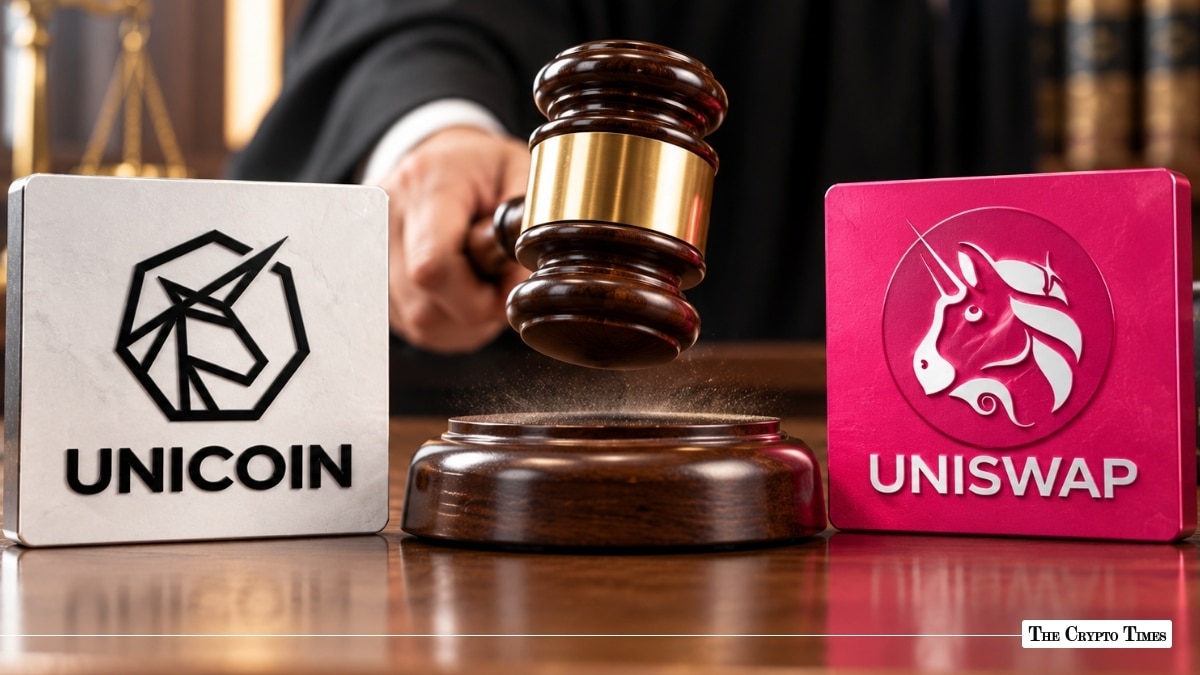
Unicoin has sued Uniswap Labs, and it is not only defending its own name. It wants a federal court to strike Uniswap’s UNI trademark from the register.
The argument is that UNI is a Latin prefix meaning “one,” that around a thousand live US registrations contain it, and that at least three unrelated tokens trade under the exact ticker on CoinGecko—so the term identifies no single source.
TransparentBusiness Inc., now operating as Unicoin Inc., filed the complaint in the US District Court for the Southern District of New York on September 8, in case 1:26-cv-07703, seeking declarations of non-infringement alongside cancellation.
What Uniswap Demanded
The dispute began with a letter from Uniswap’s counsel on June 3, accusing Unicoin of infringement, dilution, cybersquatting, and unfair competition over its use of the UNICOIN and UNICOINX marks and its unicorn logos.
According to the complaint, that letter demanded Unicoin permanently cease all use of UNICOIN and any other UNI-formative designation in connection with cryptocurrency, blockchain, or decentralized finance; transfer the domains unicoin.com and unicoin.org; provide a complete accounting of revenue and profits; and reimburse Uniswap’s legal fees.
According to the complaint, Unicoin declined on June 23. Uniswap’s counsel rejected that response on July 17 and repeated the demands, stating it would consider all other legal remedies if the matter were not resolved to its satisfaction. A further letter on August 14 said Uniswap would not continue a back-and-forth and repeated the warning. Unicoin filed three weeks later.
The Cancellation Claim
Count III is the most consequential. Unicoin asks the court to cancel US Registration No. 7,307,721 for the standard-character mark UNI, which covers minting services and blockchain governance software, with a first use date of September 16, 2020, and a registration date of February 20, 2024.
Because that registration is less than five years old, it is not incontestable, which means it remains open to challenge on grounds that would have barred it initially—including mere descriptiveness without acquired distinctiveness.
The supporting argument rests on how crowded the field is. The complaint cites more than 3,600 USPTO registrations containing UNI; roughly a thousand of them live, and names Unilever, UnitedHealth, UNIQLO, Univision, and UniCredit are among the established users. In crypto specifically, it lists Unibot, Unifi Protocol DAO, UniLend Finance, UNCX Network, UniX Gaming, Unibright, Unification, and UniLayer and notes that Universa, UnikoinGold, Unitus, Unify, and Unibright all predate Uniswap’s September 2020 token.
The Marks Themselves
Unicoin argues the complete marks differ in sound, meaning, and commercial impression. COIN is a soft, drawn-out sound against the hard monosyllables of SWAP and CHAIN, and the three convey a digital coin, an exchange, and blockchain infrastructure, respectively.
On the logos, the complaint contends any resemblance comes from the shared mythology rather than copying—Uniswap’s unicorn has flowing locks and soft curves, while Unicoin’s is composed of sharp, precise lines.
It also says unicoin.com was registered in 2003 and unicoin.org in 2015, both before Uniswap existed, and that despite years of prominent marketing, including Times Square billboards and bus wraps, nobody other than Uniswap has ever suggested a connection between the two.
The Timing Argument and What Surrounds It
Unicoin alleges Uniswap timed its demands to coincide with an imminent public offering, noting the June 3 letter referred to an initial coin offering scheduled for September 2026. It argues that Uniswap knew of the business for more than two years yet raised infringement only on the eve of that offering and pleads laches on that basis.
The complaint further alleges animus, pointing to a May 12, 2024, post by Uniswap chief executive Hayden Adams saying Unicoin should be subject to SEC scrutiny.
That allegation requires context the filing does not supply. The SEC charged Unicoin and three executives with fraud in May 2025—chief executive Alex Konanykhin, Silvina Moschini, and Alex Dominguez—alleging false and misleading statements that raised more than $100 million from over 5,000 investors under the antifraud provisions of the Securities Act and the Exchange Act. The agency sought injunctive relief, disgorgement, civil penalties, and officer-and-director bars.
Unicoin moved to dismiss, with Konanykhin describing the case as politically motivated and saying the company had voluntarily registered securities and published audited financial statements. That case has not been resolved, and the September offering referenced in the complaint would proceed while it remains pending.
What Happens Next
Uniswap has not filed a response, and the complaint notes it has not provided any covenant not to sue. Unicoin has demanded a jury trial and asks the court to find this an exceptional case warranting an award of its legal fees.
For Uniswap, the exposure runs beyond this dispute. A ruling that UNI is generic would remove a registration the company has used to police the wider field of UNI-formative crypto projects, of which the complaint identifies many.
Also read: Uniswap Fees on Robinhood Chain Push Daily UNI Burns Past $1 Million