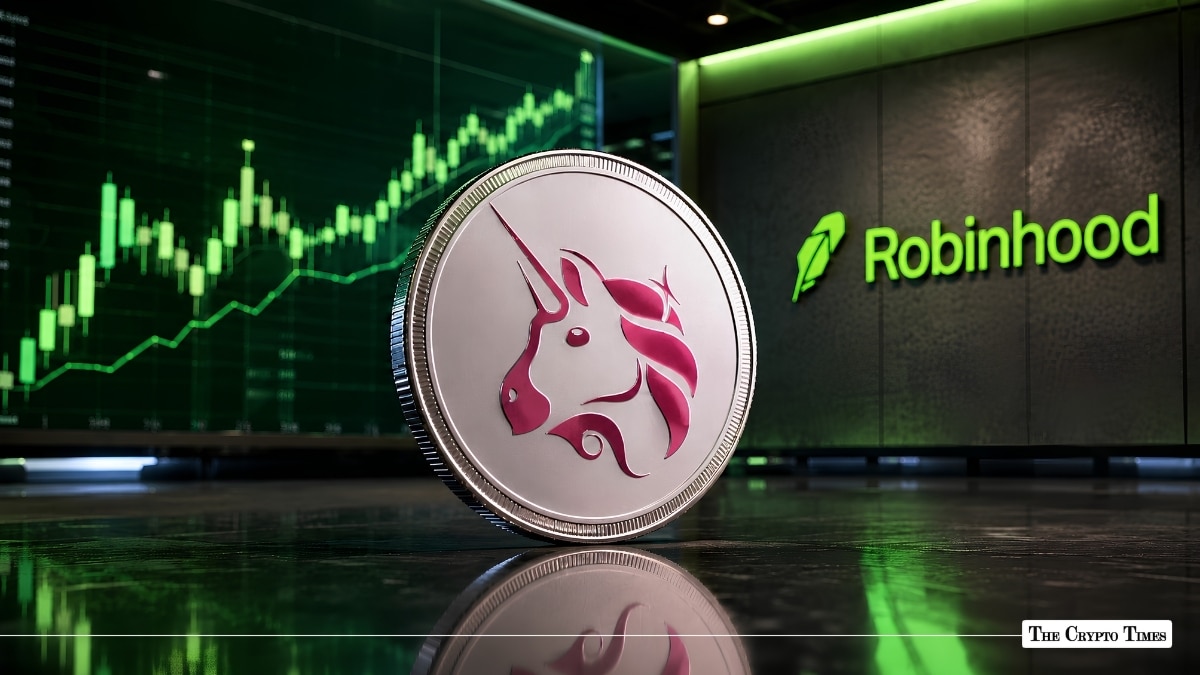
Uniswap recorded its first $1 million-plus daily token burn on September 4, as trading activity on Robinhood Chain reached a new high.
Data from a Dune dashboard, which is tracking token’s daily burn, showed $1.15 million worth of UNI destroyed on September 4, with 184,000 tokens burned in total, the second-highest daily amount on record.
According to data tracked by Wu Blockchain dashboard, Robinhood Chain accounted for 150,000 of those tokens. On the same day, decentralized exchange volume on the network exceeded $3 billion for the first time, and Uniswap handled as much as 98% of that flow.
The figures mark a sharp concentration of Uniswap activity on a chain that only launched its public mainnet on July 1. Uniswap Labs said at the time that v2, v3, v4, and UniswapX were live from day one and that Uniswap would serve as the primary public AMM on the network.
Record Burns Follow Fee Expansion on Robinhood Chain
The burn spike is tied to a governance change executed in late July. Uniswap’s Protocol Fee Expansion: Robinhood Chain proposal enabled protocol fees on the network’s v2 and v3 deployments, with v4 fees activated through a parallel vote. The proposal noted that Uniswap deployments on Robinhood Chain had already crossed $6 billion in cumulative swap volume by July 10.
Under Uniswap’s fee-to-burn design, protocol fees accumulate in TokenJar contracts. Searchers claim those assets by burning an equivalent value of UNI, which is then sent to a burn address on Ethereum. Fees generated on Robinhood Chain follow the same path used on other supported networks.
That mechanism is now drawing most of its recent fuel from one chain. DeFiLlama currently attributes $11.8 million of Uniswap’s $13.59 million in 24-hour fees to Robinhood Chain. Over seven days the figure is $53.61 million, and over 30 days it is $94.33 million, well ahead of Ethereum, Base, and other networks.
Chain-level activity remains elevated even after September 4. DeFiLlama data shows Robinhood Chain with $860.3 million in total value locked, $1.77 billion in 24-hour DEX volume, and $921.6 million in stablecoin market cap at the time of writing.
Uniswap Captures Most Trading as Volume Mix Shifts
Uniswap’s share of Robinhood Chain volume has stayed high across both speculative tokens and tokenized stocks. Independent dashboards tracking the chain, including a Dune analytics view of the Robinhood DEX landscape, show Uniswap versions accounting for the bulk of measured swap activity, with other venues such as launchpads and smaller AMMs taking a minority share.
That concentration matters for UNI holders because protocol fees, not treasury spending, now drive ongoing burns. The July fee activation did not create a new revenue model. It extended an existing system, first outlined in Uniswap governance discussions around protocol fee expansion to Robinhood Chain, to a network whose trading volumes have grown faster than most other Uniswap deployments.
The data still leave room for caution. Daily DEX volume on Robinhood Chain has moved in wide ranges since July, and a large portion of activity has been linked to memecoins and launchpad tokens rather than only tokenized equities. Robinhood Chain also remains early: two months of history is a short sample for judging whether current volumes, fee capture, and burn rates will hold after introductory incentives change.
For now, the measurable result is straightforward. A single-day UNI burn of $1.15 million, a $3 billion DEX session on Robinhood Chain, and Uniswap’s dominant share of that volume have made the new Layer 2 the largest near-term contributor to Uniswap’s fee and burn pipeline.
Read: AMC–Robinhood Feud Fuels $MEME Token Past $100 Million in Hours