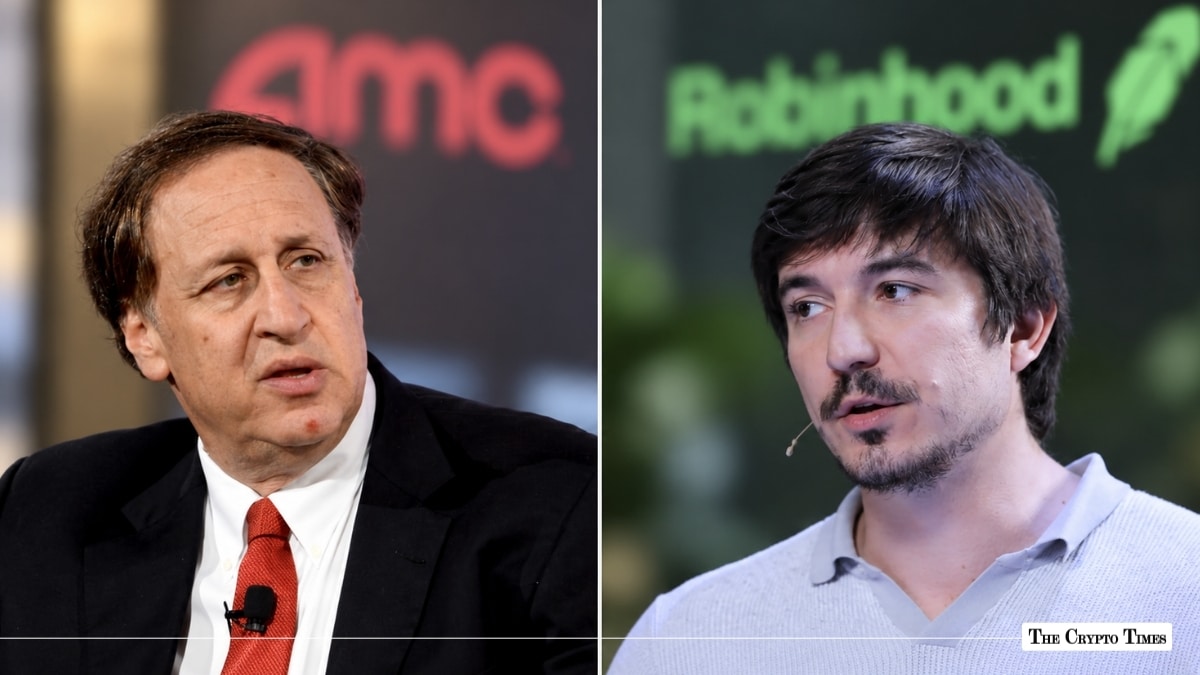
A newly launched token called A Meme Coin ($MEME) briefly became the most watched asset on Robinhood Chain after a public dispute between AMC Entertainment chief Adam Aron and Robinhood chief Vlad Tenev.
On-chain dashboards recorded a move from a low seven-figure valuation to a peak near $100 million to $151 million in a matter of hours on September 3–4, 2026, before a sharp retrace left the token near $45 million by September 5 (as of 10;30 AM UTC).
The token’s contract shows a one-billion supply, created on September 3, and a Uniswap v4 pool quoted in tokenized AMC rather than a stablecoin. That pairing is the point of the trade and the source of confusion: $MEME is not AMC equity, does not confer shareholder rights, and is not issued by the theater company. It is a meme token whose launch liquidity sits against Robinhood’s AMC stock token.
A ticker fight that became a trading pair
Robinhood has described Stock Tokens as economic exposure to more than 190 U.S. names, available outside the United States and designed for 24-hour on-chain markets. Tenev has argued that tokenization is an early “supercycle” and that the tokens are backed by underlying shares even if they are not identical to registered stock.
Aron rejected that framing for AMC. In a public reply he said U.S. securities laws exist to protect investors, objected to what he called a synthetic market set up offshore, and asked Robinhood to “cease and desist” AMC stock-token trading, adding that outside counsel had been asked whether the company could force a halt. Tenev’s earlier three-word reply — “What’s the concern?” — became a buzzing community caption.
Traders collapsed the argument into a pun: AMC as “A Meme Coin.” The token page and meme-stock board list $MEME among coins whose pools are anchored to tokenized equities, a format that also includes pairs against names such as NVDA and HIMS. Because every swap in the MEME/AMC pool moves both sides, volume in the joke token also printed as volume in the stock token. That loop, not a change in AMC’s theater business, is what on-chain screens showed.
Live terminals later printed extreme prints: multi-thousand-percent intraday gains, nine-figure notional volume, then a drawdown of roughly 40% or more in a six-hour window after the peak. Figures differ by venue and timestamp because liquidity is thin relative to the headline market cap.
Public leaderboards and the $1,491 clip
The trade that traveled farthest was attributed to Frank, known on X as @frankdegods. Wallet monitors said an address linked to that account bought about 11 million $MEME for $1,491 and, about 11 hours later, showed a mark near $1.2 million, or roughly 810 times cost. Those numbers describe position value at a moment in time. They do not, by themselves, prove a full exit at that price.
The clip spread on FOMO, a social trading app that publishes buys, size, and leaderboard P&L in a feed. Supporters treated the visibility as proof that the win was public. Critics pointed to clustered early fills and called the pattern insider-like. Matching timestamps are common at permissionless launches: snipers, bots, and people watching the same CEO thread can hit the same block.
Other wallets were also reported with seven-figure paper gains from sub-$200,000 entries. The same tape that minted those screenshots later included large losers among traders who bought after the feed went viral. That split is the usual shape of a news meme: a short window of asymmetric entry, then a crowd that arrives when the chart is already the advertisement.
What the move does — and does not — change
Robinhood Chain went live on July 1, 2026, as an Ethereum layer-2 aimed at tokenized stocks and other real-world assets. In practice, meme tokens and stock-paired memes have supplied a large share of early attention and DEX flow. $MEME is a concentrated example of that mix: a five-year-old retail-stock memory, a live issuer complaint, and a pool that can be spun up in minutes.
Three facts remain settled even while prices move. First, $MEME holders do not own AMC shares and have no claim on the company’s cash flows. Second, tokenized AMC on Robinhood is a separate instrument from NYSE-listed AMC; Aron says the company did not authorize the product, while Robinhood presents Stock Tokens as backed economic exposure for users in supported markets. Third, peak market cap on a low-liquidity pair is not the same as cash that can exit without moving the price.
As of September 5, 2026, the token still trades, the pool still sits against tokenized AMC on HoodScan’s meme-stock list, and the legal argument between the two CEOs is unresolved on X. The market cap that flashed past $100 million is no longer the live print. What remains is a case study in how quickly a public quarrel can be priced into a ticker — and how quickly that price comes back when the feed moves on.
Also read: Solana’s Yakovenko Calls Robinhood Chain Fee Model ‘Brain Dead’ as Gas Hits $0.40