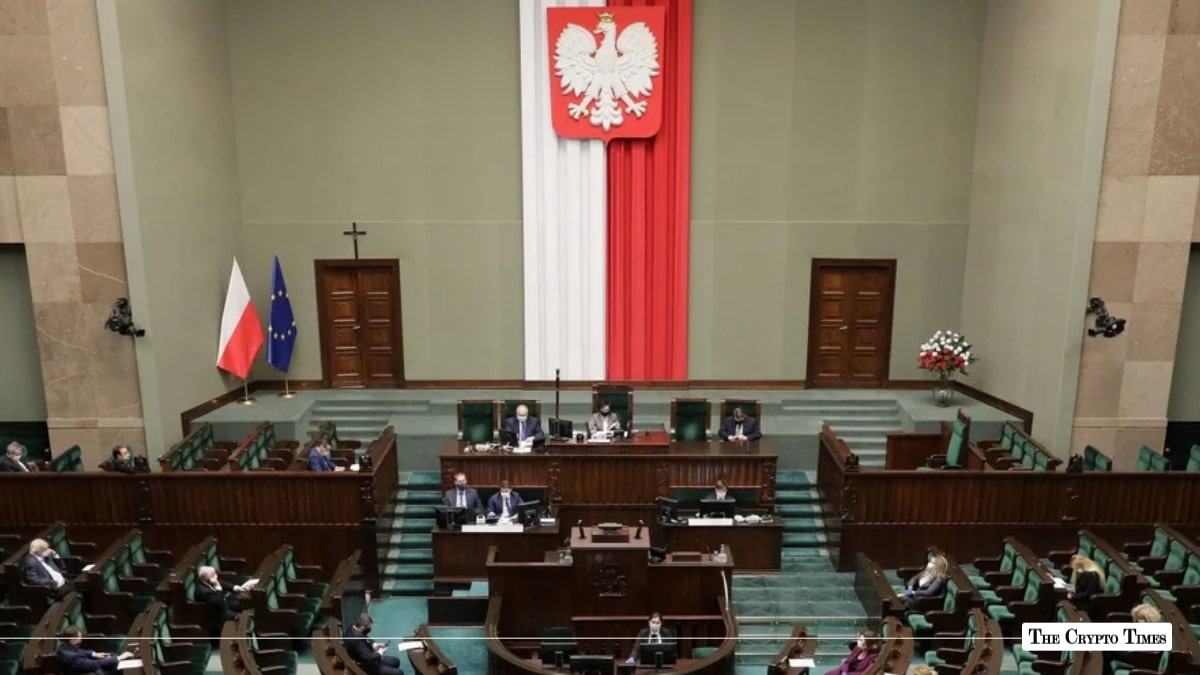
Poland’s lower house of parliament failed on Friday to overturn President Karol Nawrocki’s veto of legislation aimed at regulating the country’s cryptocurrency market, leaving the bill blocked after lawmakers failed to secure the required three-fifths majority.
According to a local report, the Sejm, officially the Sejm of the Republic of Poland: the lower house of the bicameral parliament of Poland, needed 266 votes, representing three-fifths of the 442 lawmakers present, to override the veto. A total of 241 lawmakers voted in favor of overturning it, 198 voted against and three abstained.
Crypto regulation bill remains blocked
The vote was the latest attempt by lawmakers to push through legislation regulating digital assets after Nawrocki had vetoed two earlier versions of similar legislation.
The president has argued that the proposed framework would place excessive regulatory burdens on the crypto industry and could encourage Polish companies to move their operations abroad.
The legislation was designed in part to bring Poland’s crypto market into line with the European Union’s Markets in Crypto-Assets Regulation (MiCA) and establish a domestic framework for supervising crypto-asset activities.
Under the proposed Polish framework, the country’s Financial Supervision Authority (KNF, Komisja Nadzoru Finansowego) would oversee the crypto market and gain powers to block accounts or suspend transactions for up to 96 hours, with certain restrictions capable of being extended for longer periods.
The bill would also allow the KNF to impose financial penalties on crypto-asset issuers, service providers and other regulated entities. Proposed supervisory fees were capped at 0.4% for crypto-asset service providers and up to 0.5% for certain token issuers.
Vote comes amid Zondacrypto scandal
The parliamentary vote comes as Poland faces growing concerns over the collapse of Zondacrypto, a major cryptocurrency exchange in the country.
The investigation concerns reported losses exceeding 350 million zlotys ($80 million), according to local reports.
The case also involves prominent figures. On August 27, Polish Olympic Committee President Radosław Piesiewicz was detained in Warsaw as part of the Zondacrypto investigation.
Prosecutors are examining his alleged links to Zondacrypto chief Przemysław Kral, including allegations that Piesiewicz received benefits such as a €40,000 Patek Philippe watch.
Piesiewicz has not been convicted, and prosecutors had not announced formal charges at the time of his detention. His detention and the investigation do not establish criminal liability.
Political debate over the Zondacrypto case has also featured in discussions surrounding the stalled legislation, with government officials arguing that stronger regulation is needed.
MiCA adds pressure for regulatory clarity
The failed override leaves Poland without the proposed domestic framework for implementing its crypto-asset supervisory regime, while the country remains subject to the EU’s MiCA framework.
The proposed legislation would have formally expanded the KNF’s role in overseeing crypto-asset service providers and established procedures for authorization and enforcement under the national framework.
The KNF has previously warned that the absence of a domestic framework could affect the ability of Polish crypto firms to obtain the authorisations required under EU rules.
What happens next
With the Sejm unable to secure the required 266 votes, President Nawrocki’s veto remains in place and the legislation will not take effect in its current form.
The failed vote leaves Poland’s lawmakers facing the task of determining how to establish a domestic crypto-asset supervisory framework while addressing the regulatory concerns raised by the president.
Also Read: National Sheriffs’ Association Takes Neutral Position on CLARITY Act