Bitcoin’s late-August rebound has pulled the wider digital-asset market out of a summer slump, lifting the largest coin back above $80,000 with a brief print over $81,000 and dragging ether (ETH), Solana (SOL) and several large-cap cryptocurrency higher with it.
The move looks explosive on a weekly chart. It is less mysterious once the buyers are identified. Spot exchange-traded funds (ETFs), short covering, and a shift in liquidity expectations did more of the work than a classic retail rush.
As of Thursday morning (7:00 AM UTC), Bitcoin was holding near the high $78,000s to low $79,000s after giving back the $81,000 spike, as per Coingecko data. Ether has been trading around $2,450 to $2,500 at the same time. Combined crypto market value has hovered near $2.65 trillion to $2.7 trillion.
Though these levels still sit well below last October’s cycle peak near $126,000 for BTC—as noted by Coingecko—they mark the first return to mid-May territory and the strongest weekly advance in months.
A compressed range finally broke
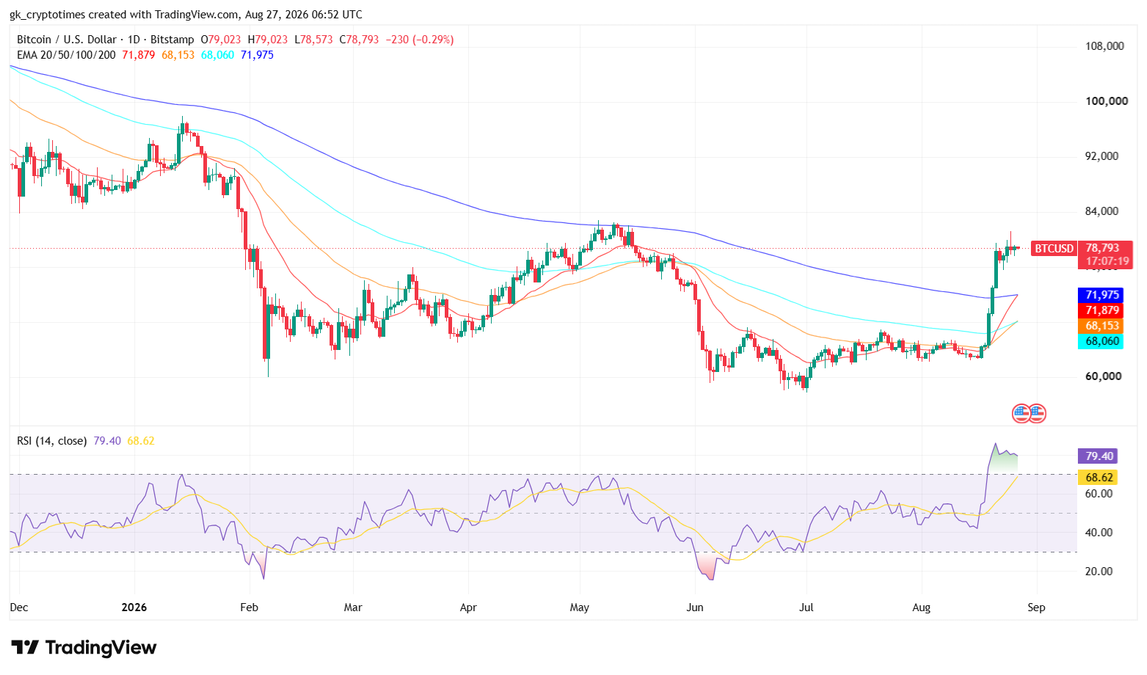
For much of June, July and the first half of August, Bitcoin spent its time grinding between roughly $60,000 and $67,000. Volatility compressed. Weekend ranges shrank. The market had the feel of a coiled spring that traders had already written off as another failed summer bounce. That changed in the week of August 17.
The Year-to-date (YTD) Bitcoin chart from TradingView shows that price jumped from the low $60,000s through $70,000 and then $80,000 in a matter of sessions. Weekly gains for Bitcoin landed around 23%.
For the broader crypto market, the Bitcoin rally brought wider gains. Ether’s weekly advance was even larger, near 29% at points. Solana and other majors participated, though several names faded once profit-taking set in midweek. The pattern was familiar: a slow grind, a violent squeeze, then a pause as traders locked in gains.
The technical break mattered because it forced two groups into the market at once. Momentum accounts that had been waiting for a close above the summer ceiling had to chase. Speculators who had sold the range had to cover. Liquidations of short positions added fuel on the way through $70,000 and again near $80,000. Those mechanics explain the speed of the move. They do not, by themselves, explain why the bid was held after the first squeeze.
Context still hangs over the rally. Bitcoin remains roughly a third below its October 2025 high. Year-to-date performance is still negative for many holders who bought the last peak.
August’s strength is a recovery inside a difficult year, not a new all-time-high campaign. That distinction is easy to lose when a seven-day candle looks this large.
The bid came through the funds
The simplest way to test the “retail only” story is to look at creations in the U.S. spot bitcoin products. Those funds do not capture every buyer, but they are the main regulated pipe for advisors, asset managers, and other professional accounts.
That pipe opened wide. The week ending August 21 brought about $1.92 billion of net inflows into U.S. spot bitcoin ETFs, as recorded by SoSoValue, the strongest week since October 2025. Spot ether ETFs added hundreds of millions in the same stretch, including a weekly total near $697 million. Daily prints stayed heavy after that: more than $300 million on both August 24 and August 25, with BlackRock’s IBIT taking the majority of Bitcoin demand on several of those days.
That is not the signature of a crowd discovering Bitcoin on a phone app. Authorized participants create shares when professional demand exceeds redemptions. IBIT’s dominance is itself a clue: the largest, most liquid product is the one institutions and model portfolios tend to use. Fidelity’s FBTC has been the usual second ticket. Smaller issuers participated, but the flow concentration at the top two funds is the opposite of a fragmented retail scramble.
The year-to-date ledger still complicates the victory lap. As shown in SoSoValue recorded data, Bitcoin ETFs spent much of 2026 in net outflow before this rebound. August is recovering ground that was lost earlier, not rewriting the full-year tape. Even so, the timing is unambiguous. The funds were buying into and through the breakout, not standing aside while small wallets did all the work.
Filing data from earlier in the year already hinted at a split in behavior. In the second quarter, reported institutional holdings inside the ETF complex rose even as total fund holdings fell, a sign that smaller investors were the ones redeeming while larger accounts added.
In a July 2026 report, market maker Wintermute noted that hedge funds and asset managers have also accounted for a larger share of over-the-counter spot volume than in prior cycles. The August tape fits that structure: professional capital using listed products, not a 2017-style search-spike mania.
The corporate giant sat this one out
If there is a grain of truth in the “no major institution” claim, it is a narrower one. Strategy, the public company formerly known as MicroStrategy and still the largest corporate holder of Bitcoin, did not add coins during the breakout week.
Recent disclosures of August 24 put its stack near 840,447 BTC at an average cost around $75,400. The firm has been raising cash through share sales, building dollar reserves and, earlier in the summer, selling modest amounts of bitcoin rather than buying the dip in size.
That absence is notable because Strategy has been the loudest corporate buyer of the cycle. When it stops stacking, commentators often treat the entire institutional complex as missing. The ETF numbers show why that leap is wrong. A single treasury company can pause without the regulated fund complex pausing with it. In this case the funds accelerated as Strategy stood still.
Macro headlines helped both groups of traders justify the risk. The U.S. Treasury’s decision to increase longer-term securities purchases fed a broader “liquidity and debasement” narrative that also supported gold at points this year. Talk of clearer digital-asset rules in Washington added a second layer of optimism. Neither catalyst required retail FOMO to move the price. Both gave allocators a reason to stop waiting for a lower print.
Read: Trump Urges Congress to Pass CLARITY Act at White House Meeting
Whales and smaller wallets did not move in lockstep either. As noted by analyst Amr Taha, on-chain cohort data through 2026 has often shown large holders accumulating while the smallest address bands are distributed. That pattern is the reverse of a retail-led melt-up. It is closer to a transfer of coins from tired small holders to better-capitalized accounts — with ETFs acting as the visible wrapper for much of that demand.
Ether joined, then the market caught its breath
Bitcoin did not rally in isolation. Ether’s weekly percentage gain outpaced Bitcoin’s at several points, and U.S. spot ether ETFs posted their best week of 2026 alongside the bitcoin products. As mentioned above, BlackRock’s ether funds led a large share of that demand.
Market data from Coingecko also shows that Solana, BNB and other large caps rose with the beta, then split: some names kept grinding, others slipped 2 to 4% as traders booked the week’s profits. Crypto’s total market capitalization pushed toward $2.7 trillion before easing.
That breadth is typical of a risk-on impulse, not proof that every token has its own independent bid. Academic work finds that when Bitcoin breaks a multi-month range and ETF volumes triple, high-beta coins usually follow. The follow-through that matters for durability is whether Ether and Bitcoin funds keep seeing creations after the first squeeze fades. One strong week can be positioning. Several weeks of inflows would look more like allocation.
Although risks are still sitting in plain sight. The market just traveled a long way in a short time. Funding and open interest rose with price. A hotter inflation print or a hawkish tone from policymakers can still knock leveraged longs over. ETF flows can reverse as quickly as they arrived; 2026 already demonstrated that.
Strategy’s decision to prioritize cash over new Bitcoin purchases removes one familiar bid. And the structural problem of the year has not vanished: if retail remains a net seller and institutions only buy in bursts, rallies can stall when the funds take a week off.
For now the evidence cuts against the simplest story. Bitcoin’s latest leg higher was not a ghost rally with empty order books and no professional participation. It was a range break amplified by shorts, supported by the largest regulated bitcoin products in the United States, and echoed across ether funds and the rest of the complex. Retail still trades and is not the whole tape. The buyers who showed up in mid-August arrived mainly through the front door Wall Street built in 2024 — and they arrived in size.
Also read: Bitcoin’s First Quantum-Safe Transaction Is Live on Mainnet, No Soft Fork Needed