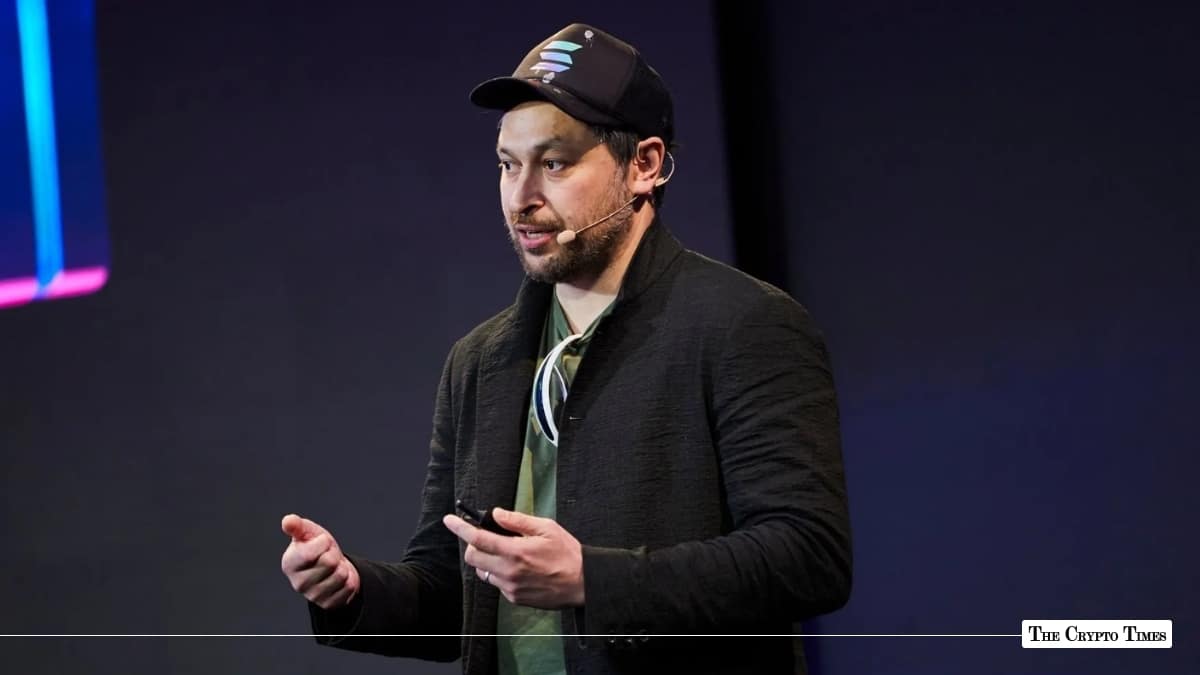
Solana co-founder Anatoly Yakovenko has publicly criticized the fee model behind Robinhood Chain, arguing that the brokerage’s decision to earn revenue from network congestion is a flawed business approach after the chain’s average transaction cost climbed to about $0.40.
The Solana Labs chief executive said in a series of posts on X, between September 3 and September 4, 2026, that a frontend brokerage should charge users a spread inside its own application rather than profit from base-layer gas that rises for every wallet on the network when blocks are full. Robinhood had not issued a public reply to the remarks at the time of publication.
What Yakovenko Said
Yakovenko’s first remark came on Thursday, September 3, 2026, at 16:05 Coordinated Universal Time (UTC) as a reply to a clip from The Chopping Block, a crypto podcast hosted by journalist Laura Shin. The clip revisited a rumor about whether Robinhood almost launched its Layer 2 (L2) network on Solana before ultimately choosing the Arbitrum stack.
Anatoly Yakovenko argued that relying on global chain congestion for revenue is a flawed business model and expressed hope that his competitors continue to believe it works.
The parent post from The Chopping Block at 15:27 UTC quoted Shin on a rumor that “Robinhood Chain almost went with Solana and switched to Arbitrum at the last minute.” Guest Tarun Chitra said both foundations had been public during what looked like a bake-off, while Shin noted that Arbitrum’s A.J. Warner did not confirm a late switch away from Solana.
On Friday, September 4, 2026, at 18:35 UTC, Yakovenko quoted a post claiming that the Robinhood Chain average fee had surged to $0.40. “What’s funny is that the 10 rev share to arb would have covered the Solana tx fees 4 times over and rh could have given a totally gas less experience to users,” he wrote, referring to Robinhood by the initials rh and to Arbitrum as arb.
The post he quoted, published at 08:44 UTC on September 4, said Robinhood Chain’s average transaction fee had climbed to over 100 times that of Solana and more than double that of Ethereum.
Later on September 4, Gnosis co-founder Martin Köppelmann replied that Yakovenko’s point amounted to saying Robinhood “could have offered it for free; instead, they are making money,” adding that he was not sure how convincing that argument would be to the brokerage.
Yakovenko responded at 22:49 UTC: “Why wouldn’t they make money from the app? Front ends charge 50-80 bips. Making money from global congestion is brain dead.”
Fifty to 80 basis points, commonly abbreviated as bips or bps, equals 0.50 to 0.80% of trade notional. It is a frontend take rate on the swap itself, separate from the underlying network gas fee.
The $0.40 Average and How It Rose
The $0.40 headline figure matches an onchain research investigation published earlier the same week. According to a September 4 study by Bitquery, an onchain analytics firm, the average Robinhood Chain transaction cost rose from about $0.007 on August 22, 2026, to $0.41 by September 3. The median, or typical, transaction rose from $0.006 to $0.20 across the same window, while the priciest one in 100 transactions rose from $0.05 to $3.46.
Total network gas on Robinhood Chain also climbed sharply into early September. Fee dashboards maintained by DefiLlama, a decentralized finance data platform, have shown 24-hour chain gas moving into the multi-million-dollar range around this period. Because such dashboards refresh continuously, the exact totals shift with each snapshot rather than reflecting a single official figure from Robinhood.
The Crypto Times previously reported that Robinhood Chain generated a record $3.8 million in daily fee revenue on September 1, 2026, and had reached a 30-day moving average annualized run rate of $127 million on the network.
The 10% Arbitrum Ecosystem Share
Robinhood Chain went live on public mainnet on July 1, 2026, as an Ethereum Layer 2 built on the Arbitrum Orbit technology stack, with the ether (ETH) token as its native gas asset.
According to the ArbitrumDAO factsheet for the launch hosted on the Arbitrum Foundation forum, the chain returns 10% of protocol net revenue under the Arbitrum Expansion Program (AEP) license. The same factsheet says 8% flows to the ArbitrumDAO treasury and 2 to the Arbitrum Developer Guild.
Yakovenko’s argument, which he did not accompany with a published line-by-line cost model, is that redirecting the 10% outflow toward Solana execution would more than cover Solana-side gas and still allow Robinhood to zero out user fees on its interface.
What Robinhood Wallet Users Actually Pay
Many end users on Robinhood’s own interface are not currently paying the sticker gas price on the chain. The Robinhood Help Center states that network fees on eligible Robinhood Chain swaps inside the self-custody Robinhood Wallet are covered from chain launch through 11:59 p.m. Eastern Standard Time (EST) on September 29, 2026.
The offer applies to crypto and Stock Token swaps on Robinhood Chain through the in-app swap flow for swaps above $0.50, and also covers one-time ERC-20 token approval fees on a first swap.
Wallet-to-wallet transfers, bridges off Robinhood Chain, dapp-browser transactions, activity on other networks, and third-party wallets are not covered under the promotion. The help page also says the operator, Robinhood Non-Custodial, Ltd., can modify or end the offer without notice.
That distinction matters when reading a fee dashboard. Onchain fee charts measure the gas paid at the protocol level. They do not indicate whether the end user, the brokerage, or an automated wallet ultimately covered the cost.
Solana Fees for Comparison
Independent Solana fee samples from the same window sit far below Robinhood Chain’s averages. A publicly available Dune Analytics query tracking daily Solana fees showed the median non-vote transaction fee near $0.00055 across September 1 to September 4, 2026, with the daily average between roughly $0.003 and $0.005 depending on the day.
A $0.40 average on Robinhood Chain therefore sits on the order of 70 to 140 times those daily Solana averages, depending on the day and methodology. The “over 100 times Solana” phrasing used in the post Yakovenko quoted is a rounded comparison rather than a single official ratio.
The Broader Backdrop
Robinhood Chain launched alongside tokenized United States equities, wallet funding via Apple Pay and Google Pay, and a 90-day network fee subsidy on eligible swaps, according to the company’s own July 1, 2026 announcement on X. Since launch, network activity on the chain has been concentrated in decentralized exchanges and memecoin launchpads such as Pons, alongside tokenized-stock trading through the wallet interface.
Yakovenko did not release an audited comparison of Solana priority fees, tips, and failed-transaction retries against Robinhood Chain’s mix of transfers and router swaps. He also did not say the network is shutting down, and no public partnership offer from the Solana Foundation to Robinhood has been disclosed.
The Chopping Block segment that prompted the initial post treated the “almost built on Solana” account as a rumor, with Shin noting that Warner did not confirm it.
For now, Robinhood has not commented publicly on Yakovenko’s remarks, and the Robinhood Wallet fee coverage remains scheduled to run through September 29, 2026, unless the company changes those terms.
Also Read: AMC CEO Adam Aron Demands Robinhood Stop Trading its Stock Tokens