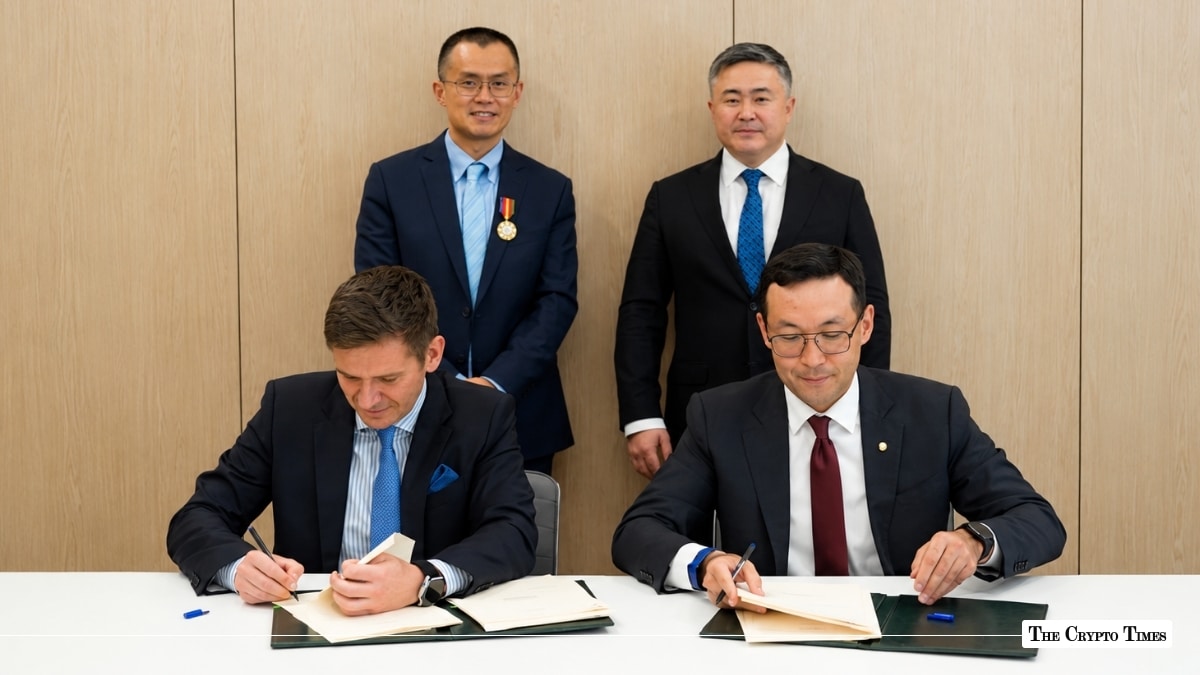
Kazakhstan’s National Bank has signed a memorandum of understanding (MoU) with Binance, under which the crypto exchange plans to apply for a Category 1 payment service provider licence in Kazakhstan.
In a LinkedIn post, Binur Zhalenov, Deputy Chairman of the National Bank of Kazakhstan, announced the agreement on September 4, describing it as a step that could help extend Kazakhstan’s payment infrastructure beyond the country’s borders. The MoU was one of three agreements involving Binance signed in Kazakhstan on September 4.
The others were with the Ministry of Artificial Intelligence and Digital Development and the Astana International Financial Centre (AIFC). The agreements are memoranda of understanding and do not themselves grant Binance a new licence. Binance has said it intends to apply for the Category 1 authorization.
What the MoU and New Licence Could Enable
The agreement centers on Kazakhstan’s Category 1 Payment Service Provider framework. The category is designed for non-bank payment providers and allows them to offer a broad range of payment services without accepting customer deposits or issuing loans. The framework also provides a mechanism for connecting digital assets with conventional money through regulated payment services.
Binance said it intends to apply for the licence under the new framework. Any authorization would remain subject to the applicable regulatory process. The discussions also included the potential issuance of a local stablecoin in Kazakhstan. However, no stablecoin has been announced or launched under the agreement, leaving the proposal at an early discussion stage.
The related MoU with Kazakhstan’s Ministry of Artificial Intelligence and Digital Development covers cooperation on digital assets, digital and computing infrastructure, payment solutions, potential stablecoin issuance, and legal and tax approaches to the sector.
Kazakhstan’s Hybrid Finance Approach
Zhalenov described the initiative as part of a broader “hybrid” financial model in which tokenized assets, stablecoins, payment providers and banks operate within the same financial system. He stated that tokenizing an asset is only part of the process if its payment and settlement remain separate from the blockchain-based system.
Zhalenov also pointed to the complementary roles of Kazakhstan’s domestic regulatory framework and the AIFC’s common-law framework. He presented the country’s payment reforms as infrastructure that could potentially be adapted for use in other markets.
Binance’s Regional Ambitions
Zhalenov said the proposed model could allow Binance to use Kazakhstan as a base for serving markets across the Commonwealth of Independent States (CIS) and beyond. That regional expansion remains subject to regulatory approvals in individual jurisdictions. The Kazakhstan MoU does not itself authorize Binance to provide payment services across other countries.
The arrangement therefore represents a potential expansion of Binance’s regulated activities in Kazakhstan rather than a completed regional payments rollout.
Binance’s Kazakhstan Presence and Regulatory Relationship
The new agreement builds on Binance’s existing regulatory presence in Kazakhstan. Binance Kazakhstan obtained a full Digital Asset Trading Facility licence from the Astana Financial Services Authority (AFSA) in September 2024, allowing the company to operate a regulated digital-asset trading platform and provide related brokerage and custody services.
Kazakhstan has also explored blockchain-based financial infrastructure through its Digital Tenge central bank digital currency initiative, including a pilot involving the BNB Chain network. The latest MoU extends the relationship into payment infrastructure, although any new services would require the relevant regulatory approvals.
The agreement also comes as Binance continues to develop regulated operations in international markets. Binance co-founder Changpeng “CZ” Zhao amplified Zhalenov’s announcement on X, but he did not sign the Kazakhstan MoU. Binance CEO Richard Teng continues to lead the exchange, while the Kazakhstan agreement was signed by Zhalenov and Binance’s regional representatives.
Zhao stepped down as Binance CEO in 2023 and was later pardoned by U.S. President Donald Trump in October 2025. That history provides broader regulatory context for Binance’s international expansion, although it does not change the status of the Kazakhstan agreement.
What Happens Next
The immediate next step is Binance’s potential application for the Category 1 payment service provider licence. The MoU itself does not constitute regulatory approval, and Binance has not yet been granted the new authorization. The potential stablecoin remains at the discussion stage, while any plans to serve customers in other countries would require separate regulatory approvals.
The Crypto Times will continue to track Binance’s licence application and any subsequent decisions by Kazakhstan’s regulators.
Also Read: Polymarket Launches Perps With Up to 20x Leverage for Global Traders