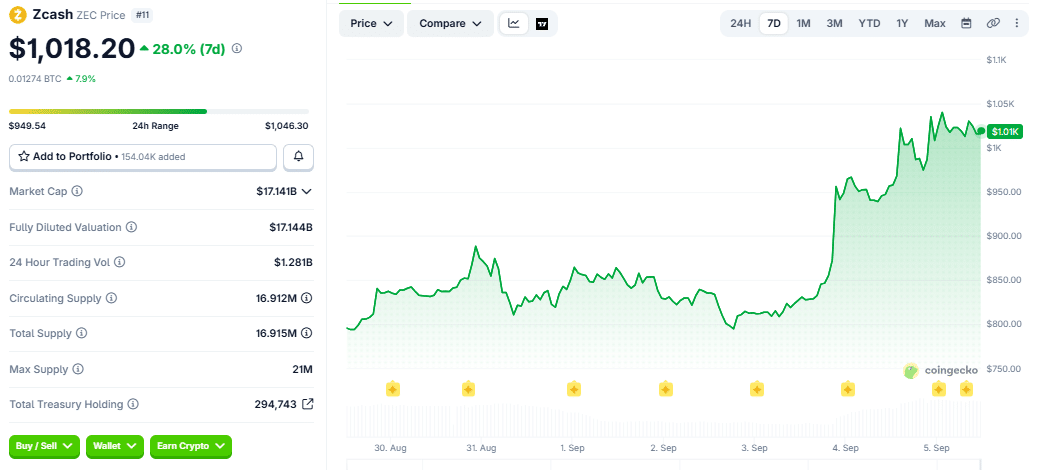
Zcash, the privacy-focused cryptocurrency, extended a strong rally over the past week, with its native token ZEC climbing roughly 28% to break above $1,000 for the first time. As of a CoinGecko snapshot on September 5, 2026 around 06:08 UTC, ZEC traded at about $1,018.20, up 28% over seven days and 7.9% against Bitcoin, within a 24-hour range of $949.54 to $1,046.30. Its market capitalization stood near $17.14 billion on 24-hour volume of about $1.28 billion, ranking it around the eleventh-largest cryptocurrency — according to CoinGecko’s ranking at the time of the snapshot.
The token crossed the $1,000 mark for the first time in nearly a decade on September 4, briefly trading above $1,020 before pulling back. Historical price data on CoinGecko shows ZEC reached roughly $1,023 during the move. The milestone caps a gain of roughly 94% over the past month and more than 2,300% over the past year. The token was trading around $40 a year ago and near $200 in March, based on the same historical market data.
Grayscale’s Zcash ETF Adds to Demand
The launch and subsequent inflows into Grayscale’s spot Zcash ETF have been one factor supporting the rally. The asset manager converted its long-running Zcash Trust, worth roughly $304 million, into an exchange-traded fund trading under the ticker ZCSH on NYSE Arca, which listed on August 25, 2026 with Coinbase Custody holding the underlying coins. It is a U.S.-listed exchange-traded product providing direct exposure to ZEC, giving investors a regulated, brokerage-account route to the token without holding it directly.
The fund has drawn inflows since launch. Grayscale reported about $414.7 million in assets under management as of September 3,
Grayscale has also actively framed the move. In posts on X, the firm attributed ZEC’s surge to a new phase of price discovery, pointing to Zcash’s 21-million-coin capped supply, a “hard money” comparison to Bitcoin, and to growing demand for financial privacy. Grayscale’s head of research, Zach Pandl, has gone further, outlining a scenario in which ZEC could reach around $8,100 if it captured 10% of Bitcoin’s market value. That figure is Grayscale’s own projection, not a forecast by The Crypto Times, and it is a hypothetical scenario rather than a target.
Privacy Narrative and Institutional Accumulation
The Zcash rally has also coincided with renewed attention on financial privacy. Grayscale has argued that advances in artificial intelligence could make it easier to connect blockchain addresses with external information, potentially increasing demand for technologies designed to protect financial transaction data.
Institutional accumulation has also been a defining feature of the 2026 run. Cypherpunk Technologies reported holding 323,394.38 ZEC as of August 11, representing about 1.92% of Zcash’s circulating supply. The company’s SEC filing identifies Zcash accumulation as a central part of its strategy. (SEC)
Other tracked entities also hold ZEC, although the scale varies substantially by holder. DeFiLlama’s Zcash treasury tracker listed three institutions with a combined 323,483.3 ZEC when checked for this report.
Derivatives Activity Add to the Move
The move has also been accompanied by heavy derivatives activity. ZEC open interest climbed to a record near $2.15 billion, according to recent market reporting, while roughly $34.5 million in short positions were liquidated during Friday’s advance, as per CoinGlass data.
The scale of the short liquidations provides evidence that derivatives positioning amplified the move, although it does not by itself establish that derivatives were the primary source of demand.
The rally has also taken place against a broader recovery across crypto markets. Bitcoin was trading around $80,000 during the period covered by the original report, according to market data, but that figure is not a direct catalyst for ZEC and is therefore not central to the move.
From a June Crash to a Nearly Decade-High
The rally is even more striking given where Zcash was three months ago. In June, developers disclosed a critical counterfeiting vulnerability in Zcash’s Orchard shielded pool, prompting emergency remediation and a sharp sell-off. The disclosure did not establish that the vulnerability had been exploited.
The Crypto Times covered the network’s Ironwood remediation plan, which was designed to address the affected shielded pool and strengthen supply verification.
Zcash’s recovery from that episode to its highest sustained price in nearly a decade underscores both the strength of the current bid and the volatility that has characterized the token throughout.
The Bull Case, and the Caveats
The constructive case is straightforward: a first-of-its-kind regulated ETF, a scarce, and capped supply, and a privacy thesis gaining institutional attention at a moment of heightened concern about surveillance. But several risks temper the enthusiasm. The rally has leaned heavily on leverage and derivatives rather than spot demand alone, and technical readings had pushed into overbought territory, conditions that can reverse quickly, as ZEC’s own history shows. The scale of the run itself, more than 2,000% in a year, also leaves the token vulnerable to sharp corrections if momentum weakens.
Privacy coins also carry a distinct regulatory overhang: they have faced exchange delistings in various jurisdictions over compliance concerns, a risk that has not disappeared. And Grayscale’s $8,100 scenario is a conditional projection, not a promise. The Crypto Times makes no price forecast; the outlook figures cited here belong to the analysts and firms that issued them.
Also read: What Is Zcash? How the Leading Privacy Coin Works and Why It Matters in 2026