
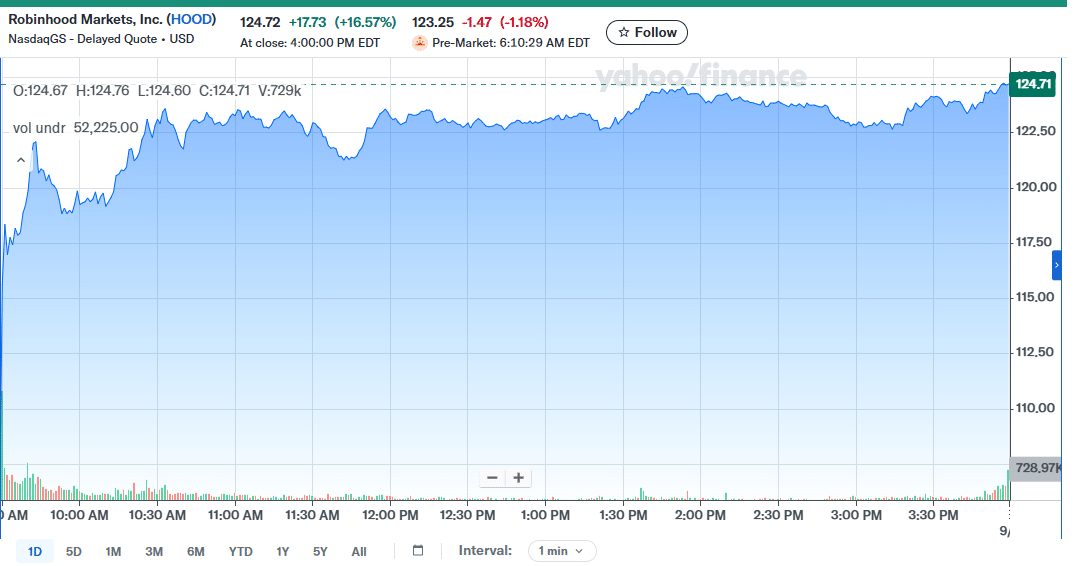
Shares of Robinhood Markets rose 16.57% to $124.72 at the September 3 close at 4:00 p.m. EDT, gaining $17.73 from the previous close of $106.99. The move came as several Wall Street analysts highlighted Robinhood’s prediction-markets business and broader product expansion. A recent revenue milestone on Robinhood Chain also added to the company’s crypto-related developments.
The stock remains below its 52-week high of approximately $153.86 as per YahooFinance data. The September 3 move therefore represents a significant one-day gain, but does not by itself establish a change in Robinhood’s longer-term valuation or operating outlook.
Prediction Markets Draw Wall Street Attention
A major focus of recent analyst commentary has been Robinhood’s prediction-markets business, which offers event contracts tied to sports, elections and other outcomes.
In a September 3 client note, Deutsche Bank analyst Brian Bedell said contracts linked to companies’ financial key performance indicators could eventually become the largest category within Robinhood’s event-contract business. He projected that U.S. company-KPI contract volume could exceed $1 trillion by 2028, compared with negligible activity today. That figure is an analyst estimate rather than a confirmed market outcome.
Piper Sandler analyst Patrick Moley also pointed to the upcoming NFL and NCAA football seasons as potential sources of additional prediction-market activity following strong engagement around the 2026 FIFA World Cup. Moley maintained a $145 price target for Robinhood.
Robinhood’s reported results provide some evidence that the prediction-markets business is already becoming financially significant. The company generated approximately $156 million in prediction-market revenue during the second quarter, according to The Crypto Times’ previous coverage.
The growth outlook nevertheless depends on user adoption, contract volumes, and the regulatory environment surrounding event contracts.
Robinhood Chain Records Revenue Milestone
Robinhood’s blockchain strategy has provided another area of investor attention. Robinhood Chain, the company’s Ethereum layer-2 network, recorded more than $3.8 million in network revenue on September 1, according to Messari data. The figure placed Robinhood Chain first among blockchains globally by network revenue that day, with the network accounting for roughly 38% of the total measured revenue.
The metric should not be confused with Robinhood Markets’ corporate revenue. Network revenue is a blockchain-level measure and does not represent the amount Robinhood reported as company revenue.
Robinhood Chain launched its public mainnet on July 1, 2026, and is built using Arbitrum technology with ETH used to pay transaction fees. The network is designed to support Robinhood’s broader push into tokenized assets and on-chain financial activity.
The Crypto Times’ Robinhood Chain explainer provides additional background on the network and its architecture.
Network Activity Is Not Limited to Tokenized Stocks
The Chain’s activity also illustrates a distinction between its current usage and Robinhood’s longer-term tokenization strategy. A significant portion of the network’s activity has come from memecoins, including CASHCAT, rather than tokenized equities. The Crypto Times examined that dynamic in its analysis of the Robinhood Chain and its memecoin activity.
Robinhood’s tokenized stock products also have specific legal and geographic limitations. The company’s Stock Tokens provide economic exposure to the price of underlying securities but do not provide the legal ownership or shareholder rights associated with the underlying stocks. The products are also not available to U.S. persons.
That distinction is important as Robinhood expands its blockchain infrastructure: higher on-chain activity does not necessarily mean that tokenized-equity adoption is driving all of the network’s current usage.
Multiple Analyst Targets Move Higher
The September 3 rally followed several positive analyst developments.
Morgan Stanley upgraded Robinhood to Overweight on September 1 and raised its price target to $150 from $124. The firm cited the potential for Robinhood’s expanding product range, including prediction markets, retirement products, banking and digital assets, to increase revenue per customer.
Scotiabank initiated coverage with a Sector Outperform rating and a $136 price target, while Bernstein maintained an Outperform rating with a $160 target, shared via a client note. Piper Sandler maintained its $145 target.
These targets represent individual analysts’ expectations and should not be interpreted as guaranteed future prices or as a forecast from The Crypto Times.
Robinhood’s Latest Results Provide the Operating Context
The analyst optimism comes against a backdrop of reported growth in Robinhood’s broader business. For the second quarter of 2026, Robinhood reported approximately $1.31 billion in revenue, up about 32% year over year, and $573 million in net income. The company also reported approximately 28.4 million funded customers. Prediction-market revenue reached about $156 million, while Robinhood’s crypto transaction-based revenue declined 38% year over year to $100 million, according to the company’s Q2 2026 results.
The quarter’s net income also included gains associated with the deconsolidation of Robinhood Ventures Fund I, meaning the headline net-income figure should be considered alongside the company’s operating metrics when assessing the quarter.
Prediction Markets and Tokenization Face Regulatory Questions
Some of the growth scenarios cited by analysts remain dependent on regulatory developments. Prediction markets have faced increasing scrutiny as financial exchanges and regulators consider how event contracts should be classified and overseen, particularly when contracts involve sports or other outcomes.
Robinhood’s tokenized-equity strategy also depends on the regulatory framework governing digital representations of securities across different jurisdictions.
For Robinhood, this means the potential contribution from prediction markets and tokenized assets depends not only on demand but also on the products the company is permitted to offer and the markets in which they can operate.
What the September 3 Move Shows
Robinhood’s September 3 rally brought several parts of its growth strategy into focus at the same time: prediction markets are attracting increased analyst attention, Robinhood Chain has recorded substantial network activity, and the company’s latest financial results show continued growth across multiple product lines.
At the same time, the data points should be considered separately. Analyst projections are estimates. Blockchain network revenue is not the same as Robinhood corporate revenue. And a single trading session does not establish the long-term direction of the stock. The company also faces regulatory, adoption, and execution risks as it expands into prediction markets, tokenized assets and blockchain infrastructure.
Robinhood is scheduled to hold its HOOD Summit on September 29–30, which investors may watch for updates on the company’s product and growth strategy. The Crypto Times makes no market or price forecast for Robinhood Markets or any other company mentioned in this article.
Also Read: Coinbase (COIN) Stock Jumps 10% After Filing for US Single-Stock Perps