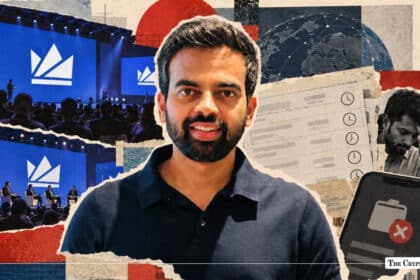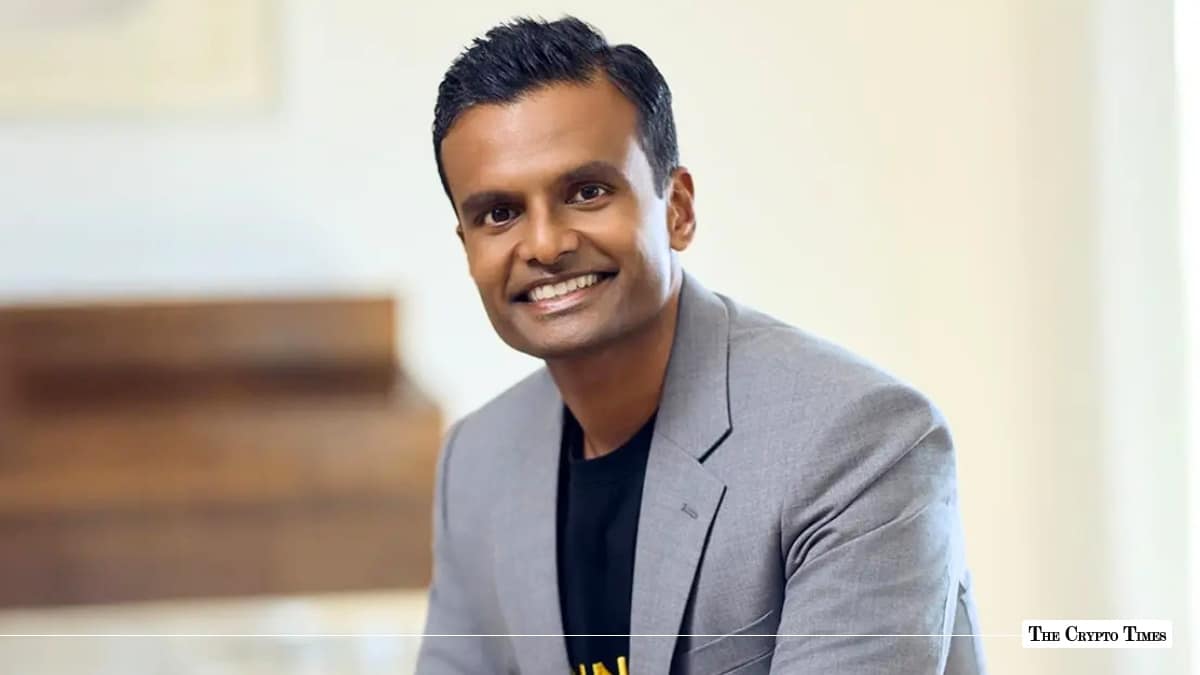
When SB Seker talks about financial regulation, he does so as someone who has sat on both sides of the table. Before he became Binance’s Head of Asia-Pacific in September 2025, he spent the early part of a two-decade career as a litigator in Australia and then as a central-banking lawyer at the Monetary Authority of Singapore, with later senior legal stints at Ant Group, Rothschild & Co and Amicorp before an executive run at Crypto.com. That résumé — regulator, then builder — shapes how he reads the region he now oversees, one that stretches, in his words, from Japan down to Australia and across to Central and South Asia.
It also makes him an unusually candid interlocutor on the market The Crypto Times pressed him hardest on: India. Binance’s history in the country is complicated, a period offline, a return, and a long effort to satisfy the Financial Intelligence Unit, and Seker did not dodge it. Over the course of a wide-ranging conversation, he made the case for a rupee stablecoin, diagnosed the dollar premium that has dogged Indian traders, weighed private stablecoins against the digital rupee, and set out what he says are the pillars of rebuilding regulator trust.
From the regulator’s chair to “the other 80%”
Asked what pulled him from enforcement and regulation into building inside the crypto industry, a question he said no one had put to him before, Seker described a realization that shaped his career. “As a regulator,” he said, “you see about 20%. You see the tip of the iceberg, and unless and until you get involved in the actual business, commercial business, you don’t ever see the other 80%.” Supervisors, he noted, concentrate their resources on the systemically important institutions and lean on checklists.
“In some respects, because you don’t know the business, you don’t understand the business, you are dependent on their narratives and their explanation of how things actually work,” he said. “As a young regulator slash prosecutor, I found that to be insufficient. I wanted to understand how business actually works.” That curiosity, he said, carried him through banking, private banking, wealth structuring, payments, remittances, money markets and capital markets, and finally into blockchain businesses.
The case for a rupee stablecoin
Seker’s central argument on India is that the country, which he says showed the world what inclusive finance looks like with UPI, now has a comparable opportunity in stablecoins, provided the local unit is built correctly.
His starting point is that stablecoins have become the default settlement layer of digital finance. “When you’re coming out of a position and thinking of going to another position, what do you come back to as a baseline? It’s always stablecoins,” he said. “Nobody really moves back to fiat,” because of the cost and the app friction of round-tripping through the banking system. On the payments side, he pointed to merchants and treasuries already settling on stablecoin rails at scale: “the ship’s no longer in the harbor,” he said, and “the ship has truly well and truly sailed.”
The benefit of a domestic rupee stablecoin, in his framing, is that it gives Indian users that baseline in their own currency. Moving in and out of any position, he said, “it’s seamless because you have a baseline, and that baseline is a locally distributed, locally accepted, and preferably locally issued stablecoin.” The result, he added, is that “you have credibility, you have friction removed,” and “that’s what day one looks like.”
But he attached a heavy caveat: “Not all stablecoins are created equal.” A credible INR stablecoin, he argued, would need a single-currency peg, high-quality and highly liquid reserves, and a top-tier custodian, with backing he said should ideally be 1:1 rather than fractional. Above all, “your redemption rights are absolute. Your redemption rights are instantaneous,” he said, likening the right structure to a safeguarded-account model rather than a lending one. “There’s a whole bunch of requirements you would expect the government of any country to walk through when deciding which issuer are they going to put in the market,” he said, including how the issuer distributes and against whom users can redeem.
The dollar premium is structural, not a blip
That argument runs directly into a problem India has already felt. In June, a supply crunch pushed the premium on dollar-backed stablecoins in India sharply higher, an issue The Crypto Times investigated in depth, finding the gap running well above the headline figures at times. Asked whether that was a one-off or evidence of something structural, Seker said “in this case it’s probably structural,” framing it as a classic arbitrage and comparing it to Korea’s “kimchi premium.” It’s the same issue, he said: when a controlled currency meets a shortage of viable local options, demand for the offshore instrument outstrips supply. “The demand for this offshore instrument vastly exceeds the supply of that offshore instrument in the market, and that’s always going to give rise to a premium.”
Crucially, he argued the premium does not prove Indian crypto is dependent on the dollar, it reflects a preference for liquid, high-quality, freely accessible stablecoins that users currently have to reach offshore to get. Give them a credible local equivalent, he said, and “there’s no reason why the same user wouldn’t use that option locally, in fact it’s probably easier,” because moving from a rupee bank account into a rupee-backed stablecoin is far smoother. “So you can bring down the arbitrage,” he said, “but you have to be able to meet the consumer demand.”
Stablecoins, the digital rupee, and an untested question
The Reserve Bank of India has continued to champion its digital rupee while remaining cautious on private stablecoins, flagging the U.S. GENIUS Act and the EU’s MiCA in its financial stability report. Can a private INR stablecoin and a CBDC genuinely coexist, or does one crowd out the other?
Seker’s honest answer was that nobody actually knows. “We have never seen this play out,” he said. There has never been a large enough open market where “there is a healthy tension between private stablecoins and a CBDC in an open market environment without intervention to see which one comes out on top.” In China, he noted, crypto is effectively absent while the CBDC exists; in the US, the reverse is true, so there is no clean test case. His best guess is that cross-system connectivity — projects such as the BIS-backed Nexus initiative linking fast-payment systems like UPI across borders — will do much of the heavy lifting on cost and settlement time, and will sit comfortably alongside private stablecoins as the connective tissue between fiat and digital assets.
He was candid that his views here are partly philosophical. He said he is personally sympathetic to CBDCs, but flagged a real trade-off: a central-bank wallet system in which commercial banks act as distribution channels can shrink the deposits banks rely on to lend, weighing on the credit cycle. In the long run, he suggested, privacy protocols and private operators may be better suited to what he called “legitimate privacy and control over assets,” which he described as “one of the dominant themes of blockchain technologies.”
Tax before regulation, and the case for a “bundle”
On India’s 30% tax on crypto gains and 1% TDS on trades, Seker declined to litigate the rates themselves, arguing instead that clarity is what the industry and taxpayers actually want. Individuals and companies are not opposed to tax per se, he said; they want to know what they get access to in return. His preferred outcome is for taxation, licensing clarity and a defined scope for permitted innovation to arrive together “as a bundle” rather than tax landing first, in isolation, on an industry that has not yet been given a clear framework to operate within.
The SRO bet and where it breaks
Seker welcomed the Indian parliament’s interest in self-regulatory organisations, noting Binance already works with SROs in markets including Indonesia, Korea, and Japan. What an SRO gets right, he said, is agility: it operates at the coalface, close to product cycles, user preferences and emerging risks, and can “test and fail more quickly,” passing the guidelines that work up to lawmakers for longer-term codification. In a large market, he argued, an SRO also forces a fragmented industry to speak to regulators “with one voice.”
But he flagged a clear failure mode. “Where it goes wrong is when an SRO becomes an exclusionary body,” he said, a lobby dominated by local incumbents that quietly works against new entrants trying to get licensed. “It becomes an echo chamber, a preferred-player marketplace. That’s something we advocate strongly against, and we try to get a seat at the table so the doors stay open to new participants.”
RWA tokenization: India’s 18-to-24-month window
Seker has called real-world-asset tokenization one of India’s biggest opportunities, pointing to state-level moves such as Maharashtra’s pilot. What has to change for it to scale beyond pilots?
“First-mover advantage is massive in this space,” he said. Tokenizing financial assets — bonds, and to a degree gold or commodities — is comparatively straightforward, he explained; the hard part is the assets India is rich in. “Agriculture, livestock, land — these are difficult to fractionalise, and therefore difficult to make fungible, and therefore difficult to securitise. But it can be done, and getting legal certainty around these novel areas is going to be absolutely critical.”
The stakes, in his telling, are about where the value chain settles. If traditional finance hubs such as Hong Kong, Singapore or Japan crack RWA issuance at scale first, “global projects will flock there for securitisation, issuance and distribution, and the countries where the actual assets sit just become sourcing grounds.” He cited a tokenized-RWA market that has grown to roughly $33 billion from about $1 billion two years ago, and Binance data showing that around 80% of its tokenized-stock traders are from emerging markets and 93% of trades are fractional, evidence, he argued, of demand for small-ticket access to assets users previously couldn’t reach. “India has the assets, the developer pool and the technical knowledge to run the whole value chain,” he said. “That’s the opportunity — and it risks missing out in the next 18 to 24 months if we don’t put critical mass behind it.”
Rebuilding trust in India
Given Binance’s history in the country, how does he rebuild trust with Indian regulators and users at once? Seker began by pushing back on a premise. Indian regulators and law enforcement, he said, are not “any more conservative than other regulators around the world. That’s a bit of a misconception.” Rather, “they proceed cautiously and on the basis of data,” and “they bear in mind their national prerogatives and their concerns,” as they should. “A regulator’s concerns are much more multifaceted than a commercial enterprise’s,” he said. “We have the luxury of being hyper-focused, which the regulators don’t, and we respect that.”
Trust, he said, is rebuilt across several pillars. The first is sustained, direct conversation — keeping the line to India’s FIU and other bodies open, or as he put it, making sure “we keep that conversation warm,” and answering questions forthrightly. The second is Binance’s regulatory posture globally: unlike competitors whose global businesses run unlicensed while they hold only local permits, he said, Binance voluntarily secured a UAE home licence that “regulates every moving part of the business: the exchange, the order book, the matching engine, custody, settlement, clearing,” with every new product pre-submitted for approval, a setup he described as closer to traditional finance than a typical crypto exchange. Local registrations, security architecture with annual localized audits, strict data-privacy practices, and how the company responds when things go wrong round out the list.
Underpinning it, he said, is money: Binance has spent $300 million on its global compliance program since 2015, amounting to about a quarter of its expenditure. He framed the exchange’s past frictions, including with US authorities, as “learning points” that pushed it to invest far more heavily in compliance, investment he credits for its ability to keep pursuing licences across new markets.
The super-app, and a goal of 3 billion users
Binance’s half-year report framed exchanges as evolving into financial “super apps” spanning equities, tokenized stocks and payments in a single account, and noted that emerging markets make up 77% of its users. Seker said that vision is driven by both user behaviour and structural convergence. “Nobody wants to open 10 different apps. Nobody wants to do KYC 10 different times,” he said, describing the status quo of selling on one platform, moving funds to a second and hunting for lower fees on a third as “suboptimal for most users.” At a macro level, he sees Web2 giants moving into Web3 and Web3 platforms moving toward traditional instruments, converging on a whole-spectrum asset offering that will separate the largest operators from the rest.
The company now lists more than 7,000 instruments, he said, toward what he calls an “everything for everyone” marketplace — tokenized, highly fractional, small-ticket access to equities, debt, commodities and other asset classes regardless of the user’s home market. A user in Singapore, he argued, could assemble a self-directed portfolio of tokenized stocks from multiple markets without opening a brokerage account in each. Paired with low-cost crypto rails, he said, that is how Binance intends to grow from more than 300 million users today toward an ambition of over 3 billion, “close to half of all of Earth’s population.”
He tied this to the round-the-clock nature of tokenized markets. Because tokenized equities trade even while US markets are closed, he argued, retail users no longer have to wait for a late-evening APAC open to hedge or exit, and the market moves “much closer to the efficient orderly marketplace” that capital markets are meant to be.
Which APAC market moves the needle
Asked which market matters most over the next year or two, Seker named India among a short list of priorities where Binance is in “active conversation with regulators,” alongside a push to deepen its presence elsewhere in the region. He pointed to the Philippines as a market Binance has localized into with a local partner, Taiwan and Vietnam, the latter under a new joint-venture licensing framework, as markets coming online, and ongoing conversations in Malaysia and licence upgrades in Australia. He said he hoped to bring “a lot more South Asian countries” into that category, with fresh focus on the region’s team.
For a company still repairing relationships in one of the world’s largest crypto markets, the message was one of patience and localization over speed. A business looks for homogeneity first, he said, but tactically the regulatory starting position differs in every market, and, as he put it, “we need to accept that.”
Also Read: Exclusive: Coinbase Says No Other International Launch For 12 Months, India Is the Bet