Ripple CEO Brad Garlinghouse said the United States is within reach of becoming the world’s crypto capital, putting the spotlight back on Washington’s evolving approach to digital assets.
In an X post published September 3, Garlinghouse wrote that he was “proud to be in the room” and said, “Making America the crypto capital of the world is within reach — let’s finish the job.” He tagged Commodity Futures Trading Commission (CFTC) Chairman Mike Selig.
Garlinghouse’s comments come against the backdrop of ongoing discussions between U.S. policymakers and the crypto industry over how digital assets should be regulated. The broader policy debate has intensified as Congress works on market-structure legislation while federal regulators consider how existing authorities can be applied to digital assets.
CFTC Pushes Ahead as Congress Works on Crypto Rules
Selig has been involved in the administration’s broader effort to establish a clearer regulatory framework for digital assets. The CFTC has been working alongside the Securities and Exchange Commission (SEC) on digital-asset policy, with both agencies seeking to clarify the regulatory treatment of cryptocurrencies and related financial products.
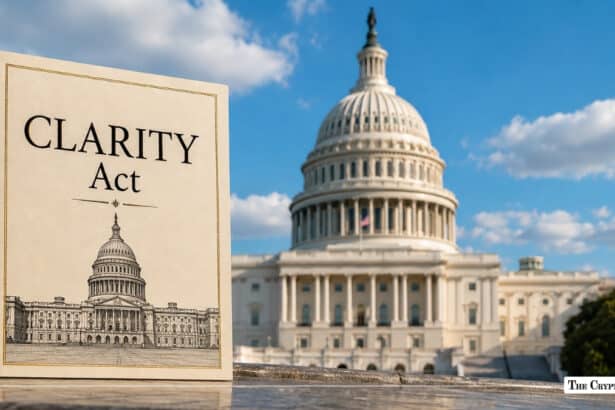
The regulatory approach matters because the division of authority between the SEC and CFTC remains one of the central questions in U.S. crypto policy. The CLARITY Act seeks to establish clearer boundaries between the agencies, including rules governing which digital assets and market activities fall under securities or commodities oversight.
The CFTC has also indicated that it can continue working within its existing authority while Congress considers broader legislation. That creates two parallel tracks for U.S. crypto policy: agency-level changes that can be implemented through regulation and a congressional process that could establish a longer-lasting statutory framework. For Garlinghouse and Ripple, the issue has particular significance following years of regulatory litigation involving the SEC and XRP.
Read more: SEC Filing Says Ripple Could Unlock More XRP if CLARITY Act Passes
CLARITY Act Faces September 15 Senate Test
Garlinghouse’s comments come less than two weeks before the Senate’s scheduled procedural test of the CLARITY Act. The Senate is scheduled to consider cloture on the motion to proceed to H.R. 3633 on September 15. The cloture motion is set to ripen at 2:15 p.m. ET, according to the Senate schedule. The September 15 vote is not a final-passage vote on CLARITY. Senators will first determine whether there is enough support to move the legislation into formal consideration.
Under Senate Rule XXII, invoking cloture generally requires three-fifths of senators duly chosen and sworn. With all 100 seats filled, that means 60 votes. Republicans currently hold 53 Senate seats, meaning at least seven Democrats or independents would be needed if every Republican supports the motion. That makes bipartisan support critical to the bill’s progress.
The procedural distinction is important for the market because a 60-vote threshold on September 15 would indicate that enough senators are willing to allow debate and further negotiations. It would not mean the Senate has agreed on the final CLARITY Act text.
Stablecoin Rewards and Ethics Remain Key Issues
The vote comes after weeks of negotiations over several provisions in the legislation. One of the most significant disputes involves stablecoin rewards. Banking groups have argued that certain reward structures could encourage consumers to move funds away from traditional bank deposits.
Republican senators have raised concerns over stablecoin yield provisions, while lawmakers have continued to discuss potential safeguards. The issue has also drawn opposition from banking organizations, which have called for changes to Section 404 of the legislation.
Democratic negotiators, meanwhile, have pushed for stronger provisions covering ethics, consumer protection, illicit finance and conflicts of interest. Seven Democratic senators involved in the negotiations said in July that the then-current Republican proposal did not go far enough on those issues, while also indicating that they would continue working toward a compromise.
Those unresolved issues matter because Republicans cannot afford to lose many votes from their own conference while still needing Democratic or independent support to reach 60. The latest CLARITY Act developments therefore remain closely tied to the question of whether negotiators can build a bipartisan coalition before the September 15 procedural vote.
What Garlinghouse’s Comments Mean for Ripple and XRP
Garlinghouse’s latest statement is best viewed as a comment on the direction of U.S. crypto policy rather than a direct XRP catalyst. Ripple has increasingly expanded beyond its traditional payments focus into institutional digital-asset infrastructure, including custody and other financial services.
The company has also expanded through acquisitions, including its purchase of prime broker Hidden Road and treasury-management platform GTreasury. That strategy places Ripple within the broader effort by financial firms and crypto companies to build institutional digital-asset infrastructure in the United States.
A clearer federal regulatory framework could reduce uncertainty for companies operating across payments, trading, custody, and tokenized assets. However, Garlinghouse’s statement itself does not establish that the CLARITY Act will pass or that Ripple or XRP will receive any specific regulatory benefit from the legislation. The more immediate question for the industry is whether the Senate can clear the September 15 procedural hurdle and move the bill into floor consideration.
Why September 15 Matters for US Crypto Policy
The Senate vote will provide an early indication of whether lawmakers can turn the administration’s more active engagement with the crypto industry into legislation. If the motion receives 60 votes, senators would move into the next stage of considering CLARITY, where amendments and further negotiations could reshape the legislation. If it falls short, negotiations could continue, but Senate leaders would need to find another opportunity to advance the bill.
That makes September 15 an important benchmark for the U.S. crypto industry, even though it is not the final vote on the legislation. For Garlinghouse, the message is straightforward: he believes the United States is close to establishing itself as a leading crypto jurisdiction.
Whether that happens may now depend less on industry optimism and more on whether Congress can turn the ongoing negotiations into a law with enough bipartisan support to clear the Senate.
Also Read: CLARITY Act Timeline Update: Missed August Deadline, September Window, Ethics Compromise