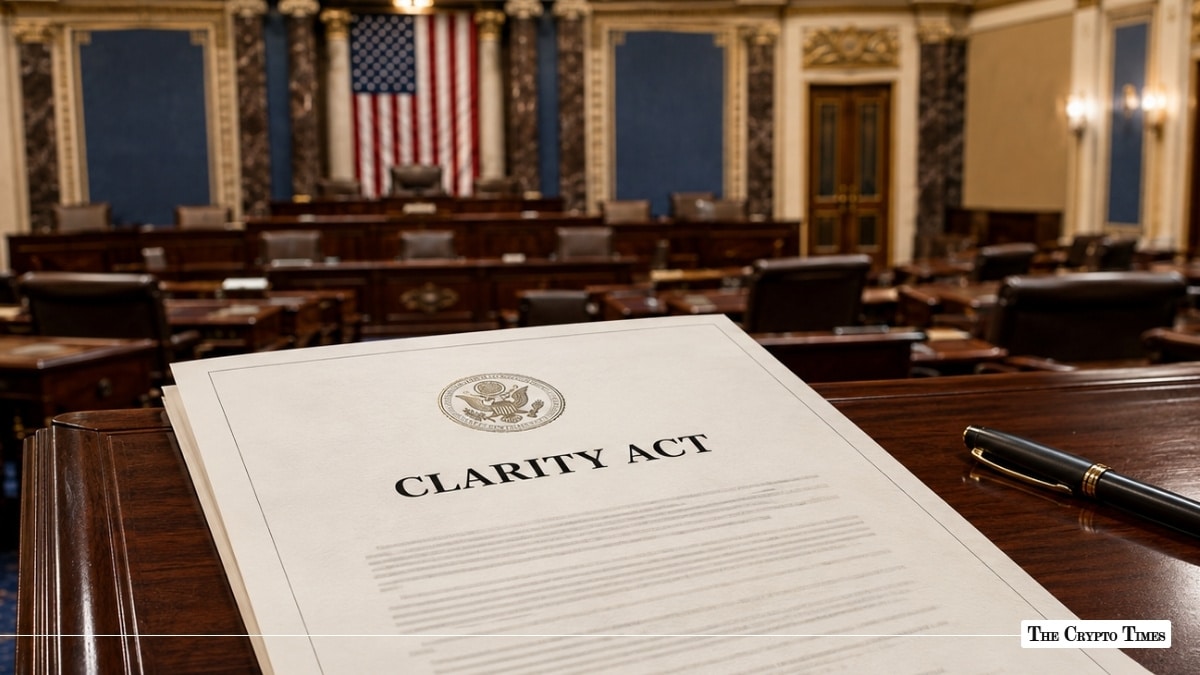
On July 13, 2026, a broad coalition of U.S. banking organizations sent a joint letter to Senate Majority Leader John Thune (R-SD) and Minority Leader Chuck Schumer (D-NY) calling for targeted revisions to the stablecoin provisions in the Digital Asset Market Clarity Act. The letter was signed by the American Bankers Association (ABA), the Independent Community Bankers of America (ICBA), and 76 state banking associations representing thousands of community financial institutions across the country.
While expressing support for responsible innovation and a well-regulated digital asset marketplace, the groups raised concerns that the current language in Section 404 does not provide enough clarity to prevent stablecoins from functioning as substitutes for bank deposits. They argued that clearer boundaries are needed to protect the flow of credit in local communities.
The Battleground: Section 404 and Stablecoin Incentives
Section 404 is the key provision in the bill that addresses how digital asset service providers can offer interest, yield, or rewards on payment stablecoins. The legislation prohibits covered parties from paying interest or yield to restricted recipients in connection with holding payment stablecoins. However, it includes exceptions and provisions related to activity-based rewards that are subject to future joint agency rulemaking.
The banking coalition warned that ambiguities in the current drafting could allow stablecoin arrangements to operate in ways that resemble deposit products, despite Congress’s intent for payment stablecoins to serve primarily as transaction tools rather than store-of-value instruments. They emphasized that deposits held by community banks support mortgage lending, small-business financing, agricultural credit, and other forms of local economic activity.
The coalition proposed the following targeted changes to Section 404(c)(1):
- Remove the word “solely” from subsection (1)(A).
- Remove the phrases “on a payment stablecoin balance” and “on an interest-bearing bank deposit” from subsection (1)(B).
- Replace the “economically or functionally equivalent” standard with a stricter “substantially similar” test.
The groups also recommended removing subsection (3)(B) in its entirety. This subsection currently permits payments of consideration, rewards, or benefits that may be calculated by reference to a balance, duration, tenure, or any combination of those factors. They argued that retaining this language could contradict the objective of the prohibition and incentivize the long-term holding of payment stablecoins rather than their use for transactions. For consistency, they recommended applying the “substantially similar” standard throughout Section 404.
This letter continues a months-long debate over stablecoin rewards that has been one of the main points of contention in the CLARITY Act’s progress. Earlier in 2026, disagreements over yield and rewards delayed committee action. The May 2026 compromise reached in the Senate Banking Committee banned direct interest or yield paid solely for holding stablecoins while allowing narrowly defined activity-based rewards under future joint rules from the SEC, CFTC, and Treasury.
Stakes for Crypto, Banks, and Consumers
For the crypto industry, further tightening of Section 404 could place additional limits on reward programs offered by exchanges and platforms, which some view as important for user engagement and stablecoin adoption. Proponents of the existing compromise argue that activity-based rewards tied to actual usage can support innovation without turning stablecoins into deposit-like products.
For community banks, the groups stressed that ensuring clear and enforceable rules around interest- and yield-like incentives is important for preserving deposits that support local lending. They noted that deposits gathered in communities are reinvested through relationship banking that benefits consumers and small businesses.
The letter stated that the associations support responsible innovation and recognize the potential benefits of a well-regulated digital asset marketplace. At the same time, they called for greater certainty that incentives tied to the holding or balance of payment stablecoins cannot be structured in ways that undermine the bill’s objectives.
Timing and Legislative Context
The sudden banking pushback lands at a highly inconvenient time for the crypto lobby. Just hours before the letter was delivered, President Trump issued a statement urging the Senate to quickly pass the CLARITY Act floor vote, framing the domestic crypto market-structure bill as a national security imperative to prevent China from dictating the digital asset landscape.
While mega-issuers like Circle and exchanges like Coinbase view flexible reward structures as essential tools for consumer adoption and digital asset innovation, traditional financial institutions are treating this as an existential zero-sum race for capital. With the Senate back in session, leadership must now decide whether to absorb these heavy banking-backed modifications or risk a chaotic, fractured floor fight that could stall the historic bill entirely.
Also Read: Warren Cites Trump’s $1.4B Crypto Windfall to Demand CLARITY Act Ethics Rules