In crypto, code is not just software. Code is custody, settlement, governance and, in many cases, the vault itself.
That is why Claude Fable 5 has become more than another artificial intelligence release. Anthropic’s most powerful generally available model is now sitting at the center of a larger fight over AI, cybersecurity, and financial infrastructure.
The model was launched, restricted by the U.S. government, restored with stronger safeguards and immediately pulled into the crypto security debate. The question is no longer whether AI can help find weaknesses in code. It is whether defenders can use it faster than attackers.
For crypto, the risk is not that Fable 5 suddenly creates an entirely new kind of hack. The bigger risk is that it makes the old ones move faster.
A weak admin key. A stale dependency. A bridge verifier flaw. A vulnerable signing process. A social-engineering path into a developer laptop. These are already the ingredients behind many of crypto’s largest losses. Frontier AI can make the search for those weaknesses cheaper, faster and more repeatable.
That is also what makes the model valuable for defense.
Claude Fable 5 could help protocol teams audit smart contracts, map dependencies, review code changes, triage old audit findings and speed up incident response. The same capabilities that worry regulators could also become the strongest defensive tool smaller DeFi teams have ever had.
This is the double-edged reality of AI in crypto security.
What Is Claude Fable 5?
Claude Fable 5 is Anthropic’s first publicly available model from its Mythos-class family. Anthropic launched it on June 9, 2026, alongside Claude Mythos 5, a more powerful cyber-focused version restricted to vetted partners through Project Glasswing. Anthropic says Fable 5 and Mythos 5 share the same underlying model, but Fable 5 includes stronger safeguards for general use.
Anthropic described Fable 5 as its most capable generally available model, with major gains in software engineering, complex reasoning, knowledge work, vision and long-running tasks. The engineering-scale capability was quickly documented in early corporate case studies: Stripe reported that Fable 5 compressed a codebase-wide migration across a 50-million-line Ruby infrastructure into a single day; a project the company estimated would have taken a team more than two months by hand. The company also warned that, without safeguards, the model’s cybersecurity capabilities could be misused to cause serious damage.
That warning is the heart of the crypto story.
A model that can reason across large codebases, understand technical documents, interpret diagrams, write tests and handle multi-step engineering work can help developers and auditors. But the same model class can also help attackers review public repositories, compare software versions, understand old audit reports and search for exploitable mistakes.
The concern was not hypothetical. Anthropic had earlier tested a prior Mythos model that found and exploited zero-day bugs across every major operating system and browser on command. This includes a 27-year-old flaw in OpenBSD; and its red team turned the freshly disclosed bugs into working exploits in less than a day. That documented capability, even in an internal test setting, is why the Mythos-class family was previously described by Anthropic itself as “too powerful in the cybersecurity domain to release publicly.” Fable 5 was designed as the safer public-facing version of that architecture.
In crypto, where software directly controls money, that distinction matters.
Why the U.S. Restricted Fable 5
The U.S. did not permanently ban Claude Fable 5. It temporarily restricted access under an export-control directive.
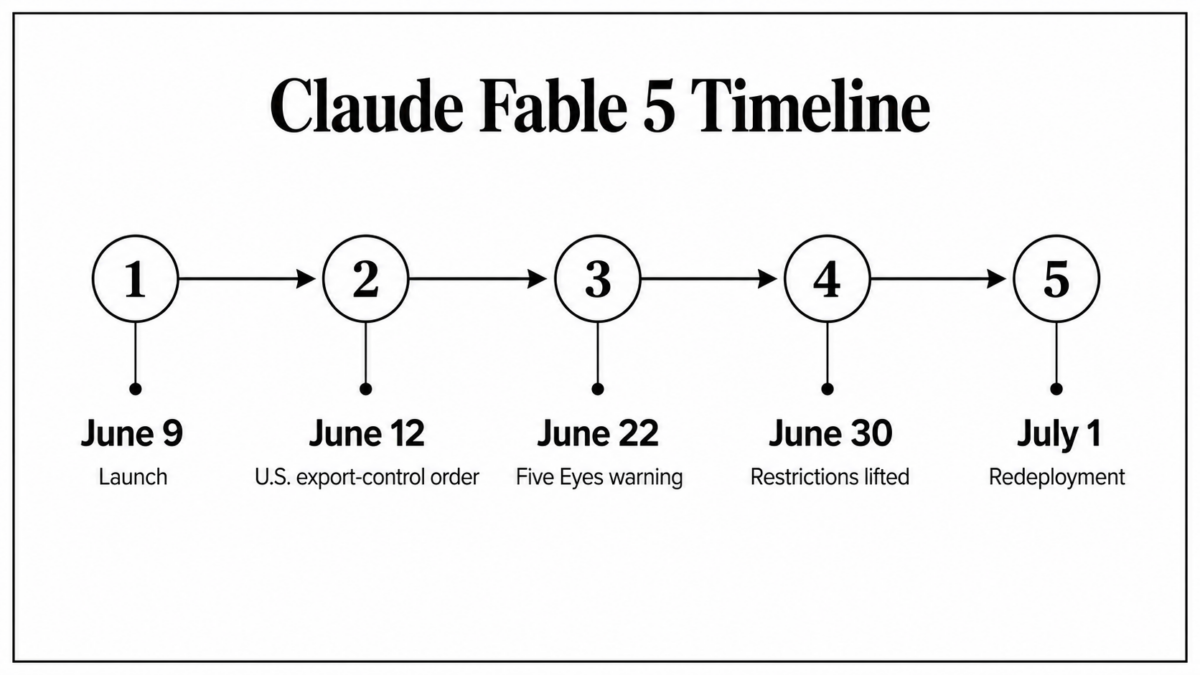
On June 12, 2026, Commerce Secretary Howard Lutnick sent a letter to Anthropic CEO Dario Amodei ordering the company to suspend access to Fable 5 and Mythos 5 for foreign nationals, whether inside or outside the United States, including foreign national Anthropic employees. The directive arrived at 5:21 PM ET, and Anthropic was given just 90 minutes to comply. Anthropic said it could not verify user nationality in real time, so it disabled access to both models for all customers globally.
The trigger was a reported jailbreak concern. Reportedly, Amazon researchers had documented a series of prompts that could get Fable 5 to provide information potentially useful in cyberattacks. Conversations between Amazon CEO Andy Jassy and the White House reportedly helped prompt the export-control directive. White House AI adviser David Sacks, who has publicly accused Anthropic of being “woke” and “leftist” and engaging in “a sophisticated regulatory capture strategy based on fear-mongering,” claimed Anthropic had refused to fix the issue.
Anthropic said the government believed it had become aware of a method to bypass Fable 5’s safeguards. According to Anthropic, the reported technique involved asking the model to read a codebase and fix software flaws, a request that can sit close to legitimate defensive cybersecurity work.
Anthropic pushed back on the severity of the action. The company said the government had provided only verbal evidence of a narrow, non-universal jailbreak and argued that similar vulnerability-identification capability was already available in other public models, including OpenAI’s GPT-5.5.
The Fable 5 dispute did not happen in isolation. In early March 2026, the Pentagon had already declared Anthropic a “supply chain risk,” requiring the U.S. military to cease using its models and prohibiting defense contractors from using them for government contracts, a designation Anthropic is challenging in federal court. The June export controls came just as Anthropic confidentially filed for an initial public offering at a $965 billion valuation, meaning the disruption landed at a maximally sensitive business moment.
Still, the government’s response was historic. It showed that frontier AI models with strong cyber capability are no longer being treated like ordinary software products. They are becoming national-security assets.
The U.S. Commerce Department later lifted the restrictions on June 30, 2026 after two weeks of intensive negotiations between Anthropic and the government. On June 26, Lutnick had already granted Mythos 5 access to approximately 100 U.S. companies and federal agencies that defend critical infrastructure, based on his determination that “appropriate safeguards” were in place for those trusted partners. As per reports, Mythos 5 remained more restricted than Fable 5, with access limited to select U.S.-based organizations approved by the government.
The 19-day shutdown had strategic costs beyond the direct enterprise disruption. Per CNBC, multiple tech executives and investors publicly warned that the crackdown “handed valuable time to Chinese open-source developers” attempting to catch up to leading U.S. models; a geopolitical framing that ultimately factored into the Trump administration’s decision to reverse course.
What Changed After Fable 5 Returned?
Anthropic restored Claude Fable 5 globally on July 1, 2026, after the export controls were lifted. The company said access returned across Claude.ai, Claude Platform, Claude Code and Claude Cowork, with cloud access through AWS, Google Cloud, and Microsoft Foundry being restored progressively.
But the model did not return exactly as before.
Anthropic said it trained an improved safety classifier specifically targeting the bypass technique described in the Amazon report. The company said the new classifier blocks the reported behavior in more than 99% of cases and routes flagged requests to Claude Opus 4.8 instead. The fallback triggers in fewer than 5% of sessions on average — meaning most legitimate coding work remains uninterrupted.
Anthropic also launched a public HackerOne program inviting researchers to report new Fable 5 jailbreaks, and committed to giving the U.S. government earlier access to test future frontier models before release. That tighter leash comes with a cost. Anthropic acknowledged that the new classifier may flag more benign requests during normal coding and debugging, especially around security-adjacent work.
For crypto developers and auditors, that trade-off is important. A prompt asking for help with a smart-contract bug, exploit prevention, fuzzing result or suspicious code path may be legitimate defensive work. But it may also resemble the same kind of request an attacker would use to identify a weakness.
That is the unresolved problem with AI cyber safety: the best defensive questions can look very similar to offensive ones.
Why Crypto Is So Exposed
Every industry faces cyber risk. Crypto faces cyber risk with instant settlement.
A bug in traditional finance may create fraud, downtime, or compliance exposure. A bug in DeFi can move funds immediately and irreversibly. There is no chargeback button on Ethereum. There is no customer-service reversal for a drained bridge.
The latest hack data shows how serious the pressure already is. TRM Labs reported that attackers carried out 207 crypto hacks in the first half of 2026, the highest number it has recorded for any six-month period. Total losses reached $972 million.
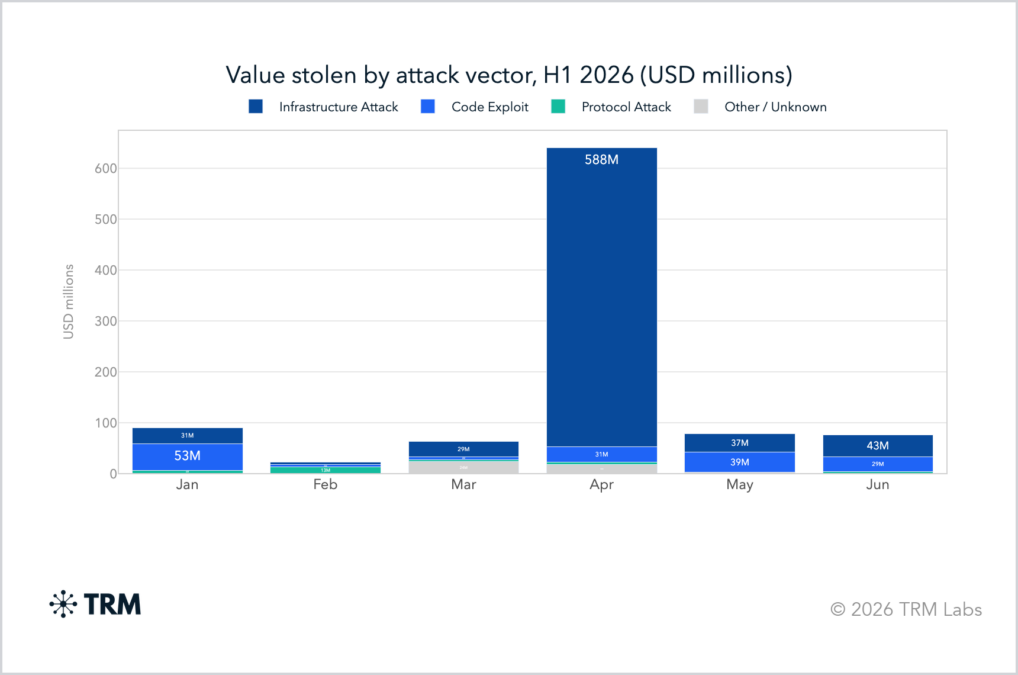
Per TRM Labs’ H1 2026 report, several data points sharpen the picture:
- Q2 2026 alone recorded 123 incidents, a new quarterly record, following a record-setting Q1
- Smart contract exploits accounted for 125 of the 207 incidents (a 60% dominance share)
- Median loss per hack was ~$219,000; mean loss was ~$4.7 million, showing wide distribution
- May recorded the highest monthly count (41), followed by June (36) and April (34)
- Ethereum was the most-targeted chain, with 56 incidents
- One physical-coercion “wrench attack” resulted in ~$24 million in losses, a specific human-risk data point
TRM’s data also shows why the AI debate matters. Smart-contract exploits drove much of the increase in incident count, but the largest losses came from infrastructure and operational compromises. Infrastructure and operational attacks represented only about 15% of incidents but accounted for roughly 76% of stolen value.
The most consequential single finding, however, is the state-actor concentration. Per TRM Labs, North Korea-linked hackers stole approximately $643 million in H1 2026, which is roughly 66% of all crypto funds stolen worldwide. Nearly 90% of that North Korean total ($577 million) came from just two attacks on decentralized finance platforms in April 2026: Drift Protocol (a Solana-based decentralized futures exchange, $285 million drained on April 1) and KelpDAO (a DeFi yield platform, $292 million drained later that month, attributed to the Lazarus Group). Only one of the largest H1 2026 hack targets fully recovered its stolen assets; two others managed to freeze just over $74 million in laundered funds. More than $620 million remained effectively lost.
That means crypto’s biggest weakness is not only code. It is the entire system around the code.
Private keys. Multisigs. Cloud accounts. Deployment pipelines. Admin roles. Bridges. Oracles. Employees. Vendors. Governance controls. Signing devices.
These are exactly the places where AI-assisted reconnaissance may matter most.
As The Crypto Times previously reported, Fable 5 first raised alarm because it appeared capable of accelerating vulnerability discovery across a large DeFi attack surface. The model’s return with tighter safeguards reduced some misuse risk, but it did not remove the underlying pressure on crypto security teams.
The Real Risk Is Machine-Speed Reconnaissance
| Crypto Attack Surface | How AI Can Accelerate Risk | Defensive Response |
|---|---|---|
| Smart contracts | Faster review of public code, old audit issues and risky logic | AI-assisted audits, fuzzing, formal review |
| Bridges | Faster mapping of verifier assumptions, relayers, upgrade paths | Stronger monitoring, limits, multi-layer validation |
| Admin keys | Easier discovery of privileged roles and weak access design | Least privilege, timelocks, hardware-backed signing |
| Signing systems | Faster analysis of transaction patterns and signer workflows | Clear signing, multisig controls, human review |
| Oracles | Faster identification of dependency and pricing assumptions | Redundant feeds, circuit breakers, manipulation checks |
| Social engineering | More tailored phishing, impersonation, vendor targeting | Verification workflows, access discipline, training |
The most important Fable 5 risk is not a movie-style AI hacker draining a protocol by itself.
The real risk is reconnaissance.
Before a major exploit, attackers need to understand the target. They review repositories, audits, dependencies, documentation, upgrade history, governance controls, signer behavior, and exposed infrastructure. They look for the place where money, authority and weakness intersect.
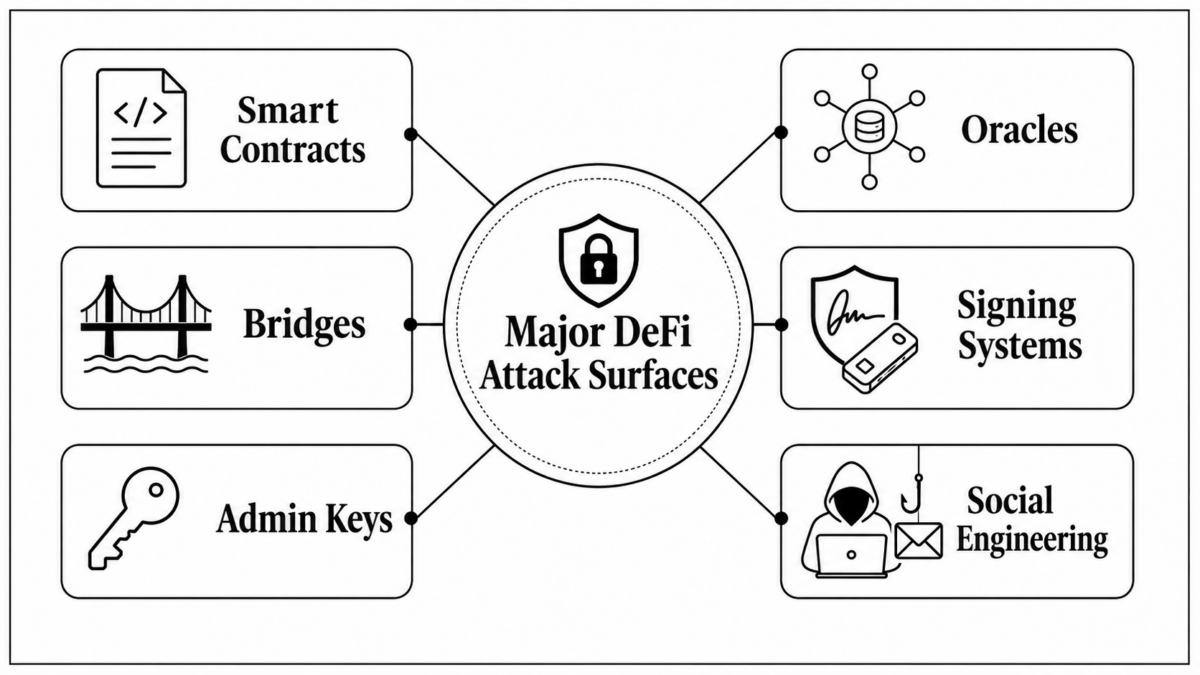
AI can make that scouting phase faster.
Security experts do not expect advanced AI to invent fundamentally new crypto hacks overnight. Instead, they warn that models like Fable 5 may dramatically speed up the process of finding misconfigurations, exposed keys, flawed signing flows and social-engineering paths.
That is what should worry DeFi teams.
An attacker does not need an AI model to write a perfect zero-day exploit. The attacker only needs the model to narrow the search. Which contract changed recently? Which dependency is stale? Which admin role still has broad permissions? Which old audit issue was marked “low severity” but never fixed? Which bridge component depends on a small verifier set? Which developer has access to deployment keys?
At scale, those questions become dangerous.
The Five Eyes Warning Made the Risk Bigger
The Fable 5 debate did not happen in isolation.
On June 22, cybersecurity agencies from the United States, United Kingdom, Canada, Australia, and New Zealand issued a joint Five Eyes warning on AI and cyber risk. The U.S. signatories were NSA Cybersecurity Director David Imbordino and acting CISA Director Nick Andersen; on the non-U.S. side, the statement was signed by the Australian Signals Directorate, Canada’s Communications Security Establishment, New Zealand’s Government Communications Security Bureau, and the UK’s Government Communications Headquarters (GCHQ). The statement said frontier AI is rapidly transforming both offensive and defensive cyber capabilities and that the timeline is “months,” not years.
The specific verbatim framing was uncompromising: “Frontier AI models are anticipated to exceed current industry expectations, fundamentally transforming both offensive and defensive cyber capabilities. The timeline is not years, it is months.” The advisory added: “AI is not a future consideration — it is already here,” and warned that organizations that fail to adapt “will face growing operational and strategic disadvantage.”
The agencies urged leaders to take five specific practical actions:
- Reduce attack surface (limit external exposure; question whether systems need external connectivity at all)
- Patch faster
- Remove or isolate vulnerable legacy systems
- Improve identity management
- Test responses to breaches
For crypto, that reads like a direct warning.
Most DeFi protocols do not fail because one line of Solidity was impossible to understand. They fail because complexity piles up: upgradeable contracts, off-chain infrastructure, admin privileges, cross-chain messaging, governance delays, oracle assumptions, and human access patterns.
AI compresses the time attackers need to understand that complexity.
The Five Eyes warning landed just as Fable 5’s access disruption was already affecting the crypto security debate. That timing matters. Governments are warning defenders to use AI, while also beginning to gate access to the most capable AI systems.
Another interesting layer of convergence: on the same day as the Five Eyes warning OpenAI announced a major expansion of its Daybreak cybersecurity initiative, releasing GPT-5.5-Cyber to verified defenders, expanding to a 28-firm partner program, including Cisco, CrowdStrike, Palo Alto Networks, and IBM, and launching “Patch the Planet.” OpenAI had previewed a further model, i.e. GPT-5.6, to a small government-approved group rather than the public, citing the same dual-use worry that Anthropic had flagged. The convergence was not a coincidence; it reflected a broader industry shift toward tiered access for the most cyber-capable models.
That creates a difficult question for crypto: what happens if attackers can access powerful or unsafeguarded models, but legitimate defenders face restrictions, false positives or approval gates?
The Jailbreak Problem Is Not Solved
Anthropic has tried to make the debate more precise.
On July 2, the company published details about Fable 5’s cyber safeguards and proposed an AI jailbreak severity framework. The framework is designed to distinguish between minor bypasses and serious jailbreaks that unlock a broader range of dangerous capabilities.
That matters because not all jailbreaks are equal.
A model that gives a high-level explanation of a known bug is not the same as a model that repeatedly helps identify and weaponize vulnerabilities across many targets. A prompt that produces one borderline answer is not the same as a reliable bypass that works at scale.
But the broader issue remains: safety systems are under constant pressure.
Anthropic itself acknowledges that jailbreaks vary in severity and that safety classifiers must separate benign security work from harmful cyber activity. Independent red-team research on Fable 5 and Opus 4.8 also argued that even hardened frontier models can retain a residual attack surface under sustained automated pressure.
This is why crypto teams should not assume model guardrails alone will protect them.
Guardrails raise friction. They do not remove the incentive to attack.
The Defensive Upside Is Huge
The most dangerous mistake would be treating Fable 5 only as a threat.
For defenders, the model class is also a major opportunity. AI can help review code changes, generate tests, summarize audit deltas, map protocol dependencies, identify risky permissions, analyze transaction graphs and speed up incident response.
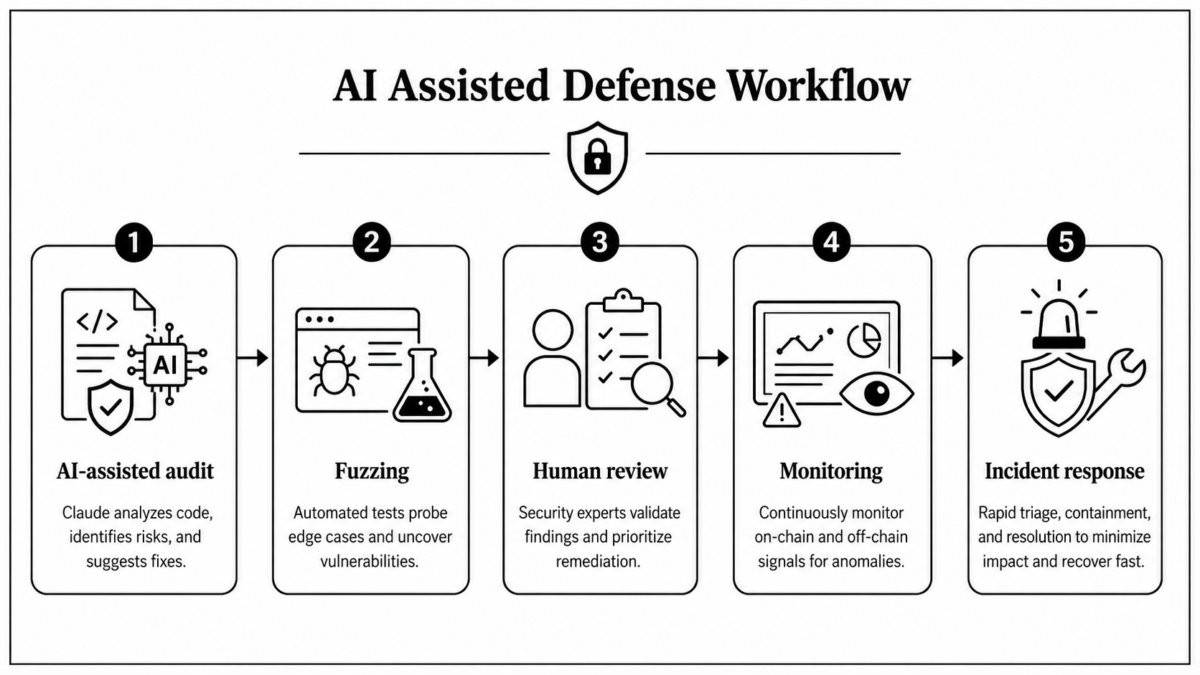
Teams such as Pendle have already used Anthropic models defensively to map codebases, stress-test contracts and catch issues early.
That is where the strongest crypto use case sits.
Not “ask AI if the protocol is safe.” That is too shallow.
The better workflow is continuous AI-assisted defense: use the model to review every pull request, compare deployed contracts against repositories, flag unusual permission changes, summarize new dependencies, generate fuzzing ideas, triage audit issues and help incident teams understand suspicious flows quickly.
AI should sit beside human auditors, formal verification, fuzzing, monitoring, bug bounties and strong operational controls. It should not replace them.
The protocols that gain from Fable-class AI will be the ones that integrate it into a mature security process. The protocols that lose will be the ones that treat AI as either a magic auditor or an irrelevant threat.
What Crypto Teams Should Do Now
The first lesson is simple: secure the systems around the contracts.
TRM’s H1 2026 data shows that infrastructure and operational compromises caused the majority of stolen value, even though they represented a smaller share of incidents. The Drift and KelpDAO cases, specifically where North Korean-linked operators drained millions in a single month by exploiting key-management and signing infrastructure rather than smart contract code, should now sit at the front of every serious DeFi team’s threat model. That should push protocol teams to focus beyond smart-contract audits.
Every serious DeFi team should now review five areas.
- First, admin keys and signing flows. Large transfers, upgrades and emergency functions should require strong multisig controls, hardware-backed signing, role separation and clear transaction review.
- Second, upgrade authority. Protocols should reduce unnecessary permissions, use timelocks where appropriate and make privileged changes visible to the community.
- Third, dependencies and deployment pipelines. AI-assisted attackers can scan repositories quickly, but AI-assisted defenders can do the same. Teams should continuously review packages, scripts, CI/CD systems and cloud access.
- Fourth, monitoring and incident response. Teams should be able to detect abnormal fund flows, pause affected contracts where possible, notify partners and communicate with users quickly.
- Fifth, human risk. Social engineering remains one of crypto’s most expensive attack paths. AI makes tailored phishing, impersonation and vendor targeting more scalable. Training, verification workflows and internal access discipline need to improve.
The Five Eyes agencies warned that breaches should be expected and that preparation determines how damaging they become. In crypto, that preparation may decide whether an incident becomes a contained bug or a nine-figure drain.
What Happens Next
The Fable 5 episode points to a larger future.
Frontier AI releases will face more government scrutiny. Trusted-access programs such as Project Glasswing may become more common. Model providers will build stronger classifiers, jailbreak bounties and risk frameworks. Governments will likely demand earlier visibility into models that can affect cybersecurity and critical infrastructure. The June 2, 2026 Executive Order 14409 already created a voluntary path for companies to have frontier models reviewed before release — the emerging regulatory framework the Fable 5 incident tested in real time. Anthropic also stated that it is working with Amazon, Microsoft, Google, and other partners on standards to assess and prevent AI jailbreaks.
That future creates tension for crypto.
Crypto is global, open and permissionless. Frontier AI access may become national, gated and permissioned.
The result could be a widening gap between well-funded institutions that get early access to the strongest defensive tools and smaller teams that rely on weaker public models or face more restrictions.
Washington’s intervention in Fable 5 may also be part of a broader pattern. The Crypto Times previously reported that U.S. scrutiny later reached OpenAI’s GPT-5.6 rollout as well, suggesting that frontier AI access is becoming a recurring policy issue rather than a one-off dispute.
For crypto, the strategic takeaway is clear: AI security is no longer optional.
Auditors will use it. Attackers will use it. Exchanges will use it. Regulators will watch it. Insurers and institutional partners may eventually ask whether protocols have AI-aware security processes in place.
Bottom Line
Claude Fable 5 did not create crypto’s security crisis. It exposed how fast that crisis may now move.
The model’s launch showed how powerful AI-assisted software analysis has become. The U.S. restriction showed that governments now view cyber-capable AI as a national-security concern. The redeployment showed that model providers are trying to balance access, safety and defensive utility. The Five Eyes warning showed that the broader cyber world sees the same shift coming in months, not years.
For crypto, the message is sharper.
The next major exploit may not require a new kind of vulnerability. It may come from the same old weaknesses: poor key management, exposed infrastructure, weak signer controls, bridge complexity, stale dependencies or social engineering.
The difference is speed.
Fable 5 and models like it can help defenders move faster. They can also help attackers move faster. The side that benefits most will be the side that adapts first.
In crypto, code is the vault. AI is now reading the vault faster than ever.
FAQs
1. What is Claude Fable 5?
Claude Fable 5 is Anthropic’s most capable generally available AI model and the public version of its Mythos-class model family, released with stronger safeguards than the restricted Mythos 5 model. Anthropic itself had previously described the Mythos-class architecture as “too powerful in the cybersecurity domain to release publicly.” Fable 5 was designed as the safer public-facing version.
2. Was Claude Fable 5 banned in the U.S.?
It was temporarily restricted under a U.S. export-control directive on June 12, 2026 issued by Commerce Secretary Howard Lutnick to Anthropic CEO Dario Amodei. Anthropic suspended global access because it could not verify user nationality in real time. Access was later restored on July 1, 2026, following a 19-day shutdown.
3. Why does Claude Fable 5 matter for crypto?
Crypto protocols are highly exposed to code flaws, infrastructure compromises and key-management failures. Advanced AI can help defenders audit faster, but it may also help attackers identify weaknesses faster.
4. Can Claude Fable 5 create crypto hacks?
The bigger risk is not that it invents new hacks automatically. Security experts warn that models like Fable 5 may accelerate reconnaissance, misconfiguration discovery and exploit preparation.
Disclaimer:
Some elements of this content may have been enhanced with the help of our artificial intelligence (AI) assistants for purposes such as basic refinement, review, image generation, and translation to deliver high-quality news in a shorter time frame. However, all AI-assisted content is reviewed and approved by our team to ensure accuracy, fairness, and editorial integrity.