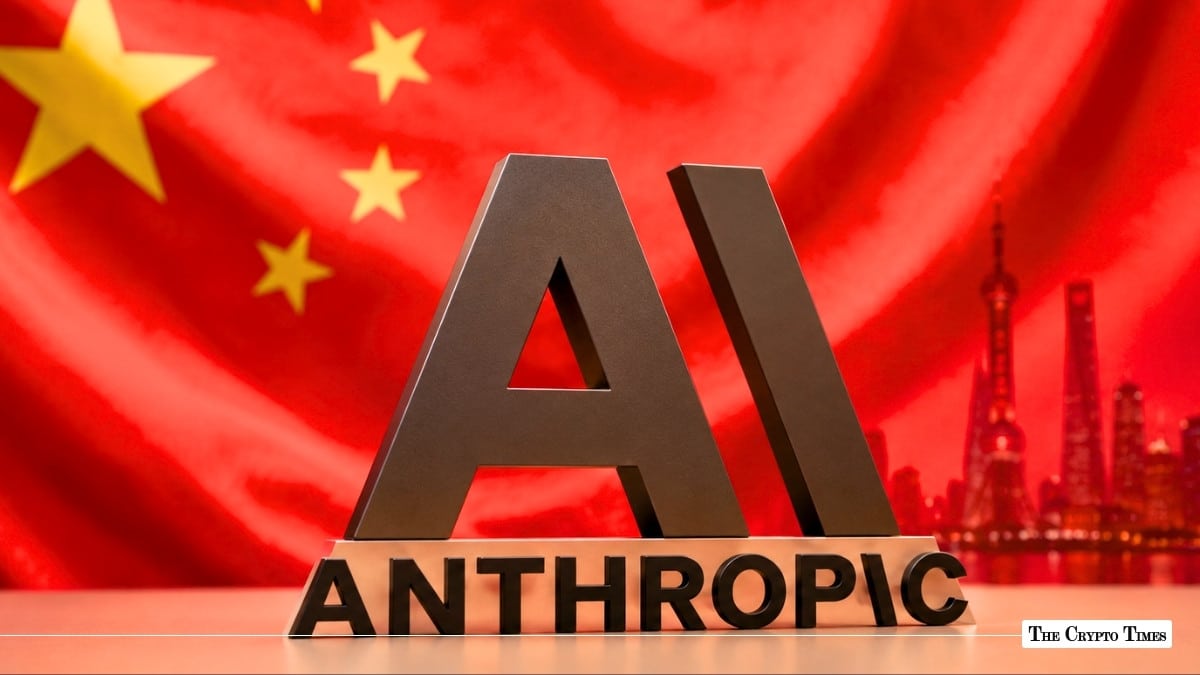
Anthropic is tightening enforcement against the indirect routes Chinese companies and developers have been using to reach its Claude AI models, and the crackdown has placed a spotlight on the growing layer of crypto-linked relay services operating in that gap, including B.AI, the AI platform backed by TRON Founder Justin Sun.
The Financial Times reported on Thursday that Anthropic is moving to close loopholes that have allowed Chinese firms to bypass its access restrictions through overseas subsidiaries, cloud providers, VPNs and so-called transfer station services, citing people familiar with the matter.
According to the report, companies including Ant Financial provided employees with corporate Claude accounts linked to a Singapore-based entity, while ByteDance reimbursed engineers for personal Claude subscriptions accessed through VPNs. Some firms also reached Claude through foreign-incorporated units running on cloud infrastructure such as Microsoft Azure. Both Ant and ByteDance declined to comment on the report.
These practices reportedly do not violate US or Chinese law, but they breach Anthropic’s terms of service. The company’s September 2025 policy update explicitly barred any company that is majority-owned, directly or indirectly, by entities headquartered in unsupported regions such as China from using its services, a change Anthropic said at the time was intended to prevent workarounds.
The FT reported that Anthropic is now stepping up detection efforts, including monitoring signals such as users’ computer time zones and usage patterns, and is specifically targeting transfer stations that relay requests from mainland China through overseas Claude accounts.
The transfer station economy and its crypto layer
Transfer stations, also called relay stations, sit at the center of this enforcement push, and they are the point where crypto infrastructure enters the story. A recent Wired investigation into China’s Claude access workarounds described how these services operate. Set up with servers in an Anthropic-supported country, they act as middlemen between Chinese users and Anthropic.
A user sends prompts to a locally accessible website, which forwards the request to Claude through overseas accounts or API keys and passes the response back. To the end user, the experience feels similar to chatting with Claude directly, just on a different platform.
The demand has grown large enough that Chinese-language websites and GitHub pages now list dozens of transfer stations, comparing supported models and token prices. The Wired report noted that Justin Sun joined this market and opened his own transfer station in May.
That platform is B.AI. According to Sun’s announcements on X, the platform provides access to Claude, GPT, Gemini, and other large language models through a single API key, with blockchain wallet logins, anonymous payment options, crypto settlement and no identity verification requirement.
TRON DAO’s launch communications in April 2026 described B.AI as financial infrastructure built for the AI agent era, addressing model access, payments, settlement, identity and coordination.
The platform incorporates the ERC-8004 on-chain identity framework, which links blockchain addresses to verifiable reputations, and the x402 payment standard, an open protocol based on HTTP 402 that allows automated value transfer between AI agents.
Sun subsequently announced a token subsidy program for the platform and later confirmed on X that B.AI added full Solana support, extending its multi-chain login and payment capabilities beyond its initial setup.
It is worth stating clearly that Anthropic has not named B.AI or any specific relay service in its enforcement actions, and no legal wrongdoing has been alleged against the platform.
Anthropic spokesperson Michael Aciman has publicly stated that the company uses a range of evolving detection systems, including identity verification, to enforce its policies, and that it has worked to detect and disrupt proxy networks used to provide Claude access in China.
China’s Crypto Stance Adds Another Layer
The context on the Chinese side makes the picture more complex. Mainland China has maintained a broad prohibition on cryptocurrency trading and related services since 2021, when the People’s Bank of China and other regulators declared crypto transactions illegal and banned domestic mining.
Despite this, stablecoins, particularly USDT, have continued to circulate informally among Chinese users as a settlement tool for cross-border and gray-market activity, while Hong Kong has taken a separate, more open regulatory path with licensed exchanges and a stablecoin framework.
On the AI side, Beijing bars companies from using overseas models in consumer-facing applications, though domestic rules still allow Chinese AI labs to use foreign models for internal research, according to the FT. This means crypto-settled AI relays operate in a space where both the payment method and the underlying model access sit outside official channels on the mainland.
The wider gray market for Claude access remains active despite Anthropic’s measures. Per the Wired report, Claude accounts are sold on Chinese ecommerce platforms like Taobao and through Telegram marketplaces, while transfer stations often undercut Claude’s official API pricing by sourcing enterprise discounts from Anthropic and licensed distributors. The FT reported, however, that larger Chinese AI groups tend to avoid transfer stations over concerns that operators might store, resell or analyze their prompts.
What emerges is a structural standoff between a centralized AI lab enforcing geographic boundaries and blockchain-based access infrastructure that does not depend on traditional accounts, payment cards or identity checks. Anthropic says its detection systems continue to evolve.
How its updated measures interact with crypto-settled relays, and how platforms like B.AI respond, will shape how this intersection develops in the weeks ahead. There is no official B.AI token, and impersonation tokens circulating on other chains have been flagged in the market.