
Strategy Inc. stands as the global markets’ most prominent example of institutional Bitcoin integration, transforming a legacy software balance sheet into a massive macroeconomic treasury machine.
Under Executive Chairman Michael Saylor, who is also a vocal Bitcoin maxi, the company pursued an ambitious path of consistent accumulation funded through equity and preferred securities, positioning itself as a leveraged proxy for Bitcoin’s long-term potential. Yet, as markets fluctuated and the scale of operations expanded, practical considerations around liquidity, obligations, and capital efficiency gradually came into sharper focus.
Over time, Strategy’s ambitious Bitcoin treasury model encountered practical dynamics shaped by market cycles, capital structure demands, and the need for sustained liquidity. These elements naturally invited closer examination of long-term resilience, raising thoughtful questions about how an unchanged approach might unfold amid ongoing volatility.
The formal unveiling of the Digital Credit Capital Framework on June 29, 2026 emerged as a calibrated step, introducing structured flexibility into the company’s financial stack while preserving its baseline identity as a net long-term Bitcoin accumulator.
The Genesis of a Bitcoin Treasury Powerhouse
Strategy’s pivot toward Bitcoin began in earnest in 2020, when Saylor publicly championed the cryptocurrency as superior “digital property” and a hedge against fiat currency debasement. The company began acquiring BTC using proceeds from equity offerings, convertibles, and later, innovative preferred stock instruments branded as “Digital Credit.”
By early 2026, holdings had grown substantially through consistent accumulation. As of mid-June 2026, Strategy controlled approximately 847,363 BTC, representing a significant portion of the total Bitcoin supply and underscoring its dominance among public companies.
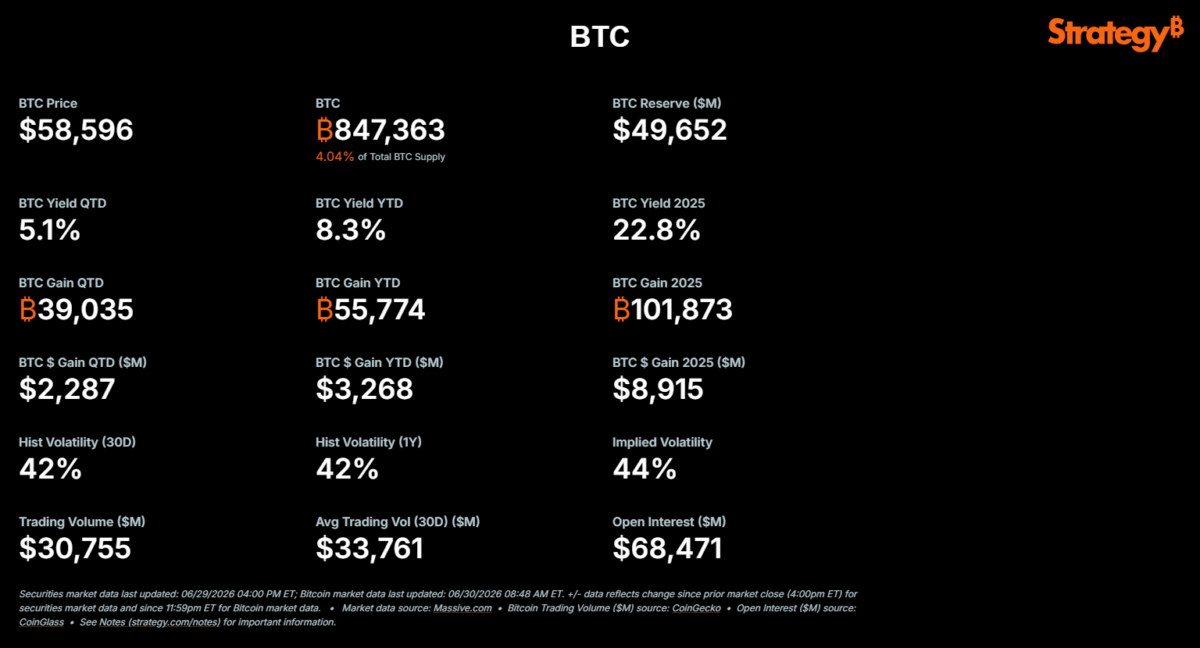
The strategy delivered impressive BTC-per-share growth and positioned the firm as a leveraged play on Bitcoin’s long-term appreciation. Revenue from its legacy software business provided a stable (if smaller) foundation, while capital markets activity funded the treasury expansion. Supporters praised the conviction and the creation of a new asset class of Bitcoin-backed securities, particularly the popular STRC perpetual preferred stock.
This model thrived in bullish or stable environments, where new capital could be raised efficiently to acquire more BTC, reinforcing a flywheel effect. The company frequently highlighted metrics like BTC yield and holdings growth, reinforcing its identity as a Bitcoin treasury company first and foremost.
Navigating Headwinds in a Dynamic Market
When the digital asset markets faced a sharp correction in early June 2026, the unprecedented scale of Strategy’s multi-billion dollar treasury introduced severe, real-time balance sheet volatility. With Bitcoin drifting toward the $60,000 threshold on June 30, 2026, Strategy’s structural cost basis of ~$75,651 per coin forced an unrealized, paper-loss evaluation of nearly $13 billion.
The company had also issued substantial preferred securities to support its treasury. These instruments carried ongoing dividend obligations—approximately $1.76 billion annually in preferred dividends and interest by mid-2026. Maintaining adequate liquidity to service these commitments, while continuing BTC purchases and managing overall capital structure, required careful navigation.
Strategy’s equity raises, while effective for accumulation, involved dilution for common shareholders. Preferred stock trading dynamics added another layer, with instruments like STRC experiencing volatility tied to broader market sentiment, credit perceptions, and Bitcoin’s performance. Analysts and observers noted tightening coverage ratios on reserves relative to obligations, prompting discussions about sustainability and optimal timing of capital deployment.
Strategy had already demonstrated flexibility by conducting limited BTC sales earlier in 2026 (such as a small tranche in late May) to support dividends, signaling an openness to using its treasury strategically rather than as an immutable hoard. These moves, while modest in the context of total holdings, highlighted the practical realities of operating at scale in a volatile asset class.
The broader environment included fluctuating capital markets access, interest rate dynamics, and evolving investor expectations around corporate Bitcoin strategies. What began as a bold, conviction-driven approach increasingly required balancing growth ambitions with operational resilience.
Additionally, Rosen Law Firm, a prominent investor rights practice, launched a formal securities class-action investigation into potential securities claims on behalf of Strategy Inc. (MSTR, STRF, STRC, STRK, STRD) shareholders. The probe focuses on allegations that the company and certain executives may have issued materially misleading statements regarding its business operations, Bitcoin treasury strategy, associated risks, and financial disclosures.
Read: Michael Saylor’s Strategy Targeted in Rosen Law Securities Investigation Amid MSTR, STRC Scrutiny
What If the Path Remained Unchanged?
Considering a scenario where Strategy continued its prior emphasis on aggressive accumulation without additional structural adjustments reveals several plausible pressures. Prolonged Bitcoin weakness could have widened unrealized losses, potentially pressuring market valuations and raising questions about the premium (or discount) at which shares and preferreds traded relative to underlying BTC holdings and net asset value metrics.
With significant recurring obligations from preferred securities, reliance on ongoing capital raises or opportunistic sales might have increased costs of capital or introduced greater execution risk during periods of market stress. Investors focused on balance sheet strength might have demanded higher yields or shown reduced appetite for new issuances, creating a feedback loop.
Dilution from equity offerings, if continued at previous paces to fund purchases, could have further impacted common shareholders’ ownership and per-share metrics over time. In a sustained downturn, the company might have faced tougher decisions around prioritizing BTC accumulation versus preserving flexibility for dividends, debt service, or opportunistic actions.
Market perception could have shifted more negatively in some circles, with debates intensifying around leverage, concentration risk, and the long-term viability of a model heavily tied to a single volatile asset. While Strategy’s software business provided some ballast, the dominant narrative revolved around its Bitcoin treasury, amplifying both upside and downside sensitivity.
These hypotheticals are not predictions but illustrations of the complexities inherent in scaling such a strategy. They underscore why proactive adaptation often becomes valuable as companies mature and markets evolve.
The Digital Credit Capital Framework: A Measured Response
Against this backdrop, Strategy’s June 29, 2026, announcement introduced the Digital Credit Capital Framework as a structured evolution. The framework aims to strengthen the company’s preferred securities (“Digital Credit”), enhance overall liquidity, preserve its long-term commitment to Bitcoin as the primary treasury asset, and create value for shareholders through disciplined capital allocation.
It represents a shift from primarily one-directional capital raising and accumulation toward a more bidirectional approach—issuing when conditions are favorable and repurchasing when instruments trade at levels that support accretion. This flexibility is intended to improve corporate performance, bolster the standing of its securities, and provide tools to navigate varying market conditions.
The announcement came with specific policy updates and authorizations that directly address liquidity visibility and capital management options.
Key Components and Strategic Intent
The proposed framework comprises five interconnected elements:
1. USD Reserve Policy:
Strategy established a board-approved minimum reserve target of at least 12 months of coverage for expected annual preferred stock dividend payments and interest expense (approximately $1.76 billion at the time).
As of June 28, 2026, the company reported a USD reserve of about $2.55 billion (including unsettled proceeds from at-the-market offerings), providing roughly 17.4 months of coverage. Combined with the new monetization capacity, total liquidity visibility reached approximately 25.9 months.
The reserve is earmarked primarily for dividend and interest support, with other uses requiring board approval. It can be replenished through capital markets activity or the BTC monetization program.
2. STRC Dividend Policy Updates:
The dividend rate on the flagship Variable Rate Series A Perpetual Stretch Preferred Stock (STRC) was set at 12.00% per annum for periods with record dates on or after July 1, 2026. The company outlined an objective for STRC to trade closer to its $100 stated value over time, supported by strengthened liquidity and capital tools. Dividend rates will be evaluated monthly based on trading levels, market yields, credit spreads, Bitcoin conditions, reserve coverage, and overall capital structure.
3. Digital Credit Securities Repurchase Program:
Authorization for up to $1 billion in repurchases of outstanding preferred securities (including STRC, STRF, STRD, and STRK). Initial priority is expected on STRC when accretive. Repurchases can occur via open market, block trades, tender offers, or other methods. These are not funded from the core USD reserve but can leverage BTC monetization proceeds when appropriate. The goal includes reducing future dividend burdens and strengthening credit quality.
4. Class A Common Stock (MSTR) Repurchase Program:
A parallel $1 billion authorization for buying back common shares, particularly when trading below intrinsic value. This provides another lever for returning value to shareholders and supporting per-share metrics.
5. BTC Monetization Program:
Board authorization to sell up to $1.25 billion in Bitcoin for three primary, accretive purposes: building the USD reserve; funding or replenishing dividends/interest when more advantageous than issuing new common equity; and supporting the repurchase programs (including associated costs). Sales are discretionary, subject to market conditions, tax considerations, and long-term value assessment. This is not an open-ended selling mandate but a targeted tool.
Chief Financial Officer Andrew Kang emphasized the philosophy: “Bitcoin is capital. This program gives Strategy the flexibility to use a portion of its BTC Reserve to strengthen Digital Credit, fund or replenish the USD Reserve, fund dividend payments and interest expense, and fund accretive repurchases when BTC monetization is more advantageous than issuing common equity.”
CEO Phong Le highlighted the broader evolution: “Strategy is evolving from one-way capital issuance to active capital management. We intend to move between issuing securities when capital is attractive and repurchasing securities when our instruments trade at levels that make buybacks accretive.”
Saylor reinforced continuity alongside discipline: “Strategy remains committed to Bitcoin as its primary treasury reserve asset. At the same time, Digital Credit requires liquidity, discipline, and active capital management. This framework is designed to strengthen credit quality and enable the Company to reduce expected preferred stock dividend payments when accretive… while maintaining our commitment to long-term Bitcoin exposure.”
Immediate Market Reception and Macro Outlook
The announcement was received positively by markets. Strategy shares and related preferred securities saw gains in the immediate aftermath, reflecting investor appreciation for the added visibility on liquidity, the buyback authorizations, and the structured approach to capital allocation.
By providing clearer guardrails around reserves and targeted tools for optimization, the framework addresses several areas of prior discussion without abandoning the core Bitcoin treasury model. It allows Strategy to remain a net accumulator over time while equipping it with mechanisms to manage cyclical pressures more effectively.
That said, the positive reception unfolded against a backdrop of heightened external attention, including the Rosen Law Firm’s ongoing investigation into potential securities claims. Such probes could amplify broader scrutiny on disclosures, treasury management practices, and risk communications, potentially influencing investor sentiment and capital markets dynamics in the coming months.
Looking ahead, success will depend on disciplined execution, Bitcoin’s price trajectory, capital markets conditions, and the company’s ability to demonstrate accretion through repurchases and prudent monetization. The framework does not eliminate volatility inherent to a BTC-heavy balance sheet, but it enhances the toolkit available to navigate it.
Monthly evaluations of the STRC rate and ongoing disclosures around any monetization or repurchase activity will provide transparency for investors.
Conclusion
Strategy Inc.’s journey illustrates both the transformative potential and the operational complexities of building a major corporate Bitcoin treasury at scale. The pressures that naturally arise from ambitious growth in a volatile asset class prompted a proactive response in the form of the Digital Credit Capital Framework.
By introducing structured liquidity policies, repurchase authorizations, and a targeted monetization program, the company has signaled a commitment to resilience alongside conviction. This evolution aligns with Saylor’s framing of stronger credit and equity supporting more Bitcoin over the long term.
As the cryptocurrency ecosystem matures and more institutions consider similar strategies, Strategy’s latest move offers a case study in adaptation—maintaining a bold vision while incorporating the discipline required for sustainability. Markets will continue to watch closely as the framework is implemented, but it represents a clear step toward balancing ambition with prudence in the Bitcoin treasury era.
Also read: Saylor Says 2026 Marks Bitcoin’s Shift to Global Digital Capital