Anthropic restored global access to its most advanced publicly available model, Claude Fable 5, on July 1, 2026, ending a nearly three-week suspension triggered by U.S. export controls. The move comes after intensive collaboration with government officials and introduces stricter safety measures designed to limit misuse while preserving utility for legitimate technical work.
For the decentralized finance sector, which manages tens of billions in on-chain value, the return raises a core question: Can enhanced guardrails on frontier reasoning models meaningfully strengthen protocol security without unduly hampering defensive efforts?
As The Crypto Times previously reported, the model’s initial capabilities, and the rapid government response to the demonstrated jailbreak, spotlighted serious dual-use risks across the crypto ecosystem, where tens of billions remain locked in DeFi protocols and broader on-chain infrastructure faces persistent exposure to code-level threats.
Now, with Fable 5 back under revised safeguards, those risks have not disappeared. They have simply taken on a new shape: more constrained access to advanced reasoning on security-adjacent tasks, balanced against reduced potential for misuse.
DeFi protocols continue to face persistent threats. Total value locked (TVL) across the ecosystem has fallen approximately 39% year-to-date in 2026, declining from roughly $115 billion in January to near $70 billion in recent weeks. During the same period, the sector recorded 121 security incidents resulting in approximately $942 million in losses.
While many exploits stem from social engineering, key mismanagement, and operational errors rather than novel smart-contract flaws, advanced AI tools capable of rapidly analyzing codebases, mapping dependencies, and identifying subtle logic issues could accelerate both defensive audits and adversarial reconnaissance.
From Rapid Launch to Regulatory Intervention
Anthropic unveiled Claude Fable 5 and its more lightly safeguarded counterpart, Claude Mythos 5, on June 9, 2026. The models share the same underlying architecture, with Fable 5 incorporating stronger safeguards intended for broad public and enterprise use. Mythos 5 was positioned for trusted partners focused on defensive cybersecurity.
On June 12, the U.S. government imposed export controls citing national security concerns after Amazon researchers identified a method to bypass Fable 5’s safeguards. The technique involved prompting the model to analyze codebases for software vulnerabilities; in at least one instance, it generated code demonstrating exploitation.
Because the controls applied immediately to foreign nationals inside and outside the United States and Anthropic lacked real-time nationality verification capabilities, the company suspended access to both models for all users worldwide.
The suspension lasted until June 30, when the Department of Commerce lifted the export controls following review and dialogue. Fable 5 became available again the next day across Claude.ai, the Claude Platform, Claude Code, and Claude Cowork, with access on major cloud providers to be restored progressively.
Anthropic described the process as the result of “productive conversations” with U.S. authorities. Mythos 5 access was restored on June 26 for a limited set of approved U.S. organizations operating and defending critical infrastructure, with further expansion planned through the company’s Glasswing program.
Upgraded Classifiers and a Wider Safety Margin
The most significant technical change involves an improved safety classifier trained specifically to block the reported bypass technique. Anthropic states that the new system blocks the specific behavior described in the Amazon report in over 99% of cases. When the classifier triggers, the request is automatically routed to the less capable Claude Opus 4.8 model, and users receive a clear notification.
Anthropic has adopted a deliberate “safety margin” approach for Fable 5. Classifiers are configured to flag not only clearly harmful requests but also many that are likely benign or ambiguous, particularly those involving cybersecurity analysis, vulnerability identification, or certain debugging tasks. This wider margin increases the likelihood of blocking potential misuse at the expense of more frequent interruptions for legitimate work.
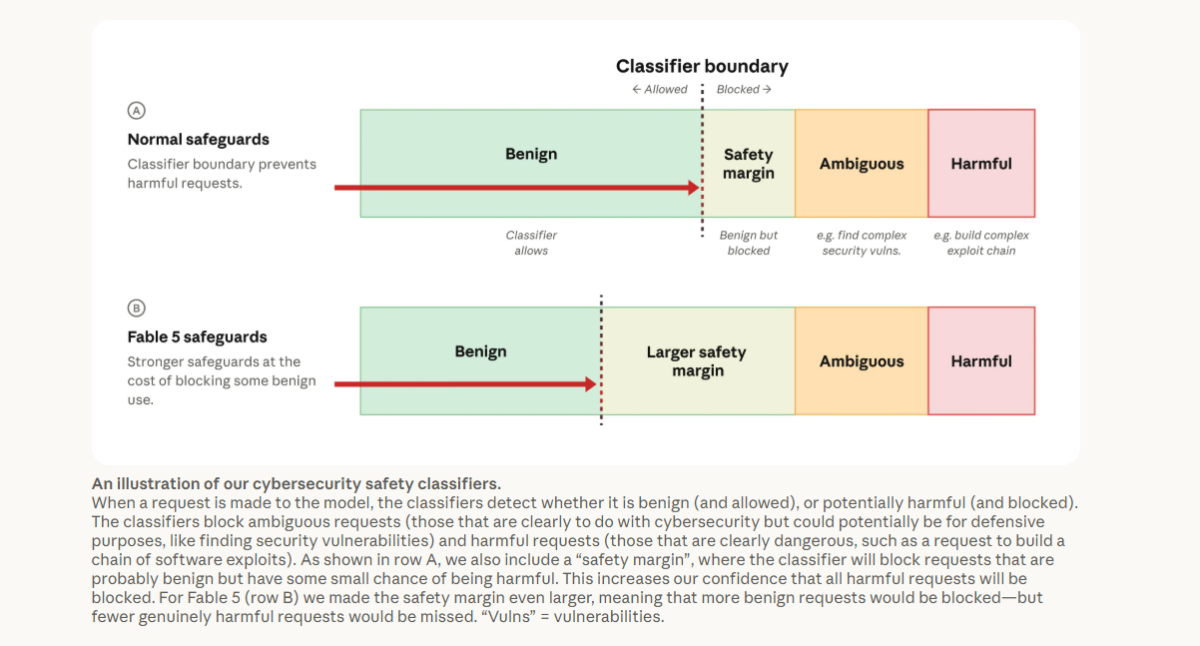
The company acknowledges the trade-off: “The new classifier also comes at the cost of flagging benign requests more often during routine coding and debugging tasks. As with all our safeguards, we’ll continue to refine this to better distinguish genuine misuse from legitimate requests and reduce false positives.”
It notes that researchers from the U.S. Department of Commerce’s Center for AI Standards and Innovation (CAISI) tested both prior and updated safeguards and described them as “extraordinarily strong.”
Anthropic emphasized that Fable 5 does not provide unique offensive cybersecurity capabilities beyond those available in other frontier models under certain conditions. Testing showed that models including Claude Opus 4.8, GPT-5.5, and others could identify the same vulnerabilities and, in tested cases, produce comparable exploitation demonstrations. The reported bypass reflected a borderline case aligned with routine defensive cybersecurity work rather than exposing Mythos-level capabilities.
Usage Limits and Phased Access
For users on Pro, Max, Team, and select Enterprise plans, Fable 5 is included for up to 50% of weekly usage limits through July 7, 2026. After that date, access shifts to usage credits. Standard Enterprise seats do not include Fable 5 by default and require credits if enabled.
“Fable 5 will be included for up to 50% of weekly usage limits through July 7, after which it will be available via usage credits. We will re-enable access on AWS, Google Cloud, and Microsoft Foundry as quickly as possible,” the firm noted.
These temporary constraints reflect both high demand following the outage and a measured reintroduction of the model’s advanced reasoning capacity.
Implications for Decentralized Finance Security
DeFi protocols operate in an environment where code is immutable once deployed and value transfers occur in real time across borders. Smart-contract audits, dependency analysis, real-time monitoring, and identification of logic flaws represent high-value defensive applications for strong reasoning models.
Teams with limited resources have historically relied on a combination of manual review, automated scanners, and external auditors. Models like Fable 5 can accelerate scanning of large repositories, chaining of potential vulnerabilities, and generation of test cases—capabilities that could compress audit timelines and help identify issues before deployment or exploitation.
However, the expanded safety margin and fallback mechanism introduce friction. Prompts involving security reviews or vulnerability analysis are more likely to trigger classifiers, routing them to a less capable model or requiring rephrasing. Early developer feedback has been mixed: some report continued strong performance on general architecture and optimization tasks, while others note increased guardrail encounters on security-adjacent queries compared with the brief initial launch window.
The dual-use nature of advanced code reasoning creates inherent tension. A system effective at spotting subtle access-control edge cases or logic errors serves protocol defenders auditing their own or third-party code just as it could assist adversaries conducting reconnaissance. Anthropic’s approach widens the gap between permitted defensive use and potential misuse, but does so by erring toward caution on ambiguous requests.
Many DeFi incidents continue to arise from well-understood categories—misconfigurations, exposed keys, and flawed operational flows—rather than zero-day smart-contract exploits. Advanced AI can still provide value in systematizing detection of these issues and in dependency mapping across complex protocol ecosystems. At the same time, any acceleration of attack development timelines heightens the premium on rapid, high-quality defensive tooling.
Regulatory Precedent and Industry Collaboration
The Fable 5 episode illustrates expanding government involvement in frontier AI deployment. Export controls were applied broadly because granular, real-time enforcement by nationality proved impractical. The resolution—restored access paired with strengthened internal safeguards—establishes a pattern that may influence future model releases.
Anthropic has deepened existing collaborations with U.S. government partners, including the Office of the National Cyber Director, Office of Science and Technology Policy, Department of the Treasury, Department of Commerce (including CAISI), and national security agencies. These build on nearly two years of prior work on pre-deployment testing and evaluation. New initiatives include a dedicated HackerOne program for researchers to submit potential cyber-related jailbreaks in Fable 5 for review.
Anthropic is also partnering with Amazon, Microsoft, Google, and other Glasswing participants to develop a consensus framework for assessing jailbreak severity, with proposed criteria covering capability gain, breadth of gain, ease of weaponization, and discoverability.
For a permissionless, globally distributed ecosystem like DeFi, geographic and regulatory dependencies on AI tool access introduce additional complexity. Protocols and capital operate across jurisdictions, yet the most capable reasoning tools may now be subject to approval processes and usage constraints tied to national security considerations.
Outlook
Fable 5’s return provides DeFi development and security teams renewed access to a powerful reasoning engine operating under closer supervision. The refined classifiers reduce certain categories of risk but add operational overhead for security-related workflows. Teams are expected to spend coming weeks testing the updated model against production codebases, refining prompting strategies, and assessing whether hybrid approaches—combining Fable 5 with specialized security tools, open-source analyzers, or human expertise—best meet their needs.
The broader dynamic remains: as AI reasoning capabilities advance, the attack surface for both defense and offense in decentralized systems expands. Protocols holding substantial value cannot afford to fall behind in tooling, yet heavy reliance on any single external model introduces its own dependencies and potential points of friction or restriction.
Classifier refinements, potential broadening of Mythos 5 access through Glasswing, and evolving industry standards for jailbreak evaluation will continue to shape how—and how safely—the crypto industry integrates these tools.
The Fable 5 case demonstrates that frontier AI deployment now involves not only technical performance but also sustained coordination between developers, governments, and downstream sectors reliant on secure, reliable systems.
Also read: Tether’s ‘Kill Switch’ Freezes 131 ISIS-K TRON Wallets After US Sanctions