In less than 48 hours, Europe’s digital asset architecture undergoes a permanent structural mutation.
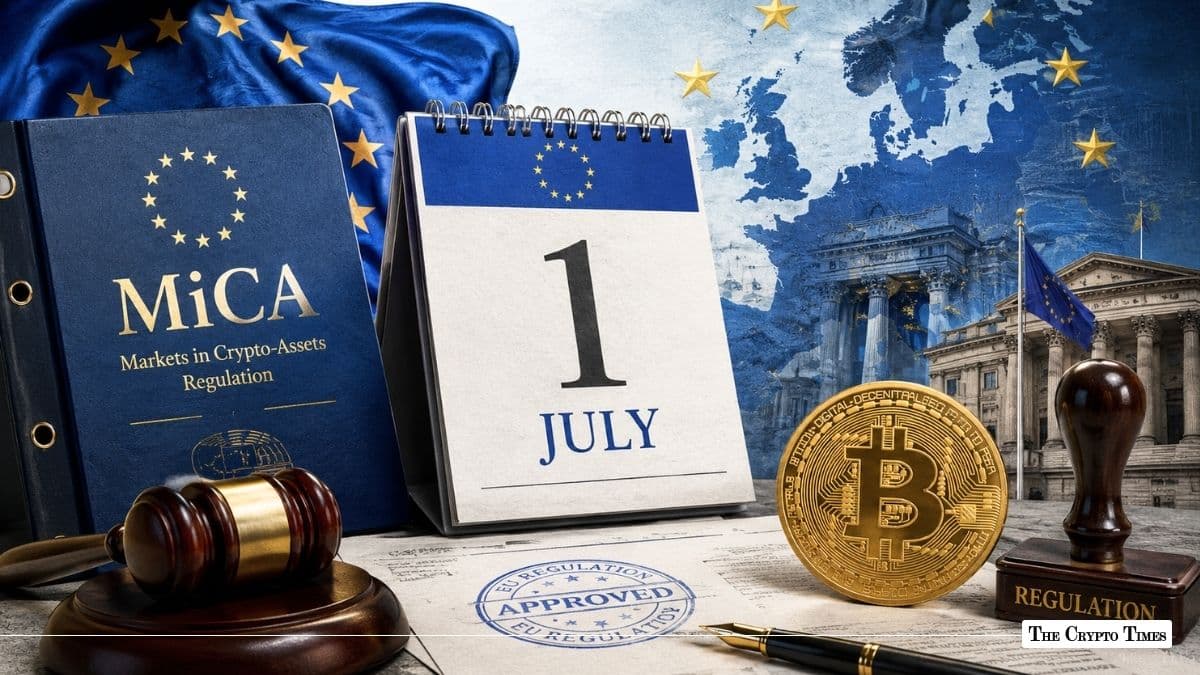
On July 1, 2026, the 18-month transitional grandfathering period under the Markets in Crypto-Assets Regulation (MiCA) officially expires across all 30 member states of the European Economic Area (EEA). After this date, any crypto-asset service provider (CASP) operating inside the bloc without full regulatory authorization will be acting in direct violation of European law. No further extension windows will be granted.
On July 1, 2026, the transitional period under the Markets in Crypto-Assets Regulation (MiCA) expires across all thirty states of the European Economic Area. After that date, any crypto exchange, broker, or custodian operating without a full MiCA license will be breaking European law. No extensions. No exceptions. Spain’s securities regulator, the Comisión Nacional del Mercado de Valores (CNMV), put it plainly last week: firms that fail to secure authorization must wind down operations and stop serving EU customers.
For the estimated 60 million Europeans who own cryptocurrency, this is not an abstract regulatory milestone. It directly affects which exchanges you can use, which stablecoins you can hold, how your transfers are tracked, and what recourse you have if something goes wrong. Here is what the MiCA deadline means in practical terms.
Key Highlights
- Only about 231-244 firms hold full MiCA authorization out of roughly 1,200 pre-MiCA national registrations, an attrition rate near 80% that is forcing millions of users to switch platforms.
- Tether (USDT) has been systematically delisted across regulated European exchanges, leaving Circle’s USDC and EURC as the dominant compliant stablecoins.
- Every transfer through a licensed exchange now carries full identity data under the Travel Rule, at a zero-euro threshold, meaning no transaction is too small to track.
The great shakeout: About 80% of crypto firms are gone
The numbers tell the story of a deliberate market contraction. Before MiCA, roughly 1,200+ firms operated across Europe under a patchwork of national registrations. As of late June 2026, only about 231-244 entities have cleared MiCA’s licensing bar — an attrition rate near 80%.
The rest face a hard choice: exit Europe entirely, geofence EU users out, or execute an orderly wind-down. For users, “orderly wind-down” means your exchange stops accepting deposits, disables trading, and puts your account into withdrawal-only mode. You keep your assets, but you lose the ability to trade or earn on that platform within the EU.
A crucial nuance is that of those ~230-244 licensed CASPs, only about 14-15 hold the specific authorization needed to run a multilateral trading platform — a traditional exchange. Yet those few venues already handle an estimated 70% to 95% of all EU crypto trading volume. MiCA has not so much redistributed the market as confirmed a consolidation that had already happened: liquidity long ago migrated to a handful of compliant giants, and the deadline simply eliminates the long tail.
This is not theoretical. Binance, the world’s largest exchange by volume, confirmed this week that it will halt EU services from July 1 after its MiCA license bid in Greece collapsed. The exchange withdrew its application on June 24, a week after reports came out that Greek regulators (alongside Irish and Latvian counterparts who jointly tracked the application) were poised to reject it, citing concerns over Binance’s past legal issues and complex corporate structure. Apparently, the Greek HCMC delay was not merely bureaucratic but heavily influenced by political pressure from central European authorities, including the European Central Bank, which is aggressively advancing its own Central Bank Digital Currency (CBDC) agenda via the digital euro. An independent, offshore-headquartered exchange commanding massive parallel liquidity, particularly deep liquidity in U.S. dollar-pegged stablecoins, represents a direct challenge to the Eurosystem’s centralized monetary roadmap
Customers in Poland, Italy, Spain, and France, markets where Binance held local registrations that MiCA now voids, received emails explaining how to withdraw. Other major platforms absent from the ESMA register include Upbit, Bitget, MEXC, and HTX. If your exchange is on that list, you need to act before July 1.
Who can still serve you?
The flip side of the shakeout is clarity. If an exchange holds a MiCA license, it can passport that single authorization across all 27 EU member states and three EEA countries — and 86% of licensed CASPs are already using those passporting rights to serve clients beyond their home market. You no longer need to wonder whether your platform is “legal in my country.” One license covers the entire bloc.
The licensed landscape has consolidated around a handful of jurisdictions (figures reflect approximate ranges per the ESMA interim register and MiCA SCAN aggregation as of Q2 2026):
| Jurisdiction | CASP Authorizations | Profile & Strategic Positioning |
|---|---|---|
| Germany (BaFin) | 53–56 | Over a quarter of all EU licenses; heavily favored by regulated banks and institutional custodians due to its robust, preexisting crypto custody frameworks. |
| Netherlands (AFM) | 25–26 | Attracts crypto-native trading platforms and cross-border digital payment providers; strictly enforced its structural transition early. |
| France (AMF) | 13–21 | Acts as the premier hub for major sovereign stablecoin issuers and globally systemic financial entities. |
| Malta (MFSA) | 12–15 | Serves as a key strategic operational gateway for global exchanges seeking immediate EU passporting capabilities. |
| Ireland (CBI) | 12 | Demands genuine local operational presence over shell entities; favored by elite international exchanges pursuing dual MiCA and e-money licensing. |
| Lithuania | 10 | Functions as a highly streamlined, compliance-accessible entry point for smaller brokerage and payment transfer firms. |
| Austria (FMA) | 9 | Acting home base to prominent native European retail exchanges and expanding Asian-platform corporate subsidiaries. |
The major global exchanges that have secured licenses include:
- Coinbase — licensed in Luxembourg (CSSF), the first major U.S. exchange to build a dedicated MiCA hub in Europe
- OKX — authorized in Malta (MFSA) since January 2025
- Kraken — licensed in Ireland, holding MiCA, MiFID II, and electronic money licenses simultaneously
- Bybit — authorized in Austria (FMA) with local headcount
- KuCoin — licensed through Malta and Germany after prior regulatory friction
Traditional finance is entering through the same door. Italy’s Banca Sella became the first Italian bank to receive MiCA authorization, with Intesa Sanpaolo building a Bitcoin position exceeding €200 million; Trade Republic and N26 hold German approvals; and Société Générale–Forge is licensed for institutional stablecoin issuance. A consortium of 37 European banks, Qivalis, is developing a MiCA-compliant euro stablecoin. For infrastructure providers caught in the transition, services like BitGo Europe’s MiCA-compliant Crypto-as-a-Service platform offer a lifeline — letting smaller firms plug into regulated custody and trading infrastructure while pursuing their own licenses.
For users, this means you may soon access crypto through your existing banking app, not just a crypto-native exchange — and the line between “crypto” and “banking” is dissolving in real time. Across the licensed CASPs, custody is the foundational permission (held by approximately 140 firms), followed by order execution (122), crypto-to-fiat exchange (110), and crypto-to-crypto exchange (94); portfolio management (31) and advice (25) remain rare.
What happens to your USDT?
If you hold Tether (USDT) on a European exchange, this section matters most.
MiCA classifies fiat-pegged stablecoins as Electronic Money Tokens (EMTs) and requires issuers to hold an EMI or banking license, maintain 1:1 liquid reserves, and keep between 30% and 60% of those reserves as unencumbered cash deposits in regulated EU credit institutions. Tether has explicitly refused to comply, arguing that concentrating reserves in fractional-reserve commercial banks would expose the stablecoin to catastrophic single-counterparty failure risks (citing the collapse of Silicon Valley Bank), and maintaining that its model of holding approximately 80% of reserves in highly liquid US Treasury bills is fundamentally safer.
The consequence is systematic: because MiCA bars licensed exchanges from listing unauthorized stablecoins, regulated venues across Europe, including Coinbase, Kraken, OKX, and Crypto.com, have restricted or delisted USDT spot pairs for EEA users. EU residents can still technically hold USDT in unhosted wallets or trade it on decentralized exchanges, but it has been entirely excised from the regulated centralized financial perimeter. If you still hold USDT on a platform transitioning out of Europe, swap into a compliant stablecoin or withdraw before access is cut.
Circle secured its EMI license in France in July 2024 and added a MiCA CASP authorization in April 2026, making USDC and EURC the dominant compliant stablecoins. The EBA register now tracks 20 authorized EMT issuers offering distinct tokens across multiple fiat currencies, yet the majority are e-money institutions rather than banks, and USDC remains one of the very few top-10 stablecoins by market cap that is fully MiCA-compliant. Tellingly, the register shows zero authorized Asset-Referenced Tokens (the multi-currency or commodity-backed category): the intense prudential capital requirements, complex governance standards, and extensive white paper obligations proved so prohibitive that tokenized-gold and basket stablecoins have effectively been frozen out of regulated EU distribution entirely.
The rules also carry a sovereignty safeguard: under Article 23 of MiCA, if a non-euro stablecoin (such as a US dollar-pegged EMT) is used primarily as a medium of exchange within the EU and exceeds 1 million daily transactions or €200 million in daily transaction value, the issuer must halt issuance and submit a remediation plan. This is not merely a prudential risk safeguard, it is a profound macroeconomic instrument designed to enforce the monetary sovereignty of the Eurozone, preventing “infrastructure dollarization” as retail, corporate, and interbank settlements migrate to blockchain rails. Europe does not intend to let dollar-pegged tokens become the default rail for euro-zone commerce.
The end of anonymous transfers
While MiCA governs who can operate, the revised Transfer of Funds Regulation (TFR) governs how your crypto moves. Regulation (EU) 2023/1113, which became fully applicable on December 30, 2024 alongside the MiCA CASP provisions, aligns the EU with FATF Recommendation 16, but implements the strictest possible interpretation of the global standard.
In fiat banking, the Travel Rule kicks in at €1,000. In crypto, the EU TFR applies a draconian zero-euro threshold to all crypto-asset transfers, significantly stricter than the FATF’s $1,000-$3,000 de minimis threshold or FinCEN’s US implementation. Every transfer, whether one euro of a stablecoin or one million euros of Bitcoin, must carry the originator’s name, address, and account identifier plus the beneficiary’s name and address, in a comprehensive, machine-readable, IVMS101-compliant data payload. If a transfer arrives without that data, the exchange cannot credit it, the funds sit in quarantine until the information is supplied, or the transfer is rejected.
Between exchanges this is mostly invisible; the platforms exchange the data behind the scenes. The friction bites when you touch a self-hosted wallet. For any withdrawal over €1,000 to a wallet you control, the exchange must verify you own the destination address, typically via the Address Ownership Proof Protocol (AOPP), where you sign a message with your private key, or a “Satoshi Test,” sending a small transaction from your wallet to prove control.
National regulators are layering on enforcement. Poland’s proposed bill, vetoed by President Karol Nawrocki three times (December 2025, February 2026, and June 2026), would have granted its regulator the power to order telecommunications providers to block crypto-related internet domains within 48 hours, and to freeze crypto-asset accounts for up to 96 hours on mere administrative suspicion of illicit activity, with public prosecutor extensions of up to six months.
Because Poland’s parliament has failed to secure the three-fifths majority required to override the veto, Poland officially breached the July 1, 2026 deadline without designating the KNF as its MiCA authority, creating a scenario best described as lex imperfecta: Polish crypto entities are bound by MiCA’s substantive obligations, but possess no domestic mechanism to actually receive CASP authorization or EU passporting rights. The European Parliament has also banned privacy coins, mixing services, and anonymity tools on regulated platforms outright.
What protections do you actually get?
Here is what MiCA gives you that the old system did not:
Asset segregation. Licensed exchanges must legally separate your crypto from their own holdings, are prohibited from re-using client assets, and must perform daily reconciliations. If the platform goes bankrupt, your assets sit outside the insolvency estate — the direct lesson of FTX, where customer funds were commingled with corporate trading.
White paper requirements. Any token offered to the public must publish a standardized MiCA white paper detailing rights, risks, technology, and issuer. It is no guarantee of quality, but it is a baseline that was previously optional; and if a project’s marketing contradicts its white paper, the issuer and any platform hosting that content face civil liability.
Marketing standards. All crypto advertising must be “fair, clear, and not misleading,” with risk warnings given equal prominence to any claims about returns. The era of “guaranteed 100x” banners is legally over, and regulators are enforcing: the Netherlands’ AFM fined a financial influencer more than €620,000 for hidden advertising and unlicensed advice.
Complaint handling and wind-down protections. Licensed CASPs must maintain formal complaint procedures with defined timelines, and any exchange that exits or loses its license must wind down in an orderly way — clear notice, time to withdraw, and information on alternatives — not simply vanish.
What MiCA does not give you: FDIC-style deposit insurance. If your exchange is hacked or your stablecoin issuer fails, no government guarantee covers your losses. Segregation reduces insolvency risk; it does not eliminate market, smart-contract, or operational risk.
The teeth behind the rules
MiCA is a binding regulation backed by penalties designed to make noncompliance genuinely painful.
| Violation | Maximum Penalty |
|---|---|
| CASP licensing/conduct/consumer rules | €5 million or 5% of annual turnover |
| Stablecoin (EMT/ART) issuer breaches | €5 million or 12.5% of annual turnover |
| Market abuse and manipulation | €15 million, 15% of turnover, or 3× the profit gained |
Beyond fines, MiCA pierces the corporate veil: regulators can hold individual executives personally liable for systemic failures, with bans from financial-sector management roles of up to 10 years for repeat offenders. They can also instantly revoke licenses, freeze corporate assets, and publicly name violators, a naming-and-shaming that triggers customer flight and severs banking relationships.
The enforcement is not hypothetical: across 2025, average fines for AML and KYC failures reached €6.8 million, and nearly 60 CASPs lost their authorizations. ESMA’s June 23 warning made clear that coordinated actions will follow for significant unauthorized firms still serving Europeans after July 1.
Your action checklist before July 1
- Check the ESMA register. Search for the exact legal entity that operates your account — the specific subsidiary, not just the brand. MiCA protections apply only to the authorized EU entity, not to others in the same group.
- If your exchange isn’t listed, move your assets. Transfer to a licensed platform (Coinbase, Kraken, OKX, Bybit, KuCoin and others hold full authorizations) or withdraw to a self-hosted wallet. Don’t wait — withdrawal times may lengthen as millions act at once.
- Audit your stablecoins. Swap USDT into USDC, EURC, or another compliant token before your platform restricts pairs. Once an exchange goes withdrawal-only, you may not be able to swap.
- Prepare for wallet verification. For withdrawals over €1,000 to a hardware or self-hosted wallet, be ready to prove control via AOPP signing or a micro-transaction test.
- Document everything. Save transaction histories, statements, and withdrawal confirmations for tax reporting and any future dispute.
The Binance question
The collapse of Binance’s EU ambitions is the most visible casualty of MiCA enforcement. Binance’s head of Europe told Reuters that “Binance is not leaving Europe,” framing it as a service suspension rather than a permanent exit; the exchange says user funds “remain safe and secure” and that it is not telling users to withdraw by July 1.
But the practical reality is clear: staying on an unauthorized platform means forfeiting every protection MiCA provides; no asset-segregation guarantee, no formal complaint procedure, no regulatory oversight. If you are a Binance EU user, verify its status on the ESMA register, move assets to a licensed exchange if needed, swap any USDT into a compliant stablecoin, and, if you prefer self-custody, withdraw to a hardware wallet (bracing for the ownership-verification step on any future deposits back to a regulated venue). Competitors are not being subtle: Bitpanda’s founder publicly invited displaced traders to his Austrian exchange, and OKX has run a months-long campaign promoting its compliance credentials.
The bigger picture for European crypto
MiCA’s effects extend well beyond individual accounts.
The institutional door is opening. With clear rules in place, banks and asset managers are entering crypto for the first time — Banca Sella’s notification-route authorization, Intesa Sanpaolo’s $235M multi-asset position by Q1 2026, the 37-bank Qivalis stablecoin consortium spanning 15 countries — dissolving the line between crypto and banking.
Monetary sovereignty is being asserted. The stablecoin caps and localized-reserve rules are a deliberate defense of the euro, ensuring dollar-pegged tokens cannot become Europe’s default digital payment rail. The Binance episode illustrates the underlying tension: the European Central Bank’s aggressive push for the digital euro creates structural friction with major offshore exchanges whose deep dollar-stablecoin liquidity represents a direct challenge to the Eurosystem’s centralized monetary roadmap.
A GDPR-style export is underway. Just as GDPR became the global privacy standard, MiCA is being studied as a template across Asia, the Middle East, and Latin America — and multinational firms adapting to it will likely apply the same standards worldwide.
A supervision fight is brewing. Behind the scenes, a clash is intensifying over whether ESMA should take direct oversight of major platforms, stripping that power from national regulators. The three biggest licensing hubs, i.e. Malta, Luxembourg, and Ireland, are resisting, arguing their hands-on experience makes them better suited than a Brussels agency. The outcome will decide whether MiCA becomes a truly unified market or a national patchwork under a common rulebook.
The bottom line
MiCA is not perfect. The Travel Rule’s zero-euro threshold is stricter than banking. The stablecoin rules purged significant liquidity. The licensing process eliminated hundreds of platforms and narrowed user choice. Privacy-focused users will find the new surveillance fundamentally at odds with crypto’s pseudonymous roots.
But for the majority of European users, people who buy Bitcoin on an exchange, hold stablecoins for payments, or use DeFi through custodial on-ramps, MiCA delivers something that did not exist before: legal certainty that your exchange must segregate your assets, disclose its risks, and answer to a regulator if it fails. The frontier era of European crypto is over. What replaces it is a regulated, institutional-grade market that trades freedom for safety and innovation for stability.
As traditional banking consortiums like Qivalis prepare to launch regulated on-chain settlement infrastructure, and as authorization is just the beginning of continuous compliance, the future of European crypto is a highly supervised financial ecosystem where compliance is the sole currency of survival. Whether that trade is worth it depends on what you value most. As of July 1, 2026, it is no longer optional.
Also Read: MiCA July 1 Deadline Puts 9 Crypto Platforms On Europe Watchlist