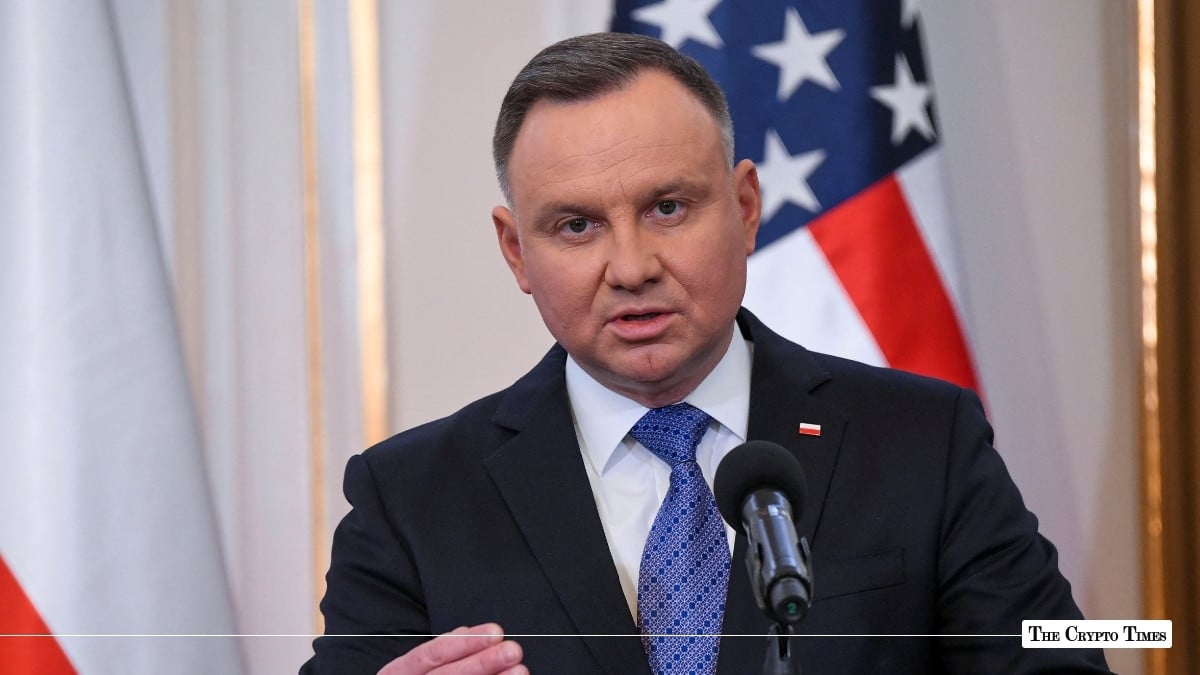
Polish President Karol Nawrocki has vetoed the country’s cryptocurrency regulation bill for the third time. This decision has plunged Poland’s digital asset ecosystem into a state of structural panic as the country rapidly approaches a critical European Union regulatory deadline.
According to a Reuters report, the legislation, approved by lawmakers in May, was intended to establish a comprehensive regulatory structure for digital assets and bring Poland into alignment with the EU’s landmark Markets in Crypto-Assets (MiCA) framework. However, Nawrocki refused to sign the bill, arguing that the government ignored key recommendations submitted by his office during previous legislative reviews.
Support the regulation, but needs amendments
In a statement released on Thursday, Nawrocki emphasized that he supports oversight of the cryptocurrency sector but believes the current legislation requires amendments before it can become law.
“I support regulating this market. I support consumer protection, but it must be done effectively. The law that reached my desk is almost identical to the draft I vetoed twice before. A bad law passed a hundred times is still a bad law.” Nawrocki said. “The bill will be signed into law if it is amended.”
Nawrocki argued that the current text focuses heavily on fighting what the government deems a “crypto shadow economy” rather than introducing a balanced system that protects consumers without suffocating technological growth. According to the Presidential Palace, parliamentary leaders incorporated only one out of 16 specific regulatory modifications proposed by his office during previous legislative sessions.
Poland risks falling behind MiCA timeline
The bill was designed to implement the European Union’s MiCA framework, which establishes common rules for crypto exchanges, stablecoin issuers, custodians, and digital asset service providers across the bloc.
Poland is required to align its domestic regulations with MiCA requirements before the EU implementation deadline, making the latest veto particularly significant for crypto businesses operating in the country. The delay could leave firms facing uncertainty as they prepare for Europe’s new regulatory regime.
The July 1 cliff
The timing of this third veto is also uniquely damaging for the domestic Web3 industry. Under EU rules, member states must formally designate their national supervisory bodies ahead of the final transition window on July 1, 2026. The vetoed bill would have officially empowered the Polish Financial Supervision Authority (KNF) to oversee the space, issue operational licenses, and implement financial penalties.
Without this local legal structure active, the KNF cannot grant MiCA-compliant licenses to local operators. Consequently, Polish Crypto Asset Service Providers (CASPs) will be unable to leverage the EU’s “passporting” privileges, which allow a company regulated in one member state to trade freely across the multi-trillion-dollar European single market.
Industry analysts warn that domestic crypto operators face a brutal choice: freeze their growth models or completely relocate their corporate entities to crypto-friendly jurisdictions like France, Germany, or Malta to preserve their European customer base.
Geopolitics and national security complications
The gridlock has triggered intense criticism from the Ministry of Finance. Prime Minister Donald Tusk openly questioned the President’s motivations on X, implying that the persistent vetoes create national security vulnerabilities.
The Tusk administration has repeatedly argued that an unregulated domestic crypto footprint exposes Poland to financial subversion, specifically alleging that illicit web networks are heavily infiltrated by entities linked to Belarusian and Russian geopolitical sabotage campaigns.
As France and other EU neighbors accelerate their compliance mechanisms, threatening non-licensed firms with mandatory, orderly wind-downs, Poland’s legislative framework remains completely frozen. Parliament currently lacks the strict three-fifths majority required to override Nawrocki’s veto, meaning lawmakers must either yield to the President’s softer approach to tech oversight or let the July 1 deadline pass with the country’s crypto sector locked entirely in limbo.
Also Read: Anthropic’s Claude Fable 5 Just Put $120–150 Billion in Crypto at Risk