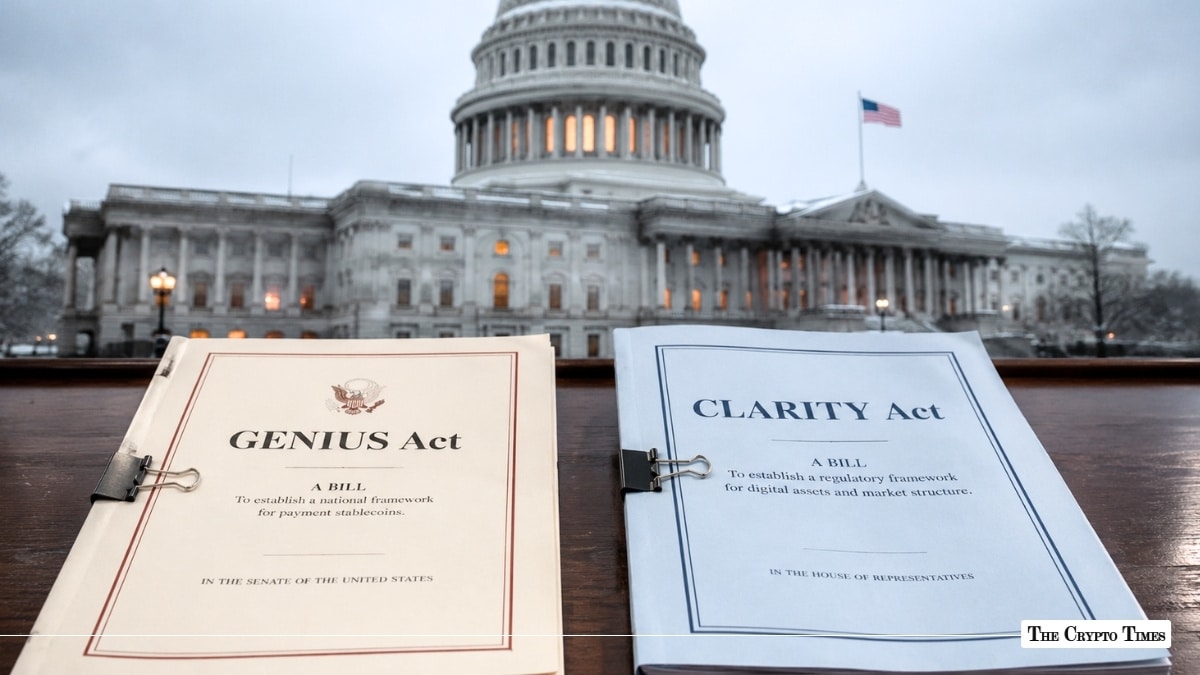
The United States now has a strange distinction in crypto policy: it is simultaneously failing to implement the crypto law it passed and failing to pass the crypto law it needs. On July 18, 2026, the first anniversary of the GENIUS Act, the federal agencies charged with writing its stablecoin rules let the statutory deadline expire without a single finished regulation. At the same time, the CLARITY Act, the market-structure bill meant to be crypto’s other pillar, sits stalled in the Senate with the clock running toward an August recess.
Two landmark laws, two forms of paralysis. Together they leave the world’s largest economy legislating crypto in slow motion while the rest of the world sprints.
GENIUS Act: Passed, Signed, Yet Still Not Operational
The GENIUS Act, short for the Guiding and Establishing National Innovation for US Stablecoins Act, was signed by President Trump on July 18, 2025, the first standalone federal crypto framework to clear Congress. It set out the architecture of a regulated stablecoin: full 1:1 reserve backing in cash or short-term Treasuries, licensing for issuers, anti-money-laundering programs, redemption rights, and public disclosure.
Section 13 of the law gave regulators exactly one year to turn that architecture into enforceable rules. That year ended on July 18, 2026, and the rules did not arrive. According to rulemaking trackers maintained by the law firm Chapman and by Paradigm, the six bodies involved — the Treasury, the Office of the Comptroller of the Currency, the FDIC, the NCUA, the Federal Reserve, and FinCEN/OFAC — collectively issued roughly ten proposed rules over the year but finalized none of them. The OCC proposed its main framework in February; the FDIC and Treasury followed in April. Several comment periods remain open past the deadline itself, with one stretching to August 21. The Federal Reserve never even published a standalone proposed rule.
The Deadline That Doesn’t Bite, And The One That Does
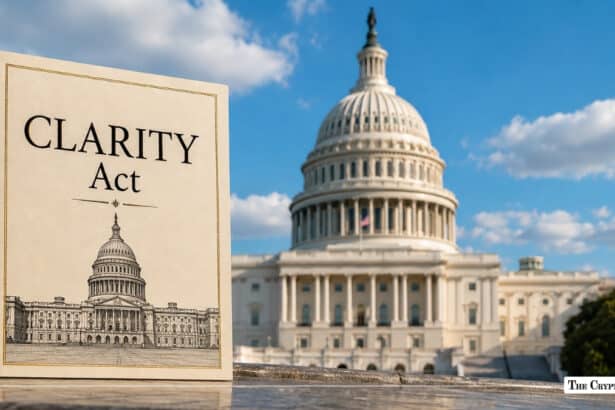
If GENIUS is stuck in the regulatory phase, the CLARITY Act is stuck a step earlier; it cannot even become law. The Digital Asset Market Clarity Act would resolve the question GENIUS deliberately left aside: which regulator, the SEC or the CFTC, oversees the broader universe of crypto assets, with most digital commodities like Bitcoin falling to the CFTC.
It passed the House in 2025 and cleared the Senate Banking Committee 15-9 in May, but has since stalled. A merged Banking-Agriculture draft dropped the ethics provision Democrats demanded, prompting three senators to formally oppose it, and crypto’s own prediction market has cut the odds of 2026 passage to around 35%, down from above 80% in February.
As the third week of July began, there was still no floor date, no updated bill text, and, by the count of the newsletter Crypto in America, whose Eleanor Terrett has closely tracked the negotiations, just 14 working days before the recess. Ethics remains the elephant in the room.
President Trump met privately in the Oval Office last Thursday with Chief of Staff Susie Wiles, White House Counsel David Warrington, Crypto Council chief Patrick Witt, Acting Attorney General Todd Blanche, and Republican Senators Cynthia Lummis and Bernie Moreno to try to nail down provisions barring officials from profiting off digital assets. Yet as of Monday morning, sources told Crypto in America, the White House still had not made clear which ethics parameters it would support, the sticking point now holding up the release of updated text, with Democrats saying they have been left largely in the dark.
The delay ripples outward, because without new text the industry itself is guessing at what has changed. Blockchain Association CEO Summer Mersinger said she expects the Section 604 developer shield (the BRCA) to “remain intact” and the Banking portion to hold, with negotiators “down to technical edits” on the Agriculture Committee’s language covering exchange vertical integration, affiliate trading, and state-law preemption. But the developer shield drew fresh fire last week when the National Sheriffs’ Association released a video branding crypto “the cartel currency of choice,” complicating the effort to win over Democrats like Catherine Cortez Masto and Mark Warner, who have signaled their support hinges on whether law-enforcement and DOJ concerns about illicit finance are addressed. “I want America to lead in digital assets,” Warner said last week, “but if we get it wrong, the downside ramifications could be huge as well.”
The mechanics leave almost no room. Capitol Hill’s prevailing view is that negotiators have until the end of this week to tee up a cloture vote on the motion to proceed, the 60-vote threshold to get the bill onto the floor at all. If CLARITY Act does not reach the floor next week, the window before the August recess effectively closes, pushing the bill past the midterms and, by Senator Cynthia Lummis’s warning, potentially toward 2030.
Why The Dual Delays Compound Each Other
Taken alone, each delay is a headache. Together they create a vacuum with a shape. The two laws were designed as complementary halves of a single framework: GENIUS governs the dollar tokens, CLARITY governs everything else and settles the regulatory turf war. With GENIUS unfinished and CLARITY unpassed, neither half is load-bearing, and the entire US crypto market is operating on proposals, no-action postures, and agency discretion rather than settled law.
That is not a neutral limbo: it picks winners. As some analysts have noted, while the rulebook stalls, federal regulators have moved quickly to grant national trust-bank charters to a small group of crypto firms, reshaping the competitive landscape before the rules that would govern everyone exist. Circle secured approval for a national digital currency bank; others are in the queue. In a vacuum, discretion flows to whoever regulators choose to bless case by case, and the advantage accrues to the largest, best-lawyered incumbents rather than being set by transparent rules applied evenly. Ambiguity is not the absence of a policy. It is a policy, and it favors those already inside the tent.
The Global Divergence That Should Worry Washington
The timing is unforgiving, because the rest of the world is not waiting. In the same month the US missed one deadline and drifted past another, Japan advanced landmark legislation to legalize Bitcoin ETFs and cut its crypto tax to a flat 20%; Europe’s MiCA regime is fully live and has already licensed 294 firms, banks included; and South Korea’s ruling party just committed to fast-track a won-stablecoin law with a September target.
The US wrote its rules first and is now the jurisdiction struggling to make them work.
Lummis put the stakes bluntly earlier this month: “Every month without clear digital asset rules is a month another country writes them for us. That’s not a risk. It’s already happening.” The GENIUS miss and the CLARITY stall are that sentence rendered in calendar form.
Three Things to Watch Next
There are three threads over the coming weeks.
- First, whether regulators close their open comment periods, including the OCC’s anti-money-laundering and sanctions rules, whose comment window closes this Friday, and move to final GENIUS rules quickly enough to give issuers a usable runway before January 2027, or whether the compliance crunch tightens further.
- Second, whether Republicans release updated CLARITY text and tee up a cloture vote by the end of this week; miss that, and floor passage before the recess effectively dies.
- Third, and most telling, whether the charter-by-charter approach continues to reshape the market in the rulebook’s absence.
The United States spent two years arguing that clear rules would cement its crypto leadership. It got the arguments passed into law and the leadership claimed in speeches. What it has not yet produced is the one thing the industry actually asked for: rules that are finished, in force, and the same for everyone. On the first anniversary of the GENIUS Act, that remains conspicuously missing.
Also Read: South Korea Targets September for Won Stablecoin Bill, Vows Fortnightly Reviews