On July 18, 2025, President Donald Trump signed the Guiding and Establishing National Innovation for U.S. Stablecoins (GENIUS) Act into law. It passed with strong bipartisan support, winning 68–30 in the Senate and 308–122 in the House. The law marked the first time the United States created a comprehensive federal framework for a category of cryptocurrency.
Exactly one year later, the law is reshaping the digital currency landscape, shifting momentum in the stablecoin market away from early crypto startups and toward the nation’s largest commercial banks and best-capitalized incumbents. Stablecoins are digital tokens designed to track a real-world currency like the U.S. dollar 1-to-1. Historically, they operated in a legal gray area. Startups issued them under a loose patchwork of state laws, while federal agencies fought over who should regulate them.
The GENIUS Act changed that. It clarified that compliant payment stablecoins are not securities, stripping the Securities and Exchange Commission (SEC) of enforcement authority over the asset class and placing oversight with federal banking regulators, led by the Office of the Comptroller of the Currency (OCC). This one-year milestone is not just an anniversary. July 18, 2026, also marked the statutory deadline for federal agencies to finish writing many of the rules that will govern the market.
With full enforcement approaching in January 2027, the industry finds itself in an ironic position. A law promoted as a way to foster private crypto innovation is building a framework whose compliance demands are easiest for traditional Wall Street institutions to meet.
What rules did the GENIUS Act introduce?
The GENIUS Act centers on a newly defined asset class: the “payment stablecoin.” The law defines this as a digital asset built on a blockchain that an issuer must redeem for a fixed dollar value on demand. To protect consumers and the broader financial system, the law introduces three key rules.
Rigid 1-to-1 reserve backing
The primary rule is that every digital dollar issued must be backed at least 1-to-1 by safe, liquid reserve assets. The law bars risky assets, corporate debt, algorithmic models, and other cryptocurrencies from backing these tokens. Permitted reserves are limited to a narrow list:
- Actual U.S. coins and physical currency, and balances at a Federal Reserve Bank.
- Demand deposits (or insured shares) held at insured depository institutions.
- Short-term U.S. Treasury bills, notes, or bonds with a remaining maturity of 93 days or less.
Repurchase agreements backed by qualifying Treasuries and government money market funds that invest only in the assets above.
The strict ban on retail interest and yield
In the early days of crypto, stablecoin applications attracted users by offering passive income or interest on digital-dollar deposits. The GENIUS Act ends this practice for regulated tokens. It bars any permitted issuer from paying interest, yield, or rewards to holders simply for holding the stablecoin.
Congress included this rule so that stablecoins act as a medium of exchange rather than an investment vehicle that competes directly with regulated bank savings accounts, a provision that also gives tokenized bank deposits an advantage over stablecoins.
The big tech restriction
The law includes a corporate firewall designed to keep technology giants from launching dominant private currencies. Public companies that are not predominantly engaged in financial activities, the large non-financial tech and commercial firms, are barred from issuing payment stablecoins unless they clear a high bar: unanimous approval from a special federal committee (the Treasury Secretary, the Federal Reserve Chair, and the FDIC Chair), based on findings about data privacy and consumer protection.
In practice, that keeps digital-dollar payment networks separate from massive e-commerce and social-media platforms.
Also Read: The Liquidity Moat: Why Open USD Won’t Displace USDC and USDT
Who regulates stablecoins now?
Before the GENIUS Act, the biggest obstacle facing the U.S. crypto industry was a regulatory turf war. The SEC frequently argued that stablecoins were unregistered securities, while the Commodity Futures Trading Commission (CFTC) treated them as commodities. Businesses were caught in a cycle of uncertainty and litigation.
The GENIUS Act resolved this through a definitive jurisdictional carve-out. The law states that a compliant payment stablecoin is neither a security nor a commodity. That language removed the SEC’s ability to pursue compliant issuers and moved stablecoin oversight into the federal banking system.
The result is a framework administered chiefly by four federal banking regulators, with the Treasury handling financial-crime compliance:
- The Office of the Comptroller of the Currency (OCC): the lead regulator, responsible for licensing “permitted payment stablecoin issuers” (PPSIs), including nonbank issuers and the subsidiaries of national banks.
- The Federal Reserve and the FDIC: the Fed oversees issuers tied to its supervised banks, while the FDIC supervises stablecoin issuance by subsidiaries of insured commercial banks. The National Credit Union Administration plays the equivalent role for credit unions.
- The U.S. Department of the Treasury: through FinCEN and the Office of Foreign Assets Control (OFAC), ensures issuers run comprehensive Anti-Money Laundering (AML) and sanctions-screening programs, and it chairs the committee that certifies whether state regimes are “substantially similar” to the federal one.
Importantly, the law is not federal-only. Issuers above $10 billion in outstanding stablecoins must move under federal oversight, but smaller issuers can operate under state regimes certified as substantially similar, a detail that softens but does not erase the advantage held by large institutions.
The year of hyper-growth: Market cap analysis
The clearest proof of the GENIUS Act’s impact is the expansion in the supply of digital dollars over the past year. Rather than freezing the market, regulatory clarity acted as a green light for capital.
Trailing 12-month expansion
When the bill was signed on July 18, 2025, the total global stablecoin market capitalization sat around $260 billion. A year later, it stands at roughly $315 billion, per DeFiLlama, an increase of more than $50 billion, or over 20%, in circulating supply in a single year.
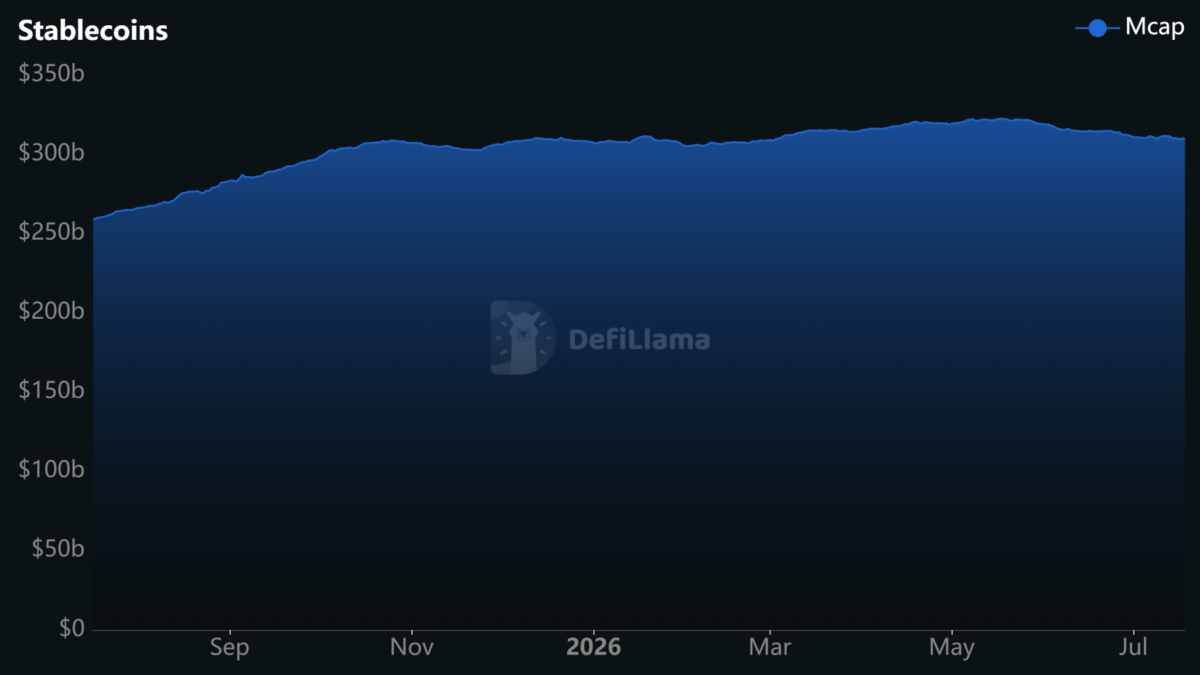
Data from DeFiLlama shows Tether’s USDT continues to dominate with about 59% of the market, followed by Circle’s USDC at roughly 24%. Together, the two account for more than 83% of the entire stablecoin supply, underscoring that the past year’s growth has largely been led by the two incumbents.
The remaining share is spread across a long tail of smaller tokens, including Sky Dollar (USDS), DAI, Ethena’s USDe, PYUSD, and USDG, each holding low single-digit percentages or less. Their collective presence reflects a gradual diversification of the ecosystem following the regulatory clarity the GENIUS Act introduced, but market leadership remains firmly with USDT and USDC. (Share figures are DeFiLlama snapshots and shift from week to week.)
How the first year reshaped the competitive landscape
While the overall market expanded, the compliance burden created clear advantages and disadvantages among issuers.
A higher bar for crypto-native issuers
Before the GENIUS Act, the market was dominated by crypto-native companies operating via state trust licenses, such as Circle (issuer of USDC) and Paxos. Meeting federal standards meant building out bank-grade compliance functions, restructuring governance, and submitting to continuous federal examination, costs that fall hardest on smaller startups.
The largest crypto-natives, however, adapted rather than disappeared. In December 2025, the OCC granted conditional national trust bank charters to Circle, Paxos, Ripple, BitGo, and Fidelity, giving them a federal path to issue under the new regime. The squeeze is felt most by smaller players that lack the capital to clear the federal bar and cannot rely on a favorable state regime.
The rise of corporate and institutional pilots
Traditional finance has spent the past year moving into the space in force. Because major banks already have advanced compliance teams, direct access to the Federal Reserve’s payment systems, and deep relationships in the Treasury market, they face a simpler path to approval.
Over the year, multiple large U.S. banking groups launched internal pilots for proprietary, dollar-backed settlement networks, often permissioned ledgers built for high-volume business-to-business payments and cross-border corporate settlement rather than consumer-facing public blockchains.
The rulemaking deadline scramble
The reason the crypto world is focused on Washington is the timeline written into the Act. Congress gave regulators roughly 12 months to publish implementing rules. Through the spring of 2026, the agencies moved, but unevenly:
March 2, 2026: The OCC published a comprehensive proposed rule, the most far-reaching of the agencies’ proposals, detailing licensing, reserves, redemption, the yield prohibition, and reporting standards for federally regulated issuers.
April 10, 2026: The FDIC issued its own proposed rule for bank-affiliated issuers, alongside separate Treasury and OCC proposals covering AML and sanctions-compliance obligations.
Even so, the agencies reached the July 18, 2026, milestone without a complete, finalized rulebook in place. As of today, the Federal Reserve has not yet issued its own proposal, and regulators are still working through thousands of public comment letters from the technology sector and the banking lobby.
Traditional banks are lobbying for flexible interpretations that let their existing affiliates process transactions without triggering duplicate licenses. Consumer advocates, meanwhile, warn that the current drafts fall short on fraud protection, dispute resolution, and insurance for retail holders.
That backlog leaves a tight schedule. The GENIUS Act takes full effect on the earlier of two dates: 18 months after signing, January 18, 2027, or 120 days after regulators finalize their rules. With the January backstop approaching, issuers could have only a few months to align their compliance frameworks before non-compliant tokens face federal penalties or operating restrictions.
Unintended consequences of the new law
While the GENIUS Act delivered long-sought legal clarity, its implementation created real market distortions.
The flight of passive income offshore
The ban on stablecoin interest, designed to protect U.S. bank deposits, had a side effect. Over the year, a divide opened between domestic and international users: retail holders seeking yield increasingly moved toward unregulated, offshore synthetic dollars and decentralized yield protocols operating outside U.S. jurisdiction, where returns are still on offer.
The government debt loop
A clear economic effect is the law’s tie to the government bond market. By requiring licensed issuers to back tokens with cash and short-dated U.S. Treasuries, the GENIUS Act has turned regulated stablecoin issuers into a meaningful source of demand for short-term government debt.
With the domestic stablecoin supply now around $315 billion and reserves concentrated in T-bills, licensed issuers collectively rank among the larger buyers of short-term U.S. government paper, aligning the industry’s growth with the Treasury’s funding needs.
The outlook for January 2027
As the GENIUS Act crosses its first anniversary, the narrative around digital dollars has shifted. The era of the unregulated, independent stablecoin startup in the United States is winding down.
The next several months, leading into the January 2027 effective date, will shape the future of digital payments. If the OCC, FDIC, Federal Reserve, and Treasury clear their rulemaking backlogs, traditional commercial institutions will be positioned to deploy regulated stablecoins at scale.
The GENIUS Act was promoted as a bridge to integrate crypto into the American economy. One year on, the bridge is open and carrying traffic, but its design gives the world’s largest banks the smoothest path across.
Also Read: CLARITY, MiCA, GENIUS & UK’s Cap: How H1 2026 Rules Reshaped the Crypto Market
Disclaimer:
Some elements of this content may have been enhanced with the help of our artificial intelligence (AI) assistants for purposes such as basic refinement, review, image generation, and translation to deliver high-quality news in a shorter time frame. However, all AI-assisted content is reviewed and approved by our team to ensure accuracy, fairness, and editorial integrity.