Key Highlights
- SPCX traded around $174.60 at 11:15 a.m. EDT (15:15 UTC) on October 6, up 2.05% after gaining 7.63% on Monday.
- The stock is above its major moving averages, although its 14-day RSI has climbed above 82 after the rapid October rally.
- A move through $180 would bring $190-$200 into focus, while $165-$170 has become the first area to watch if buyers lose momentum.
SpaceX (NASDAQ: SPCX), Elon Musk’s aerospace company behind Starlink, Falcon rockets and the Starship launch system, extended its October rally on Tuesday as its shares moved closer to $180.
SPCX was trading at about $174.60 at 11:15 a.m. EDT (15:15 UTC) on October 6, up 2.05% from Monday’s close, according to Nasdaq market data. The stock had traded between $171.07 and $176.39 during the session.
Tuesday’s rise followed a 7.63% jump on October 5, when SPCX closed at $171.09 on volume of nearly 135 million shares. It had already gained another 7.35% on October 2, rising from $148.07 at the start of the month to $158.96. The October 1-to-October 6 move has lifted the stock by almost 18%.
That rally has quickly changed the October setup. SPCX spent much of September moving around $145-$155 before breaking through $160 and then $170 in only two trading sessions. The next test now sits around $180, while $200 has returned as a realistic upside level if the breakout continues.
SPCX technicals stay bullish as momentum heats up
Monday’s 7.63% gain pushed SpaceX to its highest close since June, extending a rally that The Crypto Times reported on October 6 after Morgan Stanley reiterated its bullish view on the stock.
The move also left SPCX well above the levels it had been trading around only a week earlier. SpaceX closed September at $150.86 and fell to $148.07 on October 1 before buyers returned aggressively.
The technical readings have followed the price higher. SPCX’s five-day simple moving average stood at $168.54 on October 6, with the 10-day average at $165.13, the 20-day at $159.07 and the 50-day at $152.83, according to Investing.com’s daily technical data.
All of those averages remain below the market price, showing that the trend has strengthened across both shorter and longer time frames.
Because I was still writing it as an interpretation of the technical table — phrases like “the readings leave SPCX…,” “reinforcing the broader uptrend,” and “suggesting the trend still carries strength” are analyst-note language rather than clean published copy.
It should read like this:
SPCX holds above key moving averages as RSI reaches 70
SpaceX shares were trading around $173.99, well above their major short- and medium-term moving averages, according to TradingView.
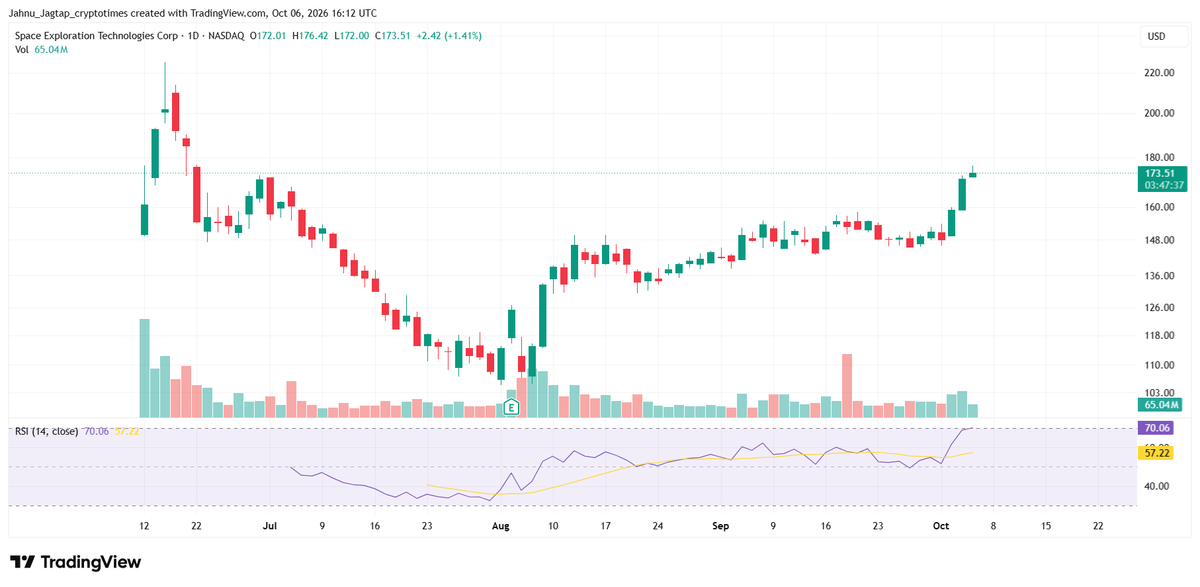
The 10-day exponential moving average stood at $158.09, while the 10-day simple moving average was at $154.28. The 20-day averages were at $153.26 and $152.32, followed by the 30-day averages at $150.61 and $149.47.
SPCX was also trading above its 50-day averages, with the exponential measure at $148.38 and the simple moving average at $141.29. TradingView showed Buy signals across all of these moving averages.
The 14-day Relative Strength Index had climbed to 70.32, bringing SPCX to the edge of overbought territory after the latest rally. Stochastic %K was at 94.08, while the fast Stochastic RSI had reached 100.
Momentum remained positive at 19.31 and MACD stood at 5.37, both carrying Buy signals. The Commodity Channel Index, however, had risen to 310.47 and Williams %R to -7.68, with both showing Sell signals.
With SPCX trading near $174, $180 remains the next level in focus. A pullback would bring the 158-153 area into view, where the stock’s 10-day and 20-day moving averages are currently clustered.
Can SpaceX stock reach $200 in October?
From $174.60, SPCX would need to gain another 14.5% to reach $200. That is a sizable move for the remainder of the month, but not out of line with the volatility SpaceX has already shown. The stock has gained almost 18% since October 1 and previously traded as high as $225.64 after its June listing.
The immediate hurdle is $180, and Tuesday’s $176.39 intraday high brought the stock within about 2% of that level. A sustained move through $180 would extend the breakout above the current October range and leave $190 as the next round-number area before $200.
The strength of the move above $180 would matter more than simply touching it. SPCX has already accelerated sharply away from its 10-day and 20-day averages, so another surge without consolidation would push the stock further into technically stretched territory.
A pullback toward $168-$170 would bring SPCX closer to its five-day average while still leaving it above the levels broken during Monday’s rally. The $163-$165 area sits near the 10-day trend, while the 20-day average around $159 provides a deeper reference point if selling becomes stronger.
A fall through $159 would erase a larger part of the October breakout and make a $200 test this month considerably harder. As long as SPCX remains above the mid-$160s, however, the price structure established since October 2 remains intact.
Starship Flight 15 returns as the next major catalyst
The rally is not being driven by the chart alone.
Morgan Stanley analyst Adam Jonas reiterated an Overweight rating and $300 price target this week, arguing that SpaceX looks cheaper when its expected growth is included in the valuation. His latest research also pointed to the next Starship launch as an approaching catalyst. MarketWatch reported that Jonas was looking ahead to Flight 15 as SpaceX works toward recovering the upper-stage Starship itself.
That mission follows Flight 14, which reached orbit and deployed 26 Starlink V3 satellites. Flight 15 could go further by attempting another major step toward full vehicle reusability, including a possible recovery of the Ship. Space.com reported after Flight 14 that upper-stage recovery is among the next technical hurdles for the program.
The $300 Morgan Stanley figure is a longer-term analyst target rather than an October prediction. At the current share price, SPCX would need to rise more than 70% to reach it.
Other analysts sit closer to the levels currently visible on the chart. TD Cowen has a $200 target, while recent analyst estimates from RBC, UBS and other firms have generally remained above the current market price. The range of targets reflects how differently Wall Street is valuing SpaceX only months after the company entered public markets.
For October itself, $200 is the more relevant level. It sits about 14.5% above the October 6 price and below SPCX’s existing post-IPO high.
SpaceX revenue growth adds support to the rally
SpaceX entered the quarter with revenue expanding considerably faster than it was a year ago.
The company reported second-quarter revenue of $7.8 billion, up 92% from $4.1 billion in the same period last year. Adjusted EBITDA increased to $3.5 billion from $1.2 billion, while the quarterly net loss narrowed to $541 million from just over $1 billion.
Starlink and other connectivity services remained the largest contributor. Connectivity revenue reached $4.29 billion, up from $2.59 billion a year earlier, as Starlink subscribers doubled to 12 million.
SpaceX’s AI business generated another $2.56 billion in quarterly revenue, compared with $737 million a year ago, while its space segment produced $962 million.
The growth has come with heavy spending. AI capital expenditure alone reached $15.8 billion during the quarter, while SpaceX reported total capital spending of $18.37 billion.
Those numbers have made SPCX increasingly sensitive to more than launch activity. Starlink growth, AI infrastructure spending and the economics of Starship are all feeding into a valuation that is now again above the company’s IPO level.
SpaceX sold its Class A shares at $135 when the company went public in June. Its SEC-filed IPO terms show that trading began under the SPCX ticker on June 12, with the company ultimately selling about 638.9 million shares after the underwriters exercised their full overallotment option.
At $174.60, SPCX is roughly 29% above that IPO price.
October also brings more shares into the market
One potential source of selling pressure remains the company’s post-IPO lock-up schedule.
SpaceX did not use a single release date for most restricted shares. Its IPO prospectus established staggered early releases beginning after second-quarter earnings and continuing through 180 days after the IPO.
The next scheduled tranche is due around October 9, when as many as 328.4 million additional shares can become eligible for sale under the staggered schedule. Another tranche follows later in October.
Eligibility to sell does not mean shareholders will immediately sell those shares, but it increases the amount of stock that can potentially enter the market. That matters more after a rally of almost 18% in a few sessions because early holders may be sitting on substantially larger gains than they were at the beginning of the month.
Previous unlocks have not produced a uniform reaction in SPCX, so the event alone does not provide a directional signal. Trading volume around the release will show whether the market can absorb the additional supply while SPCX remains near its October highs.
SpaceX is of the largest corporate Bitcoin holder
SpaceX is primarily being valued on its operating businesses, but the company also holds one of the larger corporate Bitcoin positions.
Its latest SEC filing shows 18,712 BTC on the balance sheet. The position had a cost basis of $661 million and a fair value of about $1.10 billion at June 30.
That holding gives SpaceX some direct exposure to Bitcoin without making SPCX a Bitcoin proxy. Starlink, launch operations, Starship and AI infrastructure remain far larger factors in the company’s valuation.
The Crypto Times has previously detailed how tokenized SPCX products and perpetual contracts allow eligible traders to gain SpaceX-linked exposure through crypto-market infrastructure.
Those instruments are separate from Nasdaq-listed SPCX shares and can have different custody, settlement and shareholder-right structures, but movements in the underlying stock directly affect the market built around them.
SPCX price prediction for October 2026
SPCX enters the rest of October with its strongest momentum since the initial weeks following its IPO.
The stock has already moved from $148.07 on October 1 to around $174.60, and the first test is now whether buyers can carry that momentum through $180.
A confirmed move above $180 would bring $190 into view. From there, $200 becomes achievable without requiring SPCX to revisit its previous $225.64 high. Starship Flight 15 could provide the event-driven momentum needed for such a move if the mission advances SpaceX’s reusable-launch program and the broader market remains supportive.
The chart also leaves room for a pullback before that happens. RSI above 82 shows the rally has moved quickly, while October’s staggered share releases can add supply as SPCX trades near its strongest level in months.
The $168-$170 region is the first area where buyers could attempt to hold a retracement. Below that, $163-$165 becomes more important, followed by the 20-day moving average near $159.
For October, $180 is therefore the level that decides whether SPCX can extend the current breakout toward $190-$200. A move back below the mid-$160s would weaken that setup, while sustained trading above $180 would leave the stock with a clearer path toward $200 before month-end.
The current trend favors buyers, but after an almost 18% gain in less than a week, whether SPCX reaches $200 is likely to depend on how the stock handles its first meaningful pullback as much as on how quickly it can break resistance.
Also Read: Elon Musk’s Tesla and SpaceX Still Hold Over 30,000 Bitcoin: Why Is He Not Selling?