
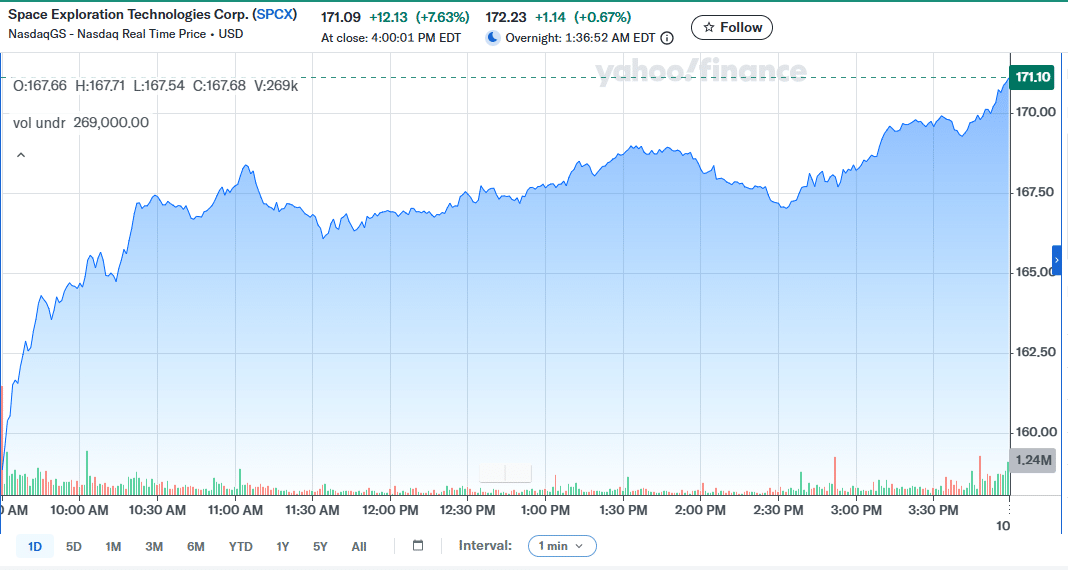
Shares of SpaceX surged again, extending a powerful run for one of the most closely watched stocks since its public debut. Space Exploration Technologies Corp. (NASDAQ: SPCX) closed at $171.09 on October 5, up $12.13, or 7.63%, and was quoted around $172.23 in overnight trading, up 0.67%, according to Yahoo Finance market data.
The move extended SPCX’s roughly 16% gain over the past week, taking the stock to its highest level since its public debut.
The rally also coincided with Elon Musk’s estimated net worth moving back above $1 trillion, according to Forbes’ real-time billionaire tracker. Musk’s wealth is closely tied to his holdings in SpaceX and other companies, so changes in SPCX’s share price can affect his estimated fortune.
Why the Stock Is Up
Several factors have been cited around the rally, with a Morgan Stanley rating and price target among the latest catalysts.
Morgan Stanley’s bullish call. In an October 5 note, Morgan Stanley analyst Adam Jonas reiterated an Overweight rating and $300 price target for SpaceX, describing the shares as “cheap and getting cheaper” on a growth-adjusted basis. The target is substantially above SPCX’s October 5 closing price. Morgan Stanley’s assessment is an analyst view rather than a guarantee of future performance, so the price target should not be presented as a forecast of where the stock will trade.
Starship and Starlink remain key parts of the investment case. SpaceX’s valuation is closely tied to expectations for its launch business and Starlink, its satellite-internet operation. However, the extent to which either business will drive future earnings remains an investor thesis rather than a settled outcome. Any discussion of a potential future Starlink listing should likewise be treated as speculation unless SpaceX or another authoritative source confirms a specific transaction.
Valuation expectations have risen. The recent rally has pushed SpaceX’s implied valuation toward the $2 trillion level, based on the company’s share price and outstanding equity. That figure should be treated as an implied market valuation rather than a separately announced company valuation. The stock’s limited public trading history also means that short-term price moves can materially affect its implied value.
The Crypto Connections
SpaceX’s public-market story also matters to digital-asset investors because of the company’s Bitcoin exposure and Musk’s history of connecting crypto with his broader business interests.
SpaceX and Tesla hold Bitcoin. Musk’s Tesla and SpaceX still hold more than 30,000 BTC. The holdings provide an indirect connection between the companies and Bitcoin, although SPCX should not be described as a direct Bitcoin proxy. The company’s valuation is primarily driven by expectations around its space, satellite and other businesses, while Bitcoin represents one component of its broader corporate exposure.
SpaceX’s investor base also overlaps heavily with the crypto industry. A review of major SpaceX investors found that at least 24 of 30 major shareholders reviewed, or 80%, had documented exposure to cryptocurrencies, crypto ETFs, blockchain companies, stablecoins, or other digital-asset businesses. The figure reflects broader crypto exposure rather than direct cryptocurrency ownership by every institution.
Crypto markets priced SpaceX before the public listing. The Crypto Times previously reported that SpaceX’s IPO made Musk the world’s first trillionaire, while crypto markets had already offered traders exposure to SpaceX’s private-market valuation. That earlier market activity illustrates the role crypto derivatives played in giving traders a way to speculate on the company’s valuation before its public-market debut.
Musk’s wealth has reached crypto-scale numbers. At an estimated $1 trillion-plus, Musk’s fortune is large enough to invite comparisons with the overall cryptocurrency market. Such comparisons are illustrative rather than a direct measure of the relative value of Musk’s wealth and the crypto market, since the two figures represent different asset and valuation concepts.
The Other Side of the Trade
The rally also carries significant risks. SPCX is a newly public, high-volatility stock, and a roughly 16% weekly gain can be followed by equally sharp declines.
A valuation approaching $2 trillion also reflects substantial expectations for SpaceX’s future growth. Delays or setbacks involving Starship, weaker-than-expected Starlink performance, changes to capital-market plans or broader shifts in investor sentiment could affect the stock’s valuation.
Morgan Stanley’s $300 target is an analyst estimate, not a guarantee, while the company’s Bitcoin holdings introduce another source of market exposure. The Crypto Times is not forecasting the future direction of SPCX, Bitcoin, or Musk’s net worth.
Why It Matters
SpaceX’s surge is a milestone for Musk and a marker of how thoroughly space, AI, and crypto narratives have fused in investors’ minds.
For the digital-asset world specifically, SPCX is a reminder that the lines between equities and crypto exposure have blurred: a rocket company can also be a Bitcoin proxy, and a stock’s valuation can be discovered on crypto exchanges before it ever trades on Nasdaq.
Whether SpaceX can grow into its $2 trillion price tag is a question for the years ahead; but for now, the rally has made the world’s richest person richer still, and handed crypto investors another reason to watch a stock that trades under a space ticker.
Also Read: MSTR Price Rises as Strategy’s Bitcoin Holdings Hit 848,000 BTC