
Dogecoin (DOGE), the most popular meme coin in crypto landscape, is trading near $0.0950 as of late September 2026, with a market value of about $16.3 billion and a circulating supply close to 172 billion coins. That is a long way below the May 8, 2021 high of $0.7376. It is also a long way above the coin’s early history as a joke fork.
This forecast does not recycle other websites’ price targets. It starts from Dogecoin’s own design, today’s market cap and supply, the new listed-product wrapper around the asset, and the simple fact that DOGE still trades as high-beta liquidity rather than as a cash-flow security. The numbers below are scenario bands, not promises.
What is Dogecoin (DOGE)
Dogecoin is an open-source peer-to-peer currency launched in 2013. The Foundation manifesto still frames it as a useful, friendly payments coin. The chain runs on Scrypt proof-of-work, produces a block about once a minute, and is merge-mined with Litecoin. Miners receive a fixed 10,000 DOGE subsidy per block. There is no maximum supply. That subsidy adds roughly 5.26 billion coins a year.
By the end of 2030, if issuance stays on that schedule, circulating supply should be near 193–195 billion DOGE. Any 2030 price therefore has to be read against a larger float than today’s. A $1 print at that supply would imply a market cap near $195 billion. That is possible only in a full-scale speculative cycle. It is not the base case from current conditions.
The market wrapper has changed. Investors can now hold Dogecoin through listed products, including the Bitwise BWOW fund and the 21Shares TDOG listing. Paxos has also added Dogecoin to regulated infrastructure used by large payment platforms. Those are distribution facts. They are not the same thing as persistent demand.
September’s tape was ordinary high-beta chop: a dip toward eight cents, a test of the 10-cent handle, then a fade back under a dime. Recent 24-hour volume has been above $1.2 billion. Liquidity is not the problem. Direction is.
How these scenarios were built
The bands below convert market-cap outcomes into price. That is more honest for an uncapped coin than projecting a percentage and ignoring new supply.
Assumptions held constant across all cases:
- Block subsidy stays at 10,000 DOGE.
- Annual issuance stays near 5.26 billion coins.
- DOGE remains listed, liquid, and merge-mined.
- Price stays tightly linked to Bitcoin liquidity and retail risk appetite.
The cases then change only three things: the size of the crypto risk budget, whether listed-product flows add or subtract coins, and whether Dogecoin is used as a payment rail or only as a ticker.
| Horizon | Bear | Base | Bull | What the band implies |
|---|---|---|---|---|
| Remainder of 2026 | $0.055–$0.080 | $0.080–$0.125 | $0.150–$0.220 | Year-end market cap of about $10B, $16–21B, or $26–38B |
| 2027 | $0.045–$0.090 | $0.090–$0.150 | $0.180–$0.280 | First full year in which ETF flows either prove sticky or fade |
| 2028 | $0.050–$0.100 | $0.100–$0.180 | $0.220–$0.350 | Mid-cycle year: either a second liquidity wave or a hangover |
| 2029 | $0.040–$0.090 | $0.090–$0.170 | $0.200–$0.380 | Supply is larger; price needs more capital to hold the same level |
| 2030 | $0.050–$0.090 | $0.110–$0.180 | $0.280–$0.450 | Market cap of about $10–17B, $21–35B, or $55–88B against ~194B coins |
These are ranges, not point targets. The base case is the path that requires the fewest new miracles. The bull case needs a broad crypto expansion plus Dogecoin keeping the default meme-beta slot. The bear case needs only fading attention and one poor liquidity year.
Weekly chart: Price is above the 20-week EMA, still under a bearish stack
On the weekly TradingView chart dated September 29, 2026, Dogecoin closed at $0.09518 after trading $0.09163 to $0.09777. That puts the week 1.74% lower and leaves a spot just above the 20-week EMA at $0.08821, but well below the 50-week EMA at $0.11070, the 100-week EMA at $0.13299 and the 200-week EMA at $0.13483.
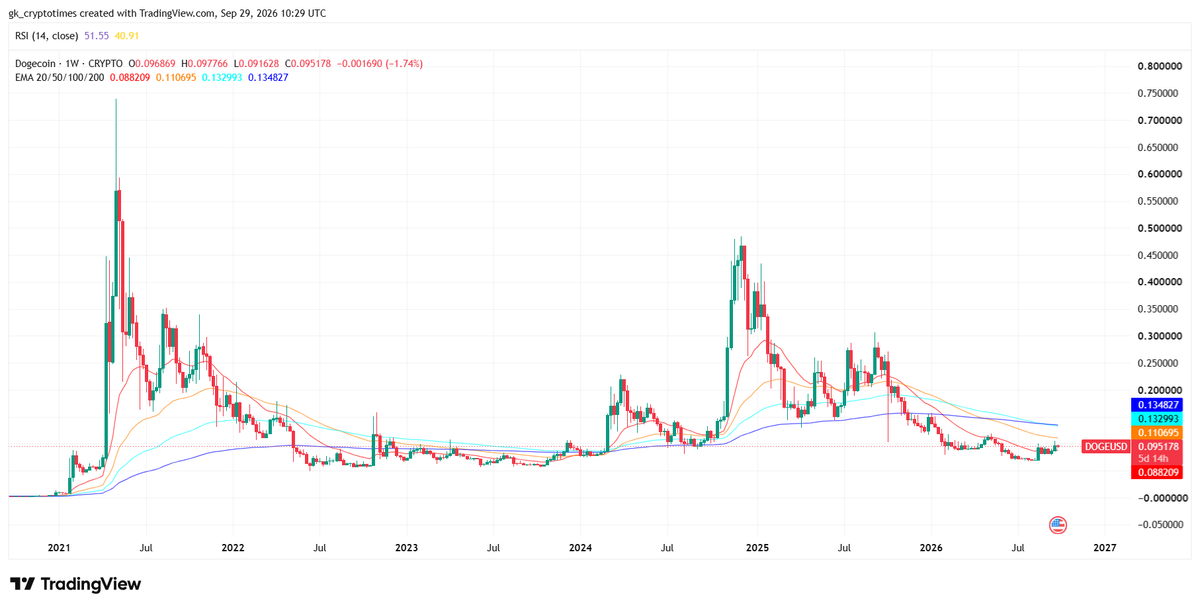
The longer averages are still sloping down after the late-2024 and early-2025 spike toward $0.45–$0.48, so the higher-timeframe trend remains a series of lower highs rather than a confirmed reversal. Weekly RSI (14) is 51.55, which is mid-range and argues for balance, not a washed-out washout or a breakout.
The structure matches that reading. DOGE has spent 2026 compressing under the declining 50-week average after losing the $0.15–$0.20 shelf, with the latest bounce coming off the $0.08–$0.09 zone that also mattered in 2022–2023.
As long as weekly closes hold above the 20-week EMA, the immediate floor stays intact and a grind toward $0.11 is the first test. A weekly close back under $0.088 would reopen the 2023-style floor near $0.07. Acceptance above the 50-week EMA at $0.111 is the level that would start to challenge the bearish stack; until then, rallies into $0.11–$0.13 still look like resistance, not a new regime.
Dogecoin price prediction 2026
Only one quarter of 2026 is left. That limits how much fundamental change can arrive before 31 December. The live question is whether nine cents is a base or a pause.
In the base case, DOGE spends the fourth quarter between $0.08 and $0.125 and finishes the year closer to the middle of that band than to a new cycle high. That outcome keeps market cap roughly where it is today, after issuance. It fits a market that has listed funds but has not shown a durable bid above 10 cents.
The bull case for 2026 is $0.15 to $0.22. That would take market cap toward the high $20 billions or low $30 billions and would require Bitcoin strength plus net creations in the listed products. It would still leave the coin at less than one-third of its 2021 high.
The bear case is $0.055 to $0.080. That path opens if the 200-day area fails and high-beta coins are sold first in a risk-off tape. It does not require a protocol failure. Dogecoin can fall on indifference.
A $1 print in 2026 is not in any of these bands. Against today’s float it would demand about $172 billion of value. Nothing in the current tape, supply schedule or payments evidence supports that as a base outcome for the next 13 weeks.
Dogecoin price prediction 2027
2027 is the first year in which the new wrappers have to prove they matter. If creations continue and Dogecoin remains the liquid meme proxy, the base case is $0.09 to $0.15. That is not a moon shot. It is a market-cap range of roughly $16 billion to $27 billion on a slightly larger supply.
The bull case of $0.18 to $0.28 needs two things at once: a constructive Bitcoin year and evidence that regulated distribution is adding holders rather than just recycling the same coins. Payment-rail headlines help only if they show up in activity.
The bear case of $0.045 to $0.090 is what happens if the novelty of listed access fades and newer meme assets take the attention budget. Unlimited issuance does not force that outcome every week. It does make a lost year harder to repair, because the float is larger when the bid returns.
Dogecoin price prediction 2028 and 2029
These two years should be read as a pair. Crypto liquidity still arrives in waves. Dogecoin has historically caught the late part of those waves and given most of it back.
The base case keeps 2028 in a $0.10 to $0.18 band and 2029 in a $0.09 to $0.17 band. The slight softening into 2029 is deliberate. If market cap is only stable to modestly higher, a larger supply produces a lower price. That is the part many percentage-only forecasts skip.
The bull case — $0.22 to $0.35 in 2028 and $0.20 to $0.38 in 2029 — assumes Dogecoin holds its place as the liquid joke that institutions can now buy in a brokerage account. The listed-product channel can extend a cycle. It cannot repeal issuance.
The bear case stays in the four-to-ten-cent area. That is a market-cap compression toward $8 billion to $18 billion. It is harsh, but it is not exotic for an asset whose demand is mostly reflexive.
Dogecoin price prediction 2030
By 2030 the supply math is unavoidable. Near 194 billion coins, price becomes a clean market-cap story.
- Bear: $0.05–$0.09: Dogecoin remains listed and mineable, but it loses cultural share. Market cap slips to about $10 billion to $17 billion.
- Base: $0.11–$0.18: The brand survives, liquidity stays deep, and crypto market value is larger than today. Market cap of $21 billion to $35 billion is enough to hold or slightly raise today’s price after inflation.
- Bull: $0.28–$0.45: Dogecoin keeps the meme-beta slot through two more liquidity waves and sees some genuine payments use. Market cap of $55 billion to $88 billion would still sit below the 2021 peak in price terms because the float is much larger now than it was then.
A $1 Dogecoin in 2030 would require a market cap near $195 billion. That is outside the bull band above. It should be treated as a tail event, not a planning number. The 2021 high of $0.7376 is also a poor 2030 compass. Reaching that price on 194 billion coins would imply about $143 billion of value, which is still above this article’s bull case.
What would push the coin from one band to another
Four variables decide the column.
- Bitcoin liquidity: Dogecoin rarely invents its own cycle. When the risk budget expands, DOGE usually receives a late and noisy bid. When that budget shrinks, it is sold.
- Fund flows: The existence of BWOW and TDOG is settled. Persistent creations would support the top of the base case and open the bull case. Persistent redemptions would confirm that a wrapper is only plumbing.
- Payments: The project still presents itself as money. Paxos distribution keeps that door open. The bull case needs visible use, not another announcement. Without that, the market will keep pricing DOGE as a sentiment chip.
- Supply: Five billion-plus new coins a year is not a rounding error. Holding a 15-cent price in 2030 requires more capital than holding a 15-cent price today. That is why the base case can look “flat” in dollar terms even if the asset remains relevant.
Bottom line
Dogecoin on 29 September 2026 is a roughly 10-cent, $16 billion asset with listed access, deep liquidity and an uncapped float. From those facts, the constructive path is not $1. It is a 2026 finish between 8 and 13 cents, a 2027–2029 range that spends most of its time between 9 and 18 cents, and a 2030 base band of 11 to 18 cents. The bull path can stretch into the $0.28 to $0.45 area by 2030 if liquidity and attention both stay with the coin. The bear path can put it back under $0.09.
That is a narrower map than the old slogan. It is also a cleaner one. Dogecoin does not need to die to stay cheap, and it does not need a new religion to stay liquid. It needs Bitcoin’s risk budget, a bid for the listed products, and enough use to justify the coins that will still be printed every minute between now and 2030.
This article is for information only and is not investment, legal or tax advice. The ranges above are scenario analysis, not guarantees. Cryptocurrency prices are volatile. Do your own research and consider speaking with a licensed adviser before risking capital.
Also read: TRON (TRX) Price Prediction 2026, 2027 – 2030: Can TRX Reach $1 Mark?