
On September 24, 2026, the Federal Reserve Board took a major step toward turning last year’s landmark stablecoin law into concrete rules. It released two notices of proposed rulemaking that spell out how payment stablecoin issuers under its supervision must back their tokens and how much capital they must hold.
These proposals sit at the heart of the GENIUS Act framework. They matter because stablecoins have grown into a $300-plus billion market that moves real value every day. The rules will shape who can issue them, how safe holders can feel, and how banks and non-bank firms compete in the space.
Why the Fed’s stablecoin rules matter right now
Stablecoins are digital tokens designed to stay steady in value, almost always pegged one-to-one to the U.S. dollar. They are used for payments, trading, and moving money across borders. According to data from DefiLlama (on September 25 at 16:00 UTC), the total market sat around $305–310 billion, with Tether’s USDT making up roughly $183–184 billion and Circle’s USDC about $76 billion. Together, those two coins dominate the market.
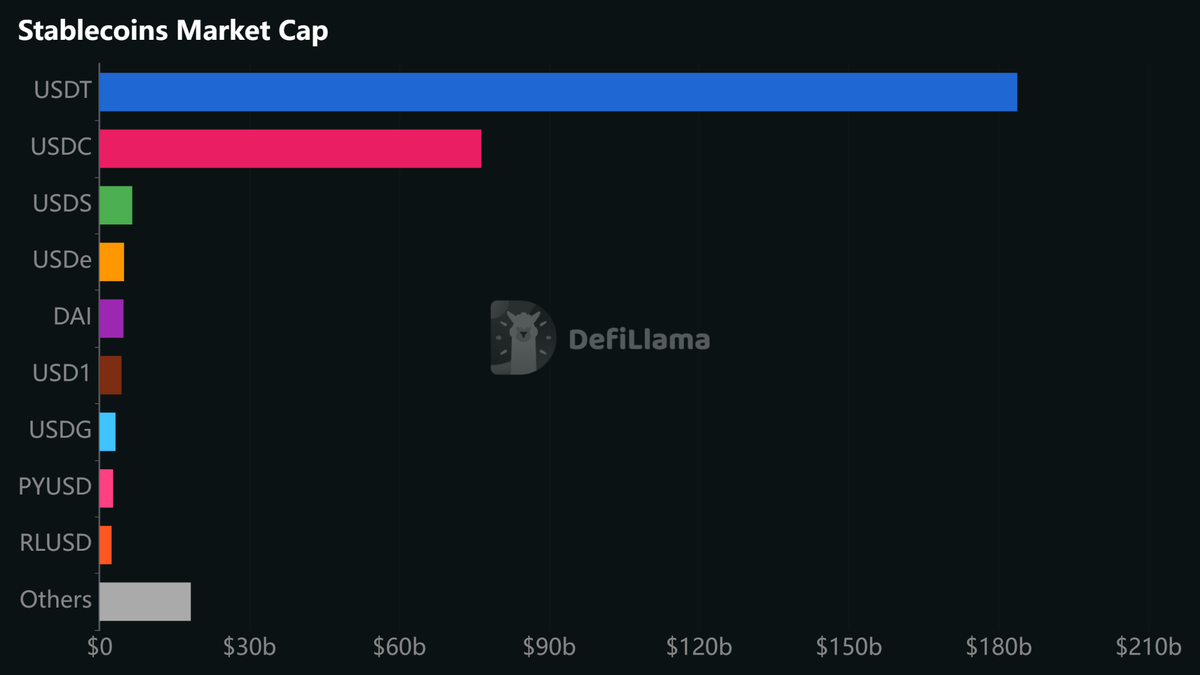
Until recently, most of this activity operated under a patchwork of state rules and voluntary practices. Congress changed that in 2025. The Fed’s new proposals are the central bank’s detailed plan for the issuers it oversees. They focus on two fundamentals: full reserve backing and enough capital to absorb operational and credit risks.
Public comments are open for 60 days after the proposals appear in the Federal Register. Final rules will help determine when the broader GENIUS Act framework becomes fully operational.
A quick look back: What the GENIUS Act actually did
President Donald Trump signed the Guiding and Establishing National Innovation for U.S. Stablecoins Act (GENIUS Act) into law on July 18, 2025. It was the first comprehensive federal statute for payment stablecoins.
The law requires that only permitted payment stablecoin issuers (PPSIs) can issue these tokens in the United States. It mandates one-to-one reserve backing with high-quality liquid assets, monthly public disclosures, and limits on what issuers can do. It also tasks the federal banking agencies, the Fed, OCC, FDIC, and NCUA, with writing the detailed capital, risk-management, and operational rules.
The Act’s effective date is the earlier of January 18, 2027, or 120 days after the primary federal regulators issue final implementing rules. Other agencies have already put out their own proposals. The Fed’s September 24 package fills in the pieces for the entities it supervises.
How GENIUS Act fits with still-pending CLARITY Act
GENIUS Act is the stablecoin-specific law already on the books. Running in parallel is the Digital Asset Market Clarity Act (CLARITY Act, H.R. 3633), the broader market-structure bill.
The House passed CLARITY in July 2025 with strong bipartisan support. It aims to draw clearer lines between the Securities and Exchange Commission (SEC) and the Commodity Futures Trading Commission (CFTC) over digital assets, define digital commodities, set rules for exchanges and intermediaries, and address related issues such as DeFi and developer protections. Updated Senate draft text was released in mid-September 2026 by Senators Cynthia Lummis, John Boozman, and Tim Scott, but the bill has not yet cleared the full Senate.
In short: GENIUS creates the prudential rules for issuing and backing payment stablecoins (the subject of the Fed’s new proposals). CLARITY, if enacted, would supply the wider market framework in which those stablecoins trade and are used. The two are complementary, not competing. The Fed’s capital and reserve rules stand on their own under the already-enacted GENIUS Act.
The Fed’s two proposals in plain terms
The Board approved two related notices of proposed rulemaking.
The first (roughly Docket R-1899) sets the core prudential rules for Board-supervised PPSIs. These include subsidiaries of insured state member banks that the Fed has approved to issue stablecoins, and certain large state-qualified issuers that transition to federal oversight once they cross the $10 billion threshold. It covers reserves, capital, risk management, custody of reserve assets, permissible activities, and the ban on paying interest or yield just for holding the stablecoin.
The second proposal (Docket R-1900) creates a tailored application process for insured state member banks that want a subsidiary to issue payment stablecoins. Banks would submit a business plan, financial information, policies, capital structure details, and certifications. The rule also sets out appeals and hearing procedures.
Both packages were approved unanimously. Governor Michael S. Barr supported the proposals while noting areas where public input will be especially useful, including interest-rate and foreign-currency risks and clarity around universal redemption rights. “Stablecoins will only be stable if they can be reliably and promptly redeemed at par in a range of conditions,” he said.
One-to-one reserves: The core backing rule
The central requirement is straightforward: Board-supervised PPSIs must maintain reserve assets whose aggregate fair value, at all times, equals or exceeds the par value of outstanding payment stablecoins. Reserves must be segregated from the issuer’s other assets.
Eligible assets are tightly limited. They include:
- U.S. dollar cash
- Balances at Federal Reserve Banks
- Demand deposits or insured shares at insured depository institutions
- U.S. Treasury securities with 93 days or less remaining maturity
- Overnight Treasury-backed repurchase and reverse repurchase agreements
- Shares of eligible investment funds that hold only permitted reserve assets
- Tokenized versions of certain of the above assets
If reserves fall below the one-to-one level, the issuer must notify the Fed. It then either follows a Board-directed plan to restore full backing promptly or liquidates the reserves and redeems all outstanding stablecoins.
Issuers must also diversify reserves so the one-to-one requirement can be met even under stress. The proposal requires mitigation of concentration risk from large uninsured deposit claims or reverse-repo exposures to a single counterparty or small group of counterparties.
These rules aim to make sure holders can redeem at par even when markets are turbulent.
Capital requirements: The new cushion issuers must hold
Reserves protect against the stablecoin liabilities themselves. Capital is meant to cover operational risks and certain credit risks that reserves alone do not address.
The Fed proposes a standardized operational-risk capital charge that is graduated by size of outstanding stablecoins:
- 2.0% on the first $20 billion
- 1.5% on the next $30 billion (from $20 billion to $50 billion)
- 1.0% on amounts above $50 billion
There is also a charge equal to 25% of the three-year average of annual non-reserve-asset revenue. This captures risks from activities such as custody services that are not directly tied to the size of the stablecoin book. A loss scalar can raise or lower the operational-risk requirement based on the issuer’s actual operational losses over time, creating an incentive for strong risk management.
Separately, a 2% capital requirement applies to reserve assets that are uninsured deposit claims or undercollateralized reverse repurchase agreements. A look-through approach applies when those assets sit inside eligible investment funds.
If an issuer fails to meet the minimum capital requirement at quarter-end, it must submit a compliance plan. If the shortfall continues through the next quarter-end, the proposal requires the issuer to liquidate all reserve assets and redeem outstanding stablecoins.
These numbers are deliberately simple and standardized so they are transparent and relatively easy to calculate. They are lower than traditional bank capital ratios because the primary risk is meant to be covered by the one-to-one reserves. Still, they create a real capital cost that scales with size and activity.
Redemptions, reporting, and personal accountability
Issuers must publicly disclose a redemption policy with a standard period of no more than two business days (subject to limited safe harbors or Board extensions for safety-and-soundness, financial-stability, or public-interest reasons).
Monthly public reports are required. These must show the amount of stablecoins outstanding and the value and composition of reserves. A registered public accounting firm examines the disclosures, and the chief executive officer and chief financial officer must certify them. This puts personal accountability behind the numbers. Beyond the monthly public disclosures, the proposal would also require issuers to file more frequent confidential reports to the Fed on issuance, redemptions, and reserves, giving supervisors a closer, more timely view of each issuer’s position.
The proposals also clarify permissible activities (core issuance, redemption, and supporting functions) and implement the GENIUS Act’s prohibition on paying interest or yield solely for holding the stablecoin. Certain third-party arrangements are presumed to violate that ban, consistent with the approach the OCC has taken in its own proposal.
A clearer path for banks to issue stablecoins
The second proposal gives insured state member banks a defined route to seek Fed approval for a subsidiary to issue payment stablecoins. The application is by letter and must include a business plan, financial information, relevant policies and procedures, capital structure details, biographical information, and required certifications.
Procedures for appeals, hearings, and final determinations are also laid out. This is meant to give banks a predictable process while the Fed focuses on the safety and soundness of both the parent bank and the stablecoin subsidiary.
What this means for issuers, banks, and broader market
For existing non-bank issuers that fall under Fed supervision (or that grow large enough to trigger it), the rules bring clearer standards but also new costs and operational requirements. The graduated capital charges and CEO/CFO certification raise the bar for governance and risk management. The strict eligible-asset list and diversification rules will influence how reserves are invested, favoring short-term Treasuries and high-quality cash equivalents.
Banks gain a clearer on-ramp. Those that want to offer stablecoins through subsidiaries now have a defined application process. At the same time, the capital and reserve rules will shape the economics of bank-issued tokens.
The broader market should see stronger confidence in redemption at par. That could support further use of stablecoins in payments and settlement. Demand for short-term U.S. Treasuries is likely to remain elevated as issuers hold large volumes of eligible reserves.
Competition between bank and non-bank issuers will turn partly on how efficiently each can meet the capital and operational standards. Smaller or less sophisticated issuers may find the compliance burden significant.
If the CLARITY Act eventually becomes law, it would add another layer of market-structure rules around trading, custody, and classification of digital assets more generally. For now, the Fed’s GENIUS-implementing proposals stand on their own and give issuers and banks concrete standards to plan against.
Timeline, comment period, and what comes next
The Fed’s proposals open a 60-day comment window once published in the Federal Register. Other agencies (OCC, FDIC, NCUA, and Treasury) have already advanced their own pieces of the GENIUS Act framework. Coordination among the agencies continues.
The statutory clock points toward effectiveness no later than January 18, 2027, or 120 days after final implementing rules from the primary federal regulators, whichever comes first. Final rules will incorporate public feedback and any adjustments the Board decides to make.
Governor Barr noted that while the proposal is an important step, further work will be needed for stablecoins to become fully reliable payment instruments. Areas such as anti-money-laundering supervision standards and clarity on certain risks remain under discussion. Separately, the Senate continues work on the broader CLARITY Act market-structure legislation.
The bottom line
The Federal Reserve’s September 24, 2026 proposals translate the GENIUS Act’s high-level requirements into specific, enforceable rules on reserves and capital for the issuers it supervises. One-to-one backing with a narrow set of high-quality assets, graduated operational capital charges, a two-business-day redemption standard, monthly certified disclosures, and a defined bank application path form the core of the blueprint.
These rules are still proposals. The comment period will shape the final version. But the direction is clear: stablecoin issuers under Fed oversight will operate with bank-like discipline around liquidity, capital, and accountability. For a market that has already reached hundreds of billions of dollars, that clarity is significant. It sets the practical terms under which dollar-backed tokens will continue to grow inside the U.S. regulatory system, while the companion CLARITY Act continues its separate path through Congress.
Also Read: Crypto Holds Firm: How Tokenization Is Navigating Rate Hikes and Regulatory Setbacks