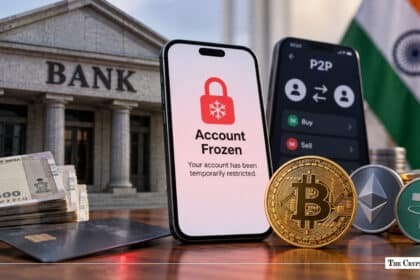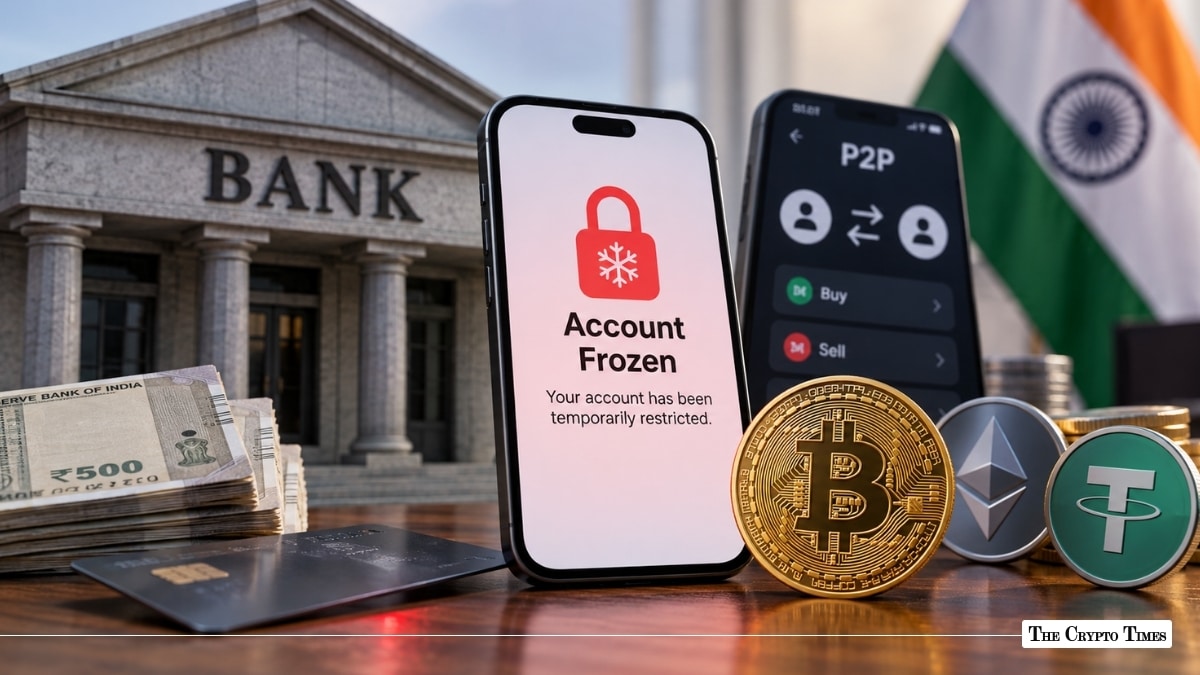
Buying stablecoins like USDT through peer-to-peer (P2P) trades is one of the main ways Indians move rupees into crypto. It is also where the risk of a frozen bank account is highest.
People who did nothing wrong are losing access to their salaries and savings for weeks or months after a single trade. The trigger is rarely the trade itself. It is what happens when rupees that pass through your account are later traced to a fraud complaint filed by a stranger.
This article explains how these freezes happen, what a lien is, what the law allows after the BNSS replaced the CrPC on July 1, 2024, and the practical steps that lower your exposure.
Key Highlights
- A freeze usually starts when INR reaching your account is later traced to a cybercrime complaint filed by a scam victim.
- Banks apply either a lien, which locks only the disputed amount, or a full freeze, which blocks the whole account.
- Section 106 BNSS lets police seize property as evidence. It does not allow them to freeze bank accounts.
- Freezing needs a Magistrate’s order under Section 107 BNSS, and High Courts have quashed police-ordered freezes that skipped this step.
- Records, counterparty screening, and a separate trading account are your strongest defences.
Why P2P is still how many Indians buy stablecoins
Crypto is legal to buy and sell in India, though it is not legal tender. Income from virtual digital assets is taxed at a flat 30% under Section 115BBH, with a 1% TDS on transfers under Section 194S. These rates were left unchanged again in Budget 2026.
The tax load and thin domestic liquidity have pushed most Indian trading volume offshore. Parliamentary submissions have put the offshore share at roughly 73% to 90% in recent estimates.
Offshore exchanges have few regulated INR on-ramps, so users turn to P2P to convert rupees into USDT and back. That shortage of on-ramps shows up in the price. The India USDT Premium Index fixes daily what a dollar of USDT actually costs in rupees against the USD/INR reference rate, and the gap has run well above parity through 2026.
That leaves the settlement sitting outside any exchange escrow and inside ordinary bank rails, where a single tainted counterparty can cause damage.
How a routine P2P trade ends with a frozen account
The mechanism is consistent. A fraudster steals money from a victim through a phishing link or a fake investment scheme. The victim files a complaint on the National Cybercrime Reporting Portal run by the Indian Cyber Crime Coordination Centre (I4C).
Investigators trace the stolen money through the UPI trail. If those rupees passed through your account during a P2P trade, your account is flagged, and the bank receives a freeze instruction from a cyber cell, often in another state.
You may have completed a clean trade with a verified merchant. It does not matter to the money trail. The rupees you received carried a history you could not see.
Buyer or seller: where the risk actually sits
When you buy stablecoins, you send INR and receive USDT, so your account is on the paying side. The freeze risk is highest for the person receiving INR, which is the seller.
Anyone active in P2P eventually sits on the receiving side, either when selling USDT or when a buyer’s payment lands in the account. That is the moment tainted money can enter, and it is why the risk applies across the full P2P cycle rather than to selling alone.
Lien marking and full freezes are not the same thing
A lien locks a specific amount in your account. If ₹20,000 is disputed, the bank reserves ₹20,000 and you can still use the rest of the balance.
A full freeze blocks the entire account, including incoming and outgoing transactions. UPI stops, EMIs bounce, and salary credits become unusable even when the disputed sum is tiny.
The gap between the two can be extreme. In early 2025, the Delhi High Court flagged a case where an account holding about ₹93 crore was frozen over a disputed ₹200. Cases reported by The Crypto Times include freezes triggered by transactions as small as ₹600 to ₹1,700.
What the law actually allows
Police powers here come from two provisions of the Bharatiya Nagarik Suraksha Sanhita (BNSS), which replaced the CrPC on July 1, 2024.
Section 106 BNSS, the successor to Section 102 CrPC, lets police seize property to preserve evidence. It does not give them the power to attach or debit-freeze a bank account.
Section 107 BNSS is a separate, newer provision for attaching proceeds of crime. It requires the investigating officer to apply to a Magistrate, who can order attachment only after following the prescribed procedure.
A police notice alone is not a lawful basis for freezing your account. A Magistrate has to authorize it.
The courts are pushing back
Multiple High Courts have said the same thing.
In Headstar Global Pvt. Ltd. v. State of Kerala, decided on June 2, 2025, the Kerala High Court held that a debit freeze is an attachment, so it can happen only under Section 107 with a Magistrate’s order. It quashed the police freeze and called the Section 106 notice beyond the officer’s jurisdiction. The Supreme Court subsequently declined to interfere with that ruling, and other High Courts have since treated it as settled law.
In Malabar Gold and Diamond Ltd. v. Union of India, decided on January 16, 2026, the Delhi High Court unfroze about ₹80.1 lakh across accounts. It ruled that freezing an account holder who is neither accused nor suspect is arbitrary and violates Articles 19(1)(g) and 21 of the Constitution.
The Allahabad High Court has gone further on proportionality, directing that investigators specify the disputed amount and inform the Magistrate within 24 hours of a freeze. These rulings give you clear grounds to challenge a blanket freeze.
How to lower your exposure before you trade
You cannot see a counterparty’s source of funds, so the goal is to limit damage and hold proof.
- Use a separate bank account for P2P with a balance you can afford to have locked, and keep salary and EMI accounts out of it.
- Prefer regulated exchange order books over open P2P where possible, since escrow and KYC add a layer the pure P2P route lacks.
- Compare the cost before you choose a route. Our daily stablecoin premium indices track what USDT and USDC are trading at in India against the dollar reference rate.
- Screen counterparties. Avoid new accounts, unusually high offers, and anyone pushing for speed or anonymity.
- Keep full records for every trade: order IDs, chat logs, UPI references, and withdrawal confirmations.
- Split large transfers or pre-inform your bank about legitimate high-value activity.
What to do if your account is already frozen
Act quickly and stay factual. The aim is to move from a full freeze to a lien on the disputed amount, then clear your name.
- Get the details. Ask the bank for the complaint acknowledgement number, the disputed amount, and the cyber cell and jurisdiction that issued the instruction.
- Request a lien, not a full freeze. Cite proportionality and the High Court rulings above, and ask that only the disputed sum be marked so you can operate the rest.
- Contact the investigating officer with your trade records showing the transaction was genuine.
- Follow up with the bank’s nodal officer, since branch and compliance teams often miss internal instructions.
- Get legal help. A lawyer can move the High Court to quash a freeze that skipped the Section 107 process.
For a first-person account of how slow and draining this process can be, read the opinion piece One P2P Trade, Months of Limbo. The Crypto Times newsroom has also documented the continuing wave of freezes hitting Indian P2P users.
Frequently asked questions
Can a bank freeze my account for a crypto P2P trade?
Yes. If rupees linked to a cybercrime complaint passed through your account, a cyber cell can instruct your bank to freeze it, even if your own trade was legitimate.
What is the difference between a lien and a freeze?
A lien locks only the disputed amount and leaves the rest usable. A full freeze blocks the whole account.
How long does a P2P freeze last in India?
There is no fixed period. Some are lifted within days after documents are shared. Others run for months across multiple states.
Is buying USDT on P2P illegal in India?
No. Buying and holding virtual digital assets is legal, though not recognized as currency. The freeze risk comes from tainted counterparty funds, not from the trade being illegal.
Can police freeze my whole account without a court order?
Not lawfully. High Courts have held that freezing needs a Magistrate’s order under Section 107 BNSS, and police-only freezes have been quashed.