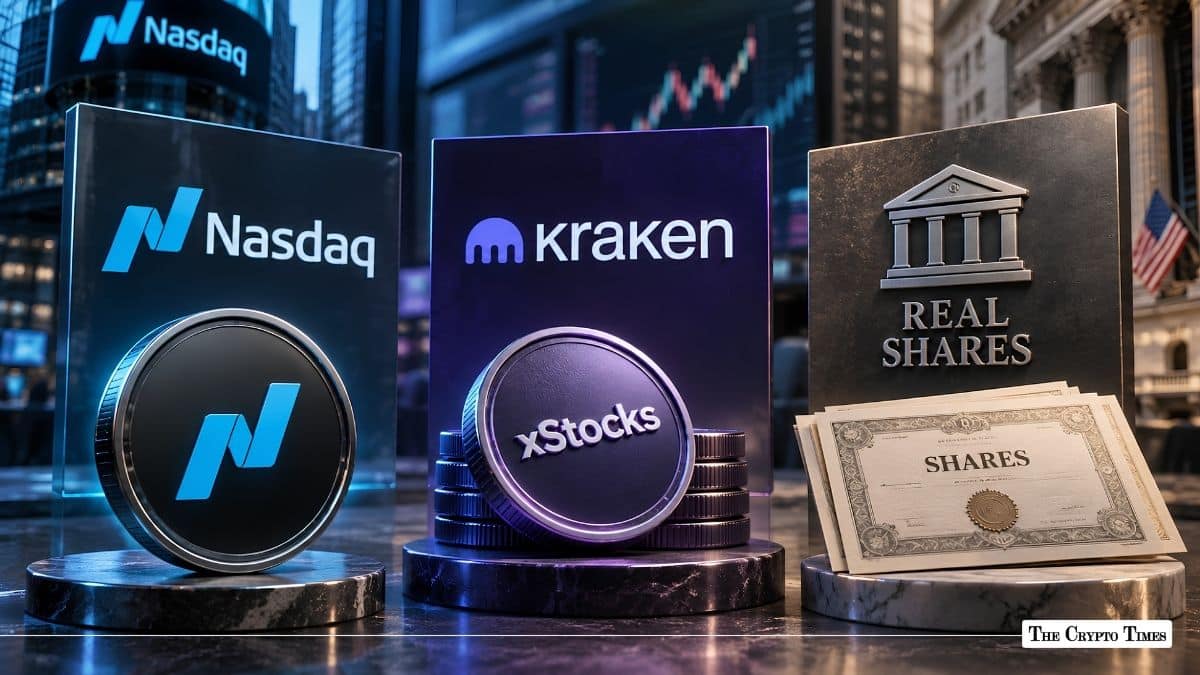
Apple shares, AAPLx and a future Nasdaq Equity Token could all give an investor economic exposure to Apple.
Legally, however, they may represent three very different things.
An ordinary Apple share gives its beneficial owner the economic and governance rights attached to Apple equity. A Kraken xStock is a separate token backed by an underlying share but does not make its holder an Apple shareholder. Nasdaq’s planned Nasdaq Equity Tokens, or NETs, are being designed differently again: Nasdaq says a transfer of the token should represent a transfer of the underlying security itself.
That distinction has become more important after Nasdaq Ventures agreed on September 10 to invest $100 million in Payward, the parent company of Kraken. The two companies now expect to launch Nasdaq Equity Tokens in the second quarter of 2027, with Payward helping provide settlement and connectivity to on-chain markets.
The partnership does not mean Nasdaq is simply putting Kraken’s existing xStocks on its exchange. Nor does it mean xStocks have suddenly become ordinary shares.
Instead, Wall Street and crypto are converging through several different models that use similar language but confer very different legal rights.
Understanding the difference comes down to one question: When you buy the token, what do you actually own?
Key Highlights
- A real share is equity in the company. Retail investors usually hold it beneficially through a broker, with shareholder rights such as voting, dividends and participation in corporate actions attached to the security.
- Kraken xStocks are not the underlying shares. They are tokens issued by Backed Assets (JE) Limited and backed 1:1 by shares held in custody. Holders receive economic exposure but do not become shareholders of the referenced company.
- Nasdaq Equity Tokens are intended to be different. Nasdaq says the blockchain record will connect to the issuer’s official share registry and transferring a NET should represent transferring the underlying security itself. NETs are not live yet.
- Nasdaq also has a separate DTC tokenization track. The SEC approved that model in March 2026, allowing eligible listed securities to trade in tokenized form while retaining the same identity, rights and regulated market structure.
- The word “tokenized stock” therefore does not tell investors enough. Ownership rights depend on the legal structure behind the token, not the blockchain label attached to it.
Why Is Nasdaq Working With Kraken’s Parent Company?
Nasdaq and Payward first announced their tokenized-equities partnership in March 2026.
On September 10, Nasdaq deepened that relationship by announcing a $100 million investment in Payward through Nasdaq Ventures. Payward will also adopt Nasdaq’s market-surveillance technology across crypto, equities, tokenized equities, futures and options venues.
The partnership revolves around an ambitious idea: combine the legal protections and liquidity of regulated equity markets with blockchain infrastructure that can operate beyond conventional market hours.
Nasdaq President Tal Cohen said its approach is designed to preserve trust, transparency and market integrity while making capital more portable. Payward co-CEO Arjun Sethi described the next phase as putting NETs on rails that “do not close” while keeping shareholder rights intact.
That sounds similar to xStocks, which already allow eligible users to move tokenized exposure to companies such as Apple, Tesla and Nvidia between crypto exchanges, self-custody wallets and blockchain applications.
But the legal architecture is different.
That difference is the point of NETs.
First, What Is a “Real” Share?
Suppose an investor buys one ordinary Apple share through a conventional brokerage.
In the U.S. market, that investor will commonly be the beneficial owner rather than having their personal name directly entered into Apple’s shareholder register. Securities held in “street name” are generally recorded through the broker and the Depository Trust Company infrastructure.
But the investor still owns the economic interest in an actual Apple security.
That matters because the rights flow from the share itself.
The investor can generally receive dividends, participate in eligible corporate actions and submit proxy votes through the brokerage chain. If Apple executes a stock split, merges with another company or distributes assets to shareholders, the investor participates according to the rights of that share class.
If Apple were ultimately liquidated, shareholders would also have the residual equity claim after creditors and other senior claims were satisfied.
The important point is not that a conventional investor physically holds a paper stock certificate.
It is that the financial instrument they beneficially own is the company’s share.
That is the benchmark against which tokenized-equity products should be measured.
What Is a Kraken xStock?
An xStock changes that legal relationship.
Take AAPLx, the xStock referencing Apple.
Kraken describes xStocks as tokenized representations of stocks and ETFs that are backed 1:1 by the underlying equity. The tokens can be withdrawn to compatible blockchain wallets and moved on-chain. Current support includes networks such as Solana, Ethereum, TON and Ink.
But 1:1 backing does not mean the token holder owns the underlying Apple share.
The legal issuer is Backed Assets (JE) Limited, a Jersey private company. Kraken distributes the products to eligible customers through regulated Payward entities depending on jurisdiction.
Kraken’s risk disclosure is explicit:
An xStock holder does not own the underlying stock.
The holder also has no legal claim against the company whose stock the token references and no claim on that company’s residual assets if it liquidates. The underlying public company is not required to participate in, sponsor or recognize the xStock arrangement.
That makes AAPLx economically connected to Apple shares without being legally identical to an Apple share.
If xStocks Are Not Shares, What Does the 1:1 Backing Mean?
It means real shares are supposed to exist behind the tokens.
Kraken says the underlying securities are held in regulated custody, with Alpaca Securities serving as a primary custodian and InCore Bank as a secondary custodian. Kraken also describes weekly on-chain proof-of-reserves reporting and quarterly assurance audits.
So an xStock is very different from a completely unbacked synthetic contract.
If one AAPLx is created, the structure is intended to have corresponding Apple equity backing it.
But the identities on opposite sides of that arrangement are important.
The custody structure owns or holds the underlying shares.
The investor owns the xStock.
Those are not legally interchangeable positions.
This distinction becomes particularly important if the company behind the underlying stock fails, the token issuer becomes insolvent, a custodian encounters problems or regulators restrict transfers.
Kraken says the structure is designed to be bankruptcy-remote, but its risk disclosures also warn investors about issuer, custody, counterparty and insolvency risks. The fact that an underlying security is held at an SIPC-member brokerage does not automatically make the xStock holder equivalent to an ordinary brokerage customer holding that share.
Do xStocks Pay Dividends?
Economically, yes. Legally and mechanically, not in the same way as an ordinary shareholder.
If Apple pays a dividend, an AAPLx holder does not receive the corporate cash dividend directly from Apple.
Instead, Kraken says the net dividend is reinvested into the underlying asset and reflected through a rebasing or multiplier mechanism. The current FAQ says the calculation is made after a 30% U.S. withholding tax, with the holder’s effective xStock balance adjusted accordingly.
Stock splits and certain other corporate actions can also be reflected through that multiplier.
That delivers an economic result designed to track the underlying share while preserving an important legal distinction:
Apple is paying its shareholder. The xStock structure then passes the economic benefit through to the token holder. The token holder is not receiving the dividend as an Apple shareholder.
What About Voting Rights on xStocks?
This became more complicated in August 2026.
Kraken’s legal disclosure still says xStock holders do not have voting rights in the underlying companies. But Payward Services has now partnered with Broadridge to allow eligible xStock holders to submit proxy voting preferences for supported securities.
Through Broadridge’s ProxyVote infrastructure, eligible token holders can authenticate using Web3 credentials, review shareholder materials and tell the structure how they want the underlying shares voted.
That is meaningful governance functionality.
But it still does not make an xStock holder the registered owner of the underlying share.
The cleaner way to describe the change is:
xStock holders can now pass eligible voting preferences through the structure; the xStock itself still is not the listed share.
That distinction matters because a contractual mechanism for conveying a vote is different from possessing the voting right because the investor owns the security.
What Are Nasdaq Equity Tokens?
Nasdaq Equity Tokens are designed to close exactly that gap.
Nasdaq announced the design in March 2026 and says it wants public companies to remain at the center of tokenization rather than allowing third parties to issue blockchain representations of their stocks without issuer involvement.
Under the proposed model, blockchain records would connect directly with the public company’s official share registry.
Most importantly, Nasdaq says:
A transfer of the token would represent a transfer of the underlying security itself.
That is fundamentally different from xStocks.
With an xStock, the real share sits behind the token and the investor holds the separate tokenized instrument.
With Nasdaq’s intended NET structure, the token is supposed to be a technological form of the security itself, carrying the legal and regulatory status of the equity.
Nasdaq says that design could also make corporate actions, proxy voting and shareholder engagement programmable while preserving issuer control and investor protections.
In simple terms:
xStocks tokenize exposure to a share.
NETs are intended to tokenize the share itself.
Are Nasdaq Equity Tokens Available Today?
No.
This is an important distinction because several Nasdaq tokenization initiatives are now running in parallel.
Nasdaq and Payward said on September 10 that they expect NETs to launch in Q2 2027. The project is therefore still a design and infrastructure initiative rather than a product investors can currently buy.
Questions also remain unanswered.
Nasdaq has not yet established through live NET products exactly which companies will participate, what self-custody will look like for each jurisdiction, how an equity token will behave after entering a permissionless blockchain environment, or what restrictions will apply to transfers involving U.S. investors.
Those details will ultimately determine how close the operational reality comes to the design.
Until the first issuer documentation and live token structure are available, claims about NET functionality should therefore be described as Nasdaq’s intended design, not existing product features.
The Other Nasdaq Tokenized-Stock Project Is Already Further Along
Confusion arises because Nasdaq has another tokenization initiative that is separate from NETs.
In September 2025, Nasdaq asked the SEC for permission to allow eligible securities to trade on its exchange in either traditional or tokenized form.
The SEC approved the rule change on March 18, 2026.
Under this approach, the investor is not buying a third-party tracker token such as an xStock.
It remains the same security, using tokenization as another settlement form.
The initial eligible universe includes Russell 1000 stocks and ETFs tracking major indices. Trades continue through regulated market infrastructure, while DTC handles the tokenized post-trade process.
Crucially, DTCC says DTC-tokenized assets maintain the same entitlements, investor protections and ownership rights as assets held in traditional form.
DTC demonstrated the infrastructure with production transactions involving tokenized assets on July 15, including equity delivery-versus-payment trades, equity transfers, securities lending and collateral workflows. Its wider Tokenization Service is currently scheduled to launch in October 2026.
So Nasdaq now has two separate tracks:
Nasdaq/DTC tokenized trading: existing securities using tokenized settlement inside regulated U.S. market infrastructure.
Nasdaq Equity Tokens: the broader issuer-sponsored design intended to connect official shares with always-on and potentially more open blockchain markets beginning in 2027.
Neither should be confused with xStocks.
Real Shares vs xStocks vs Nasdaq Tokenized Shares vs NETs
| Feature | Traditional Share | Kraken xStock | Nasdaq/DTC Tokenized Share | Nasdaq Equity Token (NET) |
|---|---|---|---|---|
| Available today? | Yes | Yes, in eligible non-U.S. markets | Limited production demonstrated; broader DTC service planned for Oct. 2026 | No; target Q2 2027 |
| What do you hold? | Beneficial ownership of actual company equity | Separate token backed by underlying equity | Same listed security in tokenized settlement form | Intended to be issuer-sponsored equity itself |
| Does the public company recognize the instrument? | Yes | No sponsorship required | Yes; it is the existing security | Intended to be issuer-centric |
| Are you an underlying shareholder? | Yes, usually beneficially through broker/DTC | No | Yes | Intended: yes |
| Voting | Proxy rights through broker/market infrastructure | No direct legal vote; eligible holders can submit voting preferences | Same rights as ordinary security | Shareholder rights intended to remain intact |
| Dividends | Corporate dividend, normally cash or DRIP | Economic benefit passed through via multiplier/rebase | Same entitlement as underlying share | Intended to preserve normal shareholder rights |
| Claim if underlying company liquidates | Equity claim after senior creditors | No direct claim on the underlying company | Equity claim | Intended equity claim |
| Self-custody | Generally no | Yes | Not equivalent to ordinary permissionless wallet token | Exact model still TBD |
| On-chain transfer | Generally no | Yes | Through DTC-supported infrastructure | Intended to bridge regulated and on-chain environments |
| U.S. investors | Yes, subject to normal rules | No | Yes, subject to participant/market rules | Access model TBD |
| Trading hours | Core exchange hours plus available extended sessions | 24/5 on Kraken; potentially 24/7 on-chain | Existing Nasdaq trading framework initially | Always-on infrastructure is the goal |
| Main additional risk | Broker/market risk | Issuer, custodian, token, regulatory and smart-contract layers | Infrastructure/operational risk within regulated market system | Final structure still unknown |
Why Can xStocks Be Useful If They Are Not Real Shares?
The distinction does not mean xStocks have no purpose.
Their advantages come from precisely the characteristics traditional brokerage shares generally do not have.
Eligible investors can withdraw xStocks into self-custody, transfer them between compatible wallets, use supported tokens in blockchain applications and move them between different crypto-market venues. Kraken says xStocks are available on multiple blockchain networks.
They have also achieved meaningful scale.
Payward said on September 1 that the xStocks framework had surpassed $40 billion in total volume, including more than $20 billion settled on-chain, across more than 200,000 holders.
For an investor whose priority is portability, blockchain settlement or DeFi compatibility, those characteristics may be valuable.
But convenience and programmability do not change legal ownership.
The correct question is not whether xStocks are “real” in a technological sense.
It is whether an xStock is the company’s actual equity security.
Under Kraken’s own legal disclosure, it is not.
How Are xStocks Different From Synthetic Stock Tokens?
There is another category that should not be confused with either.
A purely synthetic equity token or stock perpetual may track Apple’s price without holding an Apple share for every contract.
Its value can instead be maintained through derivatives, collateral, market makers, an oracle or payments between long and short traders.
Such a product can offer accurate price exposure without providing any ownership connection to Apple.
That puts the models on a spectrum:
Synthetic contract → backed xStock → issuer-sponsored NET/DTC-tokenized security → conventional share
The technology can look similar on a wallet screen while the legal relationship changes dramatically from left to right.
That is why investors should not determine ownership from a ticker, token logo or blockchain explorer alone.
Why Nasdaq’s Payward Partnership Matters
Nasdaq is effectively trying to combine properties that have so far been split between two systems.
Traditional equity markets provide established ownership rights, corporate governance, issuer recognition and deep regulated liquidity.
Crypto markets provide portability, programmability, self-custody and infrastructure that can operate continuously.
xStocks demonstrated that demand exists for putting equity exposure on those crypto rails. Nasdaq now wants to connect those capabilities to instruments where the shareholder rights travel with the token itself.
Payward provides an obvious bridge.
Its xStocks ecosystem already connects centralized exchanges, blockchain networks, wallets and DeFi applications. Nasdaq brings the listed-market infrastructure, issuer relationships, surveillance and regulatory architecture.
But the September partnership should not be interpreted as Nasdaq converting existing xStocks into company shares.
The companies are building new infrastructure intended to connect the two models.
What Investors Should Check Before Buying Any “Tokenized Stock”
Ignore the marketing label initially and find the legal documentation.
Ask four questions:
Who issues the token?
Is it Apple, an exchange-related issuer, an SPV or a derivatives platform?
Who legally owns the underlying share?
Is the token holder the beneficial owner, or does another entity hold the stock backing the token?
Where do shareholder rights come from?
Are voting and dividend rights embedded in the security itself, or passed through contractually by an intermediary?
What happens if something breaks?
A share, backed token and synthetic contract can have radically different outcomes if the issuer, custodian, broker or underlying company fails.
Those questions reveal more than the phrase “1:1 backed.”
The Bottom Line
Nasdaq Equity Tokens, Kraken xStocks and traditional stocks may eventually trade beside one another and track exactly the same companies.
They should not be treated as interchangeable.
A traditional share gives the investor beneficial ownership of company equity and the shareholder rights attached to it.
An xStock gives the investor a transferable blockchain token backed by an underlying share, but Kraken’s own disclosures say the token holder does not own that share or have a direct legal claim against the company.
A Nasdaq/DTC tokenized share is the existing regulated security represented through new settlement infrastructure.
And a future Nasdaq Equity Token is intended to go further: putting the company’s actual equity into an issuer-sponsored token structure where transferring the token transfers the security and shareholder rights remain attached.
That last model is potentially the most consequential.
It is also the one investors cannot buy yet.
The test will come in 2027, when the first NETs show whether Nasdaq can preserve the legal identity of a traditional share while giving it the portability and always-on infrastructure of a crypto token.
Until then, the simplest rule remains the most useful:
A token that tracks a stock is not necessarily a stock. Read the legal structure, not the ticker.
This article is for informational purposes only and does not constitute investment or legal advice. Availability, investor protections and regulatory treatment of tokenized securities vary by jurisdiction.
FAQs
Are Kraken xStocks real shares?
No. Kraken says xStocks are backed 1:1 by underlying stocks or ETFs, but xStock holders do not own the underlying shares. They hold tokens issued by Backed Assets (JE) Limited that provide economic exposure to those securities.
Do xStocks have voting rights?
Kraken’s legal disclosure says xStock holders do not have direct voting rights. Since August 2026, however, eligible holders of supported xStocks can use Broadridge infrastructure to submit proxy voting preferences concerning the shares backing their tokens. That does not make the token holder the registered shareholder.
Are Nasdaq Equity Tokens the same as xStocks?
No. xStocks are third-party tokens backed by underlying shares. Nasdaq says NETs are being designed as issuer-sponsored securities connected to the company’s official share registry, so transferring the token would represent transferring the security itself.
When will Nasdaq Equity Tokens launch?
Nasdaq and Payward said on September 10, 2026 that they expect NETs to launch in Q2 2027. The project remains under development, and exact issuer participation and investor-access rules have not yet been announced.
Can U.S. investors buy Kraken xStocks?
No. Kraken’s current disclosure says xStocks are unavailable in the United States and to U.S. persons. They are also currently restricted in several other markets, including the UK, Canada and Australia.
Is Nasdaq already trading tokenized stocks?
Nasdaq received SEC approval in March 2026 for a separate system allowing certain existing securities to trade in tokenized form, with post-trade processing tied to DTC. DTCC completed limited production transactions with tokenized securities in July and is targeting October 2026 for the broader DTC Tokenization Service. This system is separate from the planned NET product.
What is the biggest difference between a tokenized share and a stock-backed token?
The key difference is legal ownership. With a true tokenized share, the token represents the security itself. With a stock-backed token, another entity owns or holds the underlying security while the investor owns a separate token designed to track its economics.