Key Highlights
- Polymarket and Kalshi traders assign a 72%–73% probability to the Federal Reserve holding interest rates in July.
- A 25-basis-point hike carries roughly 27% odds as elevated PCE inflation and energy-market risks complicate the decision.
- Bitcoin’s reaction will depend on how the decision changes Treasury yields, the US dollar and expectations for September.
The Federal Reserve enters its July policy meeting with financial markets expecting no change in interest rates, but the decision is no longer considered straightforward.
Prediction markets give the Fed roughly a 72%–73% probability of maintaining its current 3.50%–3.75% target range. At the same time, traders assign approximately 27% odds to a 25-basis-point increase, leaving a meaningful portion of the market positioned for tighter monetary policy.
That pricing has turned the July 28–29 Federal Open Market Committee (FOMC) meeting into a test of whether Chair Kevin Warsh can keep rates unchanged without persuading markets that the Fed’s inflation-fighting campaign is over.
A hold that pushes Treasury yields and the US dollar lower could loosen financial conditions and support Bitcoin. A hold accompanied by stronger inflation warnings could produce the opposite result, keeping yields elevated and limiting demand for risk assets.
Prediction Markets Price a 27% Chance of a Fed Hike
Polymarket traders assigned a 73.4% probability to no change and a 26.6% probability to a 25-basis-point increase when the supplied market data was captured. The probability of an increase of 50 basis points or more remained below 1%.
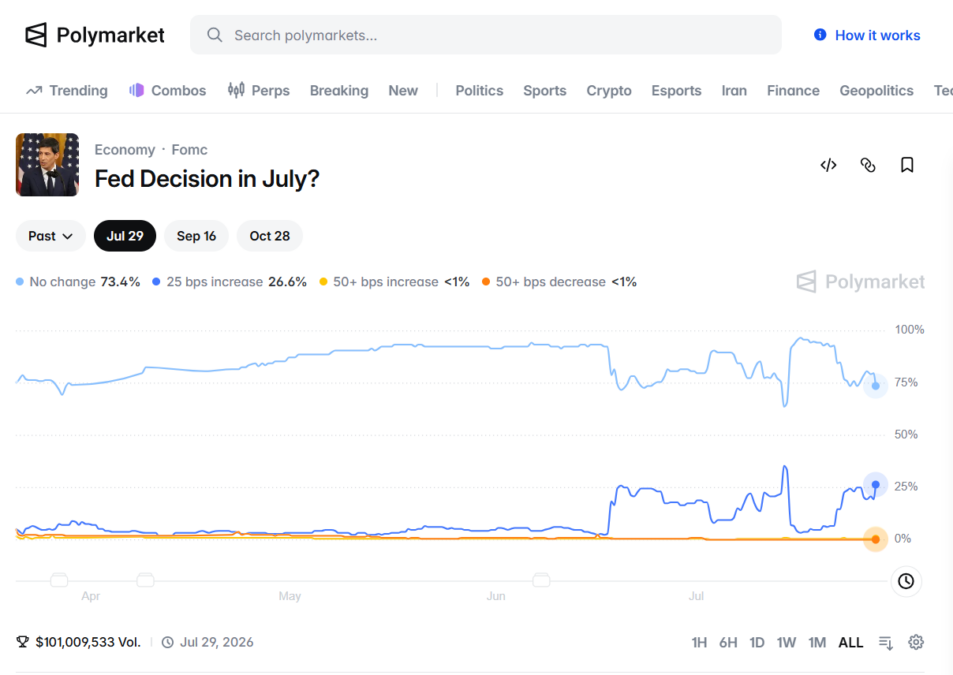
The market had generated more than $101 million in trading volume, making it one of the most heavily traded financial-policy events on the platform. Polymarket’s broader chart also showed that expectations of a July hike had moved from low single-digit levels earlier in the year to around 25% as inflation and geopolitical risks intensified.
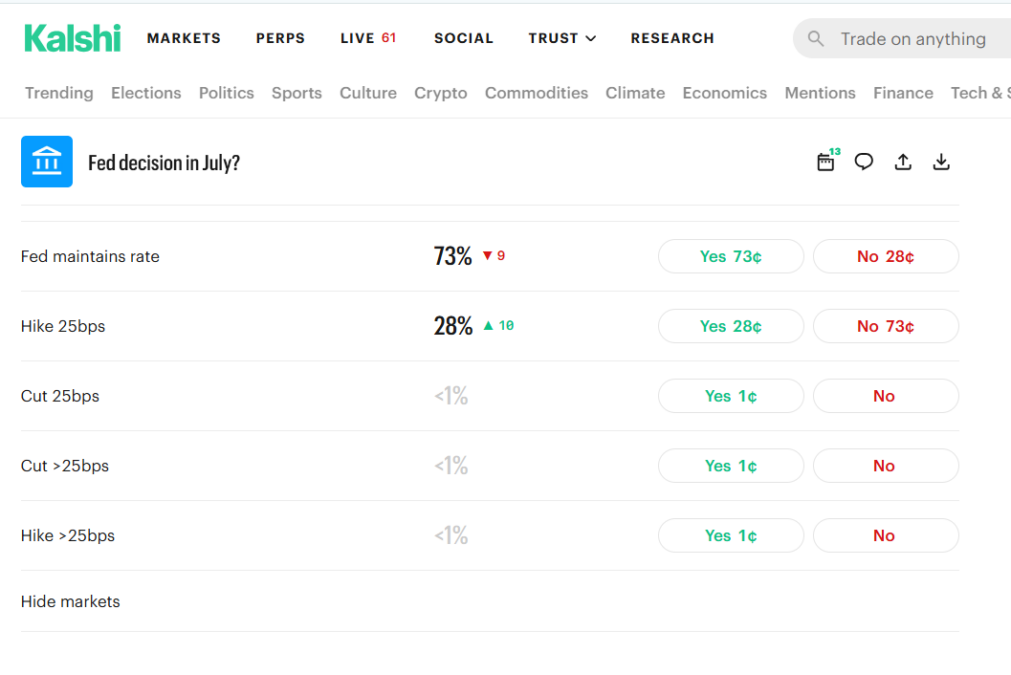
Kalshi displayed almost identical expectations. Its market assigned a 73% probability to an unchanged rate, a 28% probability to a 25-basis-point hike and around a 1% chance of a larger increase. The market had attracted approximately $42.97 million in volume when the screenshot was taken.
The convergence between the two markets is financially significant. Kalshi and Polymarket operate through different market structures and participant bases, yet traders on both platforms reached almost the same conclusion: a hold remains the base case, but a hike is too plausible to ignore.
Prediction-market probabilities are not official forecasts and should not be treated as guaranteed outcomes. They reflect the prices at which participants are willing to risk capital and can change rapidly when economic, geopolitical or policy information enters the market.
The current pricing nevertheless shows that investors are not debating whether the Fed will cut rates. The July decision has effectively become a choice between maintaining a restrictive stance and tightening it further.
When is the July FOMC meeting?
The July FOMC meeting will take place over two days on July 28 and July 29, 2026.
The Federal Reserve will release its policy statement at 2:00 p.m. Eastern Time on July 29, followed by Warsh’s press conference at 2:30 p.m. ET. For readers in India, the decision will arrive at 11:30 p.m. IST, while the press conference will begin at midnight on July 30.
The meeting will determine the target range for the federal funds rate, which influences borrowing conditions throughout the US economy.
Changes in this rate can affect Treasury yields, the US dollar, equity valuations and investor demand for riskier assets such as Bitcoin and altcoins.
What interest-rate decision is expected from the July 2026 FOMC meeting?
Most economists still expect the Fed to leave the federal funds rate unchanged at 3.50%–3.75%, the range maintained at the June meeting. However, renewed energy-price volatility and the absence of clear forward guidance from Warsh have increased uncertainty around that call.
Oil prices moved sharply higher during the latest escalation in the Middle East before retreating after the United States and Iran paused further strikes. Brent crude subsequently fell to $88.90, while the US 10-year Treasury yield declined to around 4.65% as the immediate inflation threat eased.
That reversal reduced the urgency for a July hike, but it did not remove the underlying policy problem. A renewed increase in oil prices could raise transport, production and household energy costs, making it harder for the Fed to return inflation sustainably to its 2% objective.
The Federal Reserve’s July Monetary Policy Report acknowledged that inflation had increased during 2026 and remained elevated partly because of supply shocks, including energy-related price increases. It also described the labour market as broadly stable, leaving policymakers focused primarily on whether inflation requires another response.
CPI Improved, but the Fed’s Preferred Inflation Measure Did Not
June’s Consumer Price Index gave the Fed a strong reason to wait.
Headline CPI declined 0.4% from the previous month, bringing annual inflation down from 4.2% to 3.5%. Core CPI, which excludes food and energy, was unchanged monthly and slowed to 2.6% annually from 2.9% in May.
The report initially supported Bitcoin and other digital assets because it reduced the probability of immediate monetary tightening. As CryptoTimes reported following the CPI release, Bitcoin moved above $63,000 while Ethereum crossed $1,820 as traders covered bearish positions.
However, the same report showed that energy prices remained 15.7% higher than a year earlier, driven partly by a 26.7% annual increase in gasoline prices. The Fed must therefore separate the improvement in underlying inflation from the renewed pressure facing households and businesses through energy costs.
The picture becomes less comfortable when measured through the Personal Consumption Expenditures price index, which the Fed uses for its formal inflation target.
Headline PCE inflation stood at 4.1% in May, while core PCE remained at 3.4%. Both measures were materially above the Fed’s 2% objective and showed less progress than the June CPI report.
An important timing issue also limits the Fed’s visibility. The June PCE report is scheduled for July 30, one day after the FOMC decision. Policymakers must therefore decide without a fresh official reading from their preferred inflation gauge.
This timing strengthens the case for patience because the committee can wait for another month of inflation data. It also creates a risk that the Fed holds rates immediately before receiving a report showing that price pressures remain stronger than expected.
The Labour Market Supports Patience, Not Easing
The latest employment figures do not force the Fed towards either an immediate hike or a rate cut.
The US economy added 57,000 jobs in June, while the unemployment rate remained relatively low at 4.2%. Hiring has weakened considerably, but the data do not indicate the kind of abrupt labour-market deterioration that would require monetary support.
These conditions give the Fed room to keep rates restrictive while studying inflation. They also make a precautionary hike more difficult to justify because higher borrowing costs could intensify the slowdown in hiring if the latest energy shock proves temporary.
The trade-off is clear. Waiting could allow inflation expectations and financial conditions to loosen, while hiking could place additional pressure on employment and economic activity before policymakers know whether energy inflation will persist.
What Is the Most Likely July FOMC Outcome?
The most likely outcome is a hawkish hold.
Under this scenario, the Fed would maintain the 3.50%–3.75% range while emphasising that inflation remains above target and that further tightening may be necessary. That message would allow the committee to wait for June PCE data without giving financial markets a reason to price the end of the tightening cycle.
A hawkish hold would also align with prediction-market pricing. Traders overwhelmingly expect no immediate change, but the 27% assigned to a hike suggests that markets expect Warsh to preserve the possibility of action in September.
The Fed’s June projections reinforce that risk. The median participant expected the federal funds rate to finish 2026 near 3.8%, slightly above the present midpoint of 3.625%, while the median PCE inflation projection stood at 3.6%.
Those projections indicate that policymakers were already considering additional tightening before the latest volatility in energy markets.
Four Possible July FOMC Outcomes
| FOMC outcome | Policy interpretation | Likely market transmission | Possible Bitcoin response |
| Hawkish hold | Fed waits but keeps September hike open | Front-end yields and dollar remain supported | Initial relief may fade |
| Balanced hold | Fed acknowledges lower CPI but retains data dependence | Limited move in yields and dollar | Bitcoin may remain volatile but range-bound |
| Dovish hold | Fed treats energy inflation as temporary | Yields and dollar decline as hike odds fall | Most supportive outcome for crypto |
| 25 bp hike | Fed prioritises inflation credibility | Yields and dollar rise as risk exposure falls | Strongest immediate downside risk |
| 50+ bp hike | Emergency-style response to inflation risks | Severe repricing across bonds and equities | Sharp liquidation risk, although markets price this below 1% |
The difference between these outcomes will not be determined by the rate alone. Markets will compare the decision with the probability already embedded in bonds, currencies, derivatives and prediction markets.
A 25-basis-point hike would be bearish because roughly three-quarters of prediction-market participants expect the Fed to hold. A no-change decision, by contrast, would not automatically be bullish because it is already the dominant expectation.
Why a Rate Hold May Not Help Bitcoin
Bitcoin responds to monetary policy through the effect of interest rates on liquidity, yields and the dollar rather than through the policy rate in isolation.
When Treasury yields rise, investors can earn higher returns from government securities, increasing the opportunity cost of holding assets that do not generate contractual income. Higher yields can also raise borrowing costs and reduce the amount of capital available for speculative or leveraged positions.
A stronger dollar creates another layer of pressure. Because Bitcoin trades globally against the US currency, tighter dollar liquidity can weigh on international risk appetite and make dollar-denominated funding more expensive.
The June FOMC meeting demonstrated why an unchanged rate can still hurt crypto. The Fed held rates as expected, but its more restrictive policy signal contributed to approximately $122 million in liquidations within four hours and more than $337 million over the broader 24-hour period.
As covered in CryptoTimes’ June FOMC market report, Bitcoin and Ethereum accounted for more than $82 million of those liquidations.
The market reacted not to the unchanged rate itself, but to the gap between the decision investors expected and the policy path communicated by the Fed.
Why Bitcoin’s First Move Could Be Misleading
The Federal Reserve will release its decision at 2:00 p.m. ET on July 29, followed by Warsh’s press conference at 2:30 p.m. ET. The meeting does not include a new Summary of Economic Projections or dot plot.
Bitcoin could therefore experience two separate moves.
The first will follow the statement and rate decision. The second will develop during the press conference as Warsh explains how the committee views inflation, oil prices, employment and the possibility of a September increase.
A Bitcoin rally immediately after a hold could reverse if Warsh says that inflation risks have increased or that another hike remains likely. A negative initial move could recover if he treats the energy shock as temporary and signals that current rates are sufficiently restrictive.
The two-year Treasury yield and the US dollar may provide a clearer reading of the policy message than Bitcoin’s first five-minute candle. Rising short-term yields would indicate that markets heard a hawkish signal, while falling yields would suggest that investors reduced expectations for further tightening.
What Should Markets Watch in the Statement?
The inflation language will provide the first indication of whether the committee has become more concerned. A stronger reference to upside risks, energy prices or inflation expectations would make an unchanged decision appear more hawkish.
The labour-market assessment will also matter. If the Fed continues describing employment conditions as solid, markets may conclude that policymakers have room to raise rates. Greater concern about slowing payroll growth would support waiting through September.
Voting dissent could produce another important signal. A hold accompanied by one or more votes for an increase would reveal that support for tighter policy is building inside the committee, even though the majority did not act.
Warsh’s treatment of September will probably determine the lasting market reaction. He does not need to promise a hike; describing every meeting as live and refusing to rule out further action may be enough to keep yields and the dollar elevated.
CryptoTimes readers can follow the decision alongside the other major market events covered in the latest crypto week-ahead report.
Final Assessment
Prediction markets establish a clear base case for July: the Federal Reserve is more likely to hold than hike.
However, the approximately 27% probability assigned to a 25-basis-point increase is large enough to create substantial event risk. More than $140 million in combined volume across Polymarket and Kalshi shows that participants are committing significant capital to both sides of the decision.
The economic data support a hawkish hold. Core CPI has improved, but the Fed’s preferred PCE measure remains elevated, energy inflation is still significant and the next PCE release will not arrive until after the meeting.
A hold accompanied by firm September guidance would allow the Fed to wait for more information without relaxing financial conditions. That outcome could limit Bitcoin’s upside even though rates remain unchanged.
A surprise hike would produce the strongest negative reaction because markets have not fully priced it. Treasury yields and the dollar could rise, while leveraged crypto positions would face a higher probability of forced liquidation.
The question facing markets is therefore not simply whether the Fed will raise rates in July. It is whether Warsh can hold rates without convincing investors that further tightening is no longer coming.
Also Read: Crypto Week Ahead: FOMC, Coinbase & Strategy Earnings, Zcash Upgrade