IREN Limited has transformed from a Bitcoin mining operation into a major player in AI cloud infrastructure. On July 20, 2026, the company disclosed $2.8 billion in new multi-year AI cloud contracts, lifting its 2026 annualized run-rate revenue (ARR) target for AI Cloud to over $4 billion, with about 85% now under contract.
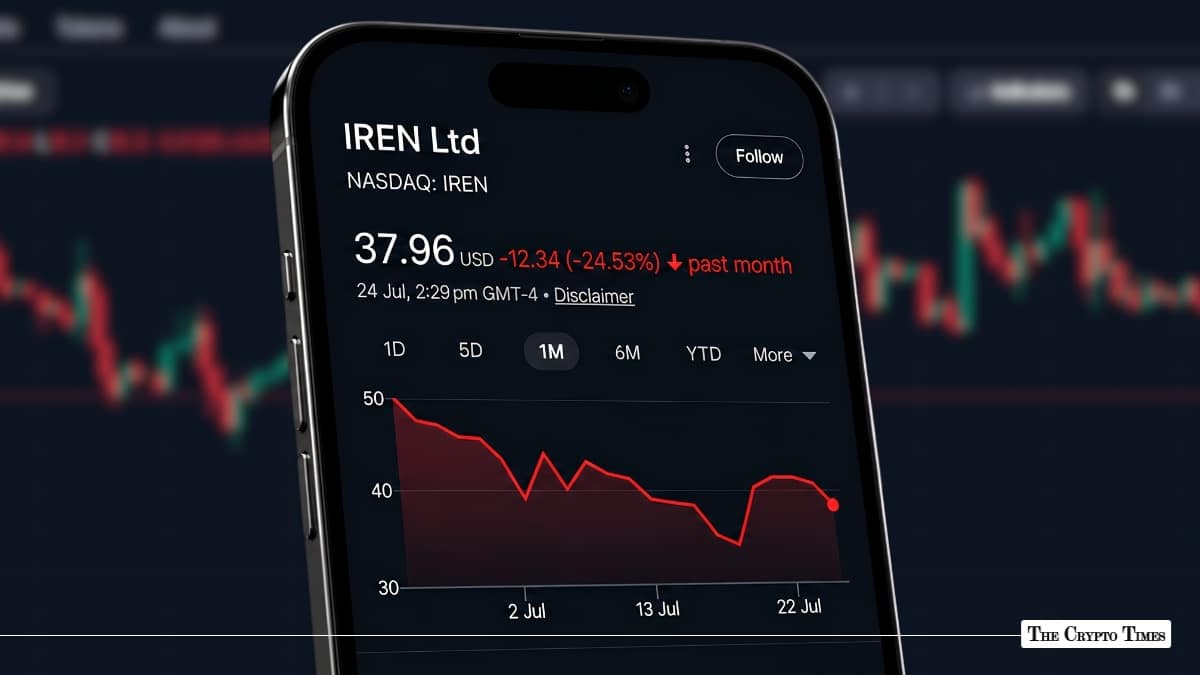
The market reaction was immediate: shares jumped as much as 20% intraday. But the announcement landed at the end of one of the worst stretches in the stock’s recent history. Heading into the news, IREN had fallen more than 40% over the trailing month, hitting its lowest level since early April amid a sector-wide selloff in AI infrastructure names and a governance fight over a $700 million executive stock award. Even after the rebound, the stock is down roughly 24% over the past month, trading at $38.42 as of midday July 24.
The contrast highlights execution momentum against investor caution over dilution, capital needs, and Bitcoin mining heritage. IREN does not hold Bitcoin on its balance sheet; its operations rely on renewable-powered data centers optimized for both legacy mining and emerging HPC/AI workloads.
From mining roots to AI infrastructure
IREN, formerly Iris Energy, built its foundation on renewable energy-powered Bitcoin mining facilities in Australia, Canada, and the United States. The company has shifted strategy toward high-performance computing (HPC) and AI cloud services, repurposing and expanding data centers for GPU deployments. The pivot leverages existing power infrastructure while targeting demand for AI training and inference capacity.
As of the March 31, 2026 quarterly report, IREN outlined plans to expand AI Cloud capacity significantly. The company reported progress on liquid-cooled data centers and partnerships that support both bare-metal and managed cloud offerings. Vertically integrated operations, controlling power procurement, site development, and deployment, provide a competitive edge in a power-constrained market.
Recent contracts involve major clients including Microsoft, NVIDIA, Perplexity, Figure AI, Together AI, Fluidstack, Fireworks AI, Fal AI, Hume AI, and additional AI developers. These deals span multi-year terms, often four years or longer, and include prepayments covering approximately 45% of associated GPU capital costs. Pricing ranges from $3.80 to $4.30 per GPU-hour, offering visibility into future revenue streams.
The $2.8 billion contract
On July 20, 2026, IREN announced the $2.8 billion in new contracts, prompting a sharp intraday stock rally of nearly 17-20%. Management raised the year-end 2026 AI Cloud ARR target from $3.7 billion to more than $4 billion. This acceleration reflects strong demand exceeding available capacity, with customers engaging in 2026 and 2027 expansion plans.
The contracts build on prior wins, including a substantial Microsoft agreement for GPU clusters at the Childress site. According to an official release, earlier in 2026, IREN secured a five-year deal with NVIDIA. Collectively, these position the company to deliver hundreds of megawatts of AI capacity. Plans call for 480 MW of AI Cloud by end-2026, scaling toward 1.2 GW in 2027.
Prepayments from customers reduce reliance on external financing for GPU acquisitions. This structure mitigates some balance sheet strain while aligning incentives. IREN’s customer diversification across hyperscalers, AI labs, and developers spreads risk beyond single-name exposure.
IREN stock monthly performance
IREN shares entered July trading in the low-to-mid $40s but faced downward pressure. By mid-month, concerns over a large executive stock award contributed to a decline. The stock recovered sharply following the July 20 contract announcement, closing the month around $39-40 after a period of volatility. Overall, the month reflected approximately a 24% decline from early July levels, which were near $48-50 peaks earlier in the period.
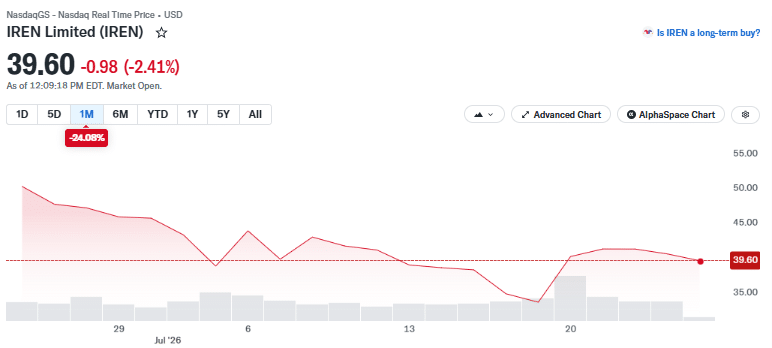
Daily closes showed swings: early July around $44-45, dipping toward $33 mid-month before rebounding above $40. Trading volumes surged on announcement days, exceeding 90 million shares on July 20. Market capitalization hovered around $13-14 billion.
This performance occurred against a backdrop of Bitcoin price fluctuations near $63,000-$64,000 and sector-wide pressures on former miners transitioning to AI. Peers like Hut 8, Cipher Digital, and Riot Platforms showed mixed results, with many exhibiting similar volatility tied to AI narrative strength and dilution fears.
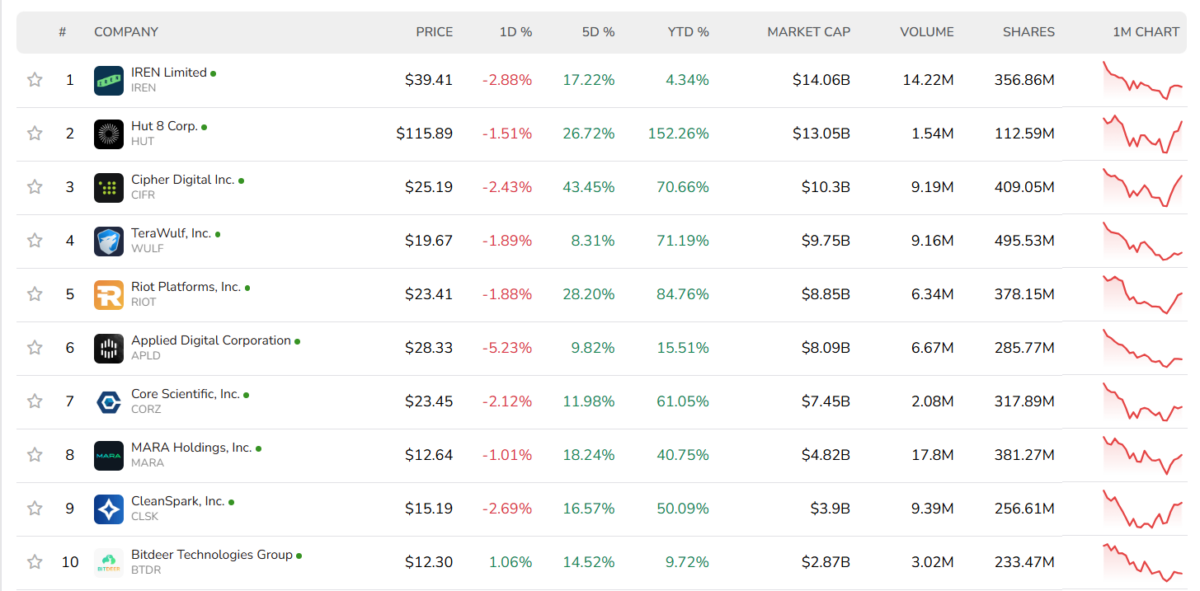
IREN ranked at the top of such lists in some snapshots, with a market cap near $14 billion, though its recent monthly change reflected the broader pullback before the contract-driven rebound.
Executive compensation and investor reaction
On June 30, 2026, IREN’s board approved approximately $700 million in restricted stock units (RSUs) for co-founders and co-CEOs Daniel Roberts and William Roberts. The award totaled about 18.2 million RSUs, split equally, representing roughly 5% of outstanding shares. Vesting occurs over six years in equal installments, with additional lock-up periods.
The announcement triggered a roughly 7% stock drop on July 13 as investors weighed potential dilution against retention incentives. No further stock awards to the CEOs are planned until fiscal 2031. The package followed compensation committee review and aimed to align leadership with long-term growth amid the AI transition.
Critics highlighted the size relative to ongoing net losses in earlier periods. For the quarter ended December 31, 2025, revenue reached $184.7 million, but a net loss of $155.4 million persisted, typical for capital-intensive infrastructure builds. Full fiscal 2025 results showed $501 million in revenue, up 168% year-over-year, with a positive net income of $86.9 million.
Operational and financial context
IREN’s SEC filings detail risks inherent to the pivot: hardware obsolescence, power procurement challenges, customer concentration initially, and execution on capacity builds. The March 31, 2026 10-Q emphasized forward-looking plans for data center repurposing, GPU deployments, and geographic expansion while cautioning on supply chain and regulatory hurdles.
Bitcoin mining remains part of operations but is de-emphasized relative to AI growth. Renewable energy sourcing supports both activities, providing operational flexibility. The company does not hold BTC as a treasury asset, focusing instead on service-based revenue.
Beta and volatility metrics reflect sensitivity to both crypto cycles and AI investment sentiment. Forward P/E and other multiples remain elevated, consistent with high-growth infrastructure plays. Analyst targets range widely, with some projecting $70-$90 based on ARR achievement, while others cite valuation caps amid execution risks.
Broader industry landscape
The AI data center boom drives competition among former miners and dedicated providers. Companies like Core Scientific, Applied Digital, and others pursue similar strategies, benefiting from existing power assets. IREN differentiates through vertical integration and rapid scaling from a small self-built AI base (around 3 MW a year prior) to hundreds of MW planned.
Bitcoin price movements near $63,000 in July influenced sentiment, though IREN’s AI focus increasingly decouples performance. Sector peers showed varied monthly results, with some posting gains on AI news while others faced headwinds.