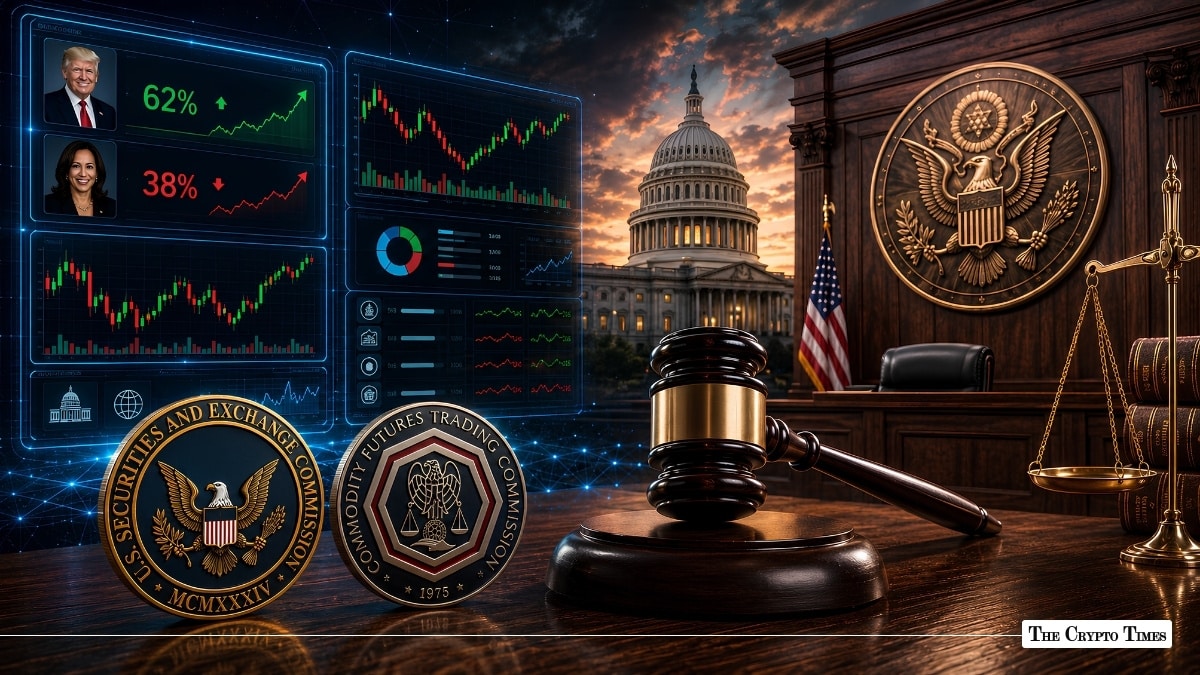
Prediction markets are expanding faster than U.S. regulators and courts can agree on how they should be governed. July trading reached a record $50.59 billion across Kalshi, Polymarket’s international platform, and Polymarket US, as federal and state authorities continued to clash over whether event contracts fall primarily under federal commodities law or state gambling rules.
Combined notional volume across the three platforms rose 7.8% from a revised $46.95 billion in June, according to data compiled by The Block (as of August 7 at 5:30 PM UTC). Kalshi took the largest share at $37.7 billion, about 74.5% of the total, up 14% from the prior month.
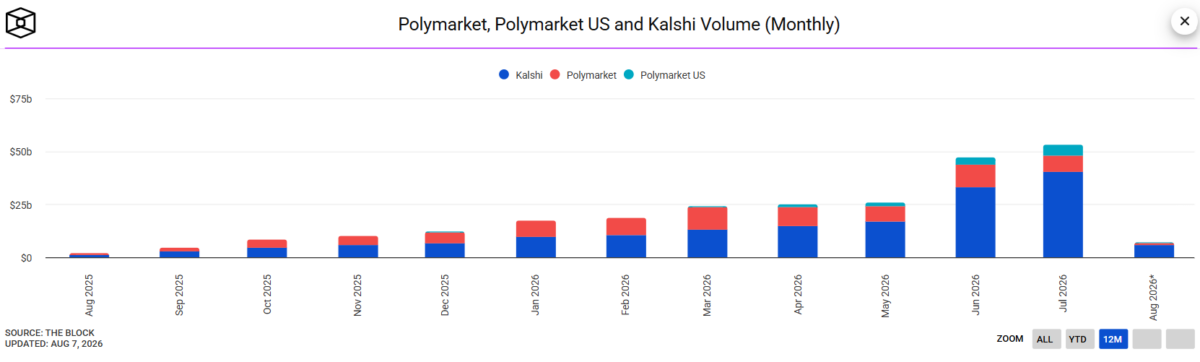
Polymarket’s offshore platform fell 26% to $7.9 billion, while its CFTC-regulated U.S. exchange, Polymarket US, rose 54% to $5 billion, its strongest month since the company dropped its waitlist and opened to all U.S. users in May. Combined, Polymarket’s two businesses processed $12.9 billion, down from roughly $14 billion in June.
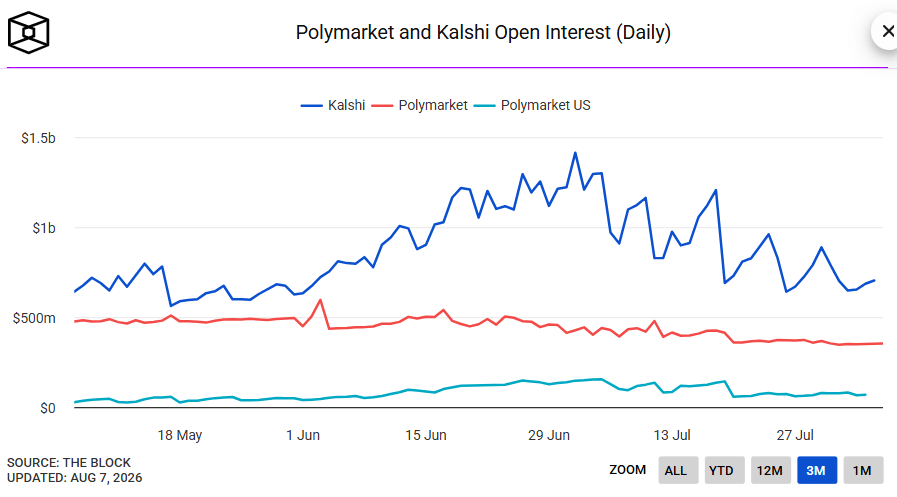
The surge coincided with the closing weeks of the 2026 FIFA World Cup, which ran from June 11 to the July 19 final. Kalshi’s contract on the Spain-Argentina final, won by Spain, 1-0, drew close to $1.9 billion in trading on its own, while Polymarket’s market on the tournament’s eventual winner attracted roughly $4 billion. Activity cooled sharply once the tournament ended: open interest across the three platforms fell from about $2 billion at the start of July to roughly $1.2 billion by month’s end, as positions tied to the World Cup settled and traders exited.
The volume figures land amid an unresolved, multi-front legal and regulatory fight over whether event contracts fall under exclusive federal commodities oversight or remain subject to state gambling law, a conflict now playing out in federal courtrooms in at least a dozen states, in a pending federal rulemaking, and in dueling public statements from state attorneys general and the Commodity Futures Trading Commission.
A World Cup stress test, on-chain
Because Polymarket’s international platform settles trades in USDC on the Polygon blockchain, its World Cup activity is independently verifiable on public ledgers, a rarity in retail trading markets.
Blockchain analytics firm Chainalysis, in a July 30 report, put total on-chain prediction-market volume tied to the World Cup at $20 billion measured from January 2026 through the tournament, including roughly $5.7 billion wagered during the five-week tournament window itself, when World Cup markets accounted for about 63% of all prediction-market activity on-chain. Nearly 400,000 wallets participated, with the United States and China generating the largest attributable volumes, followed by Canada, Thailand, and the United Kingdom.
Illicit exposure was limited but not zero. Chainalysis identified roughly 3,700 wallets, under 1% of participants, with ties to illicit actors, and traced about $5.4 million in flows from sanctioned sources, primarily the sanctioned exchange Huobi/HTX, into World Cup betting wallets. That is a small fraction of the $20 billion total but a reminder that on-chain venues remain exposed to sanctions-evasion risk even at low participation rates.
The federal rulemaking at the center of the fight
On June 10, the CFTC published a Notice of Proposed Rulemaking that would amend CFTC Regulation 40.11 and add a new Appendix F to the agency’s Part 40 rules, formalizing how the Commission decides whether an event contract is “contrary to the public interest” under Section 5c(c)(5)(C) of the Commodity Exchange Act, a provision known as the “Special Rule” that lets the CFTC prohibit contracts involving terrorism, assassination, war, gaming, or other unlawful activity.
The proposal defines “gaming” as an activity typically pursued for recreation or entertainment, governed by rules, and dependent on chance, skill, or athletic performance. Under the proposed framework, contracts on the aggregate outcome of professional or collegiate sporting events, with objective, verifiable settlement and adequate market surveillance, would generally be treated as unlikely to run afoul of the public-interest standard.
Contracts tied to player injuries, officiating calls, discrete individual actions by a single participant, or pre-collegiate events would draw heightened scrutiny. The proposal lays out a 90-day review process and a list of factors the Commission would weigh, including a contract’s price-discovery or hedging value, its susceptibility to manipulation or insider trading, and the adequacy of a platform’s compliance systems.
The public comment period closed July 27. No final rule has been issued. CFTC Chairman Michael Selig said in announcing the proposal that the agency intends to “protect the integrity of our regulated markets without standing in the way of responsible innovation.”
Minnesota tests the limits of state authority
Minnesota became the first state to pass an outright ban on operating, hosting, or advertising prediction markets, with felony penalties, signed by Governor Tim Walz in May and set to take effect August 1. The Justice Department, the CFTC, Kalshi, and Polymarket sued to block it.
On July 27, U.S. District Judge Katherine Menendez granted a preliminary injunction, finding the plaintiffs were likely to succeed on their argument that the Commodity Exchange Act preempts Minnesota’s law with respect to contracts that meet the federal definition of a “swap” and that letting the ban take effect would cause irreparable harm.
Her order is narrower than the platforms’ full request, however: Menendez explicitly noted that some event contracts on Kalshi and Polymarket may not meet the statutory definition of a swap, meaning any permanent injunction “may be much narrower” than the temporary one, leaving the door open for Minnesota to pursue a more tailored ban later in the litigation.
Minnesota Attorney General Keith Ellison called prediction markets “gambling, plain and simple,” said the state “has every right to keep predatory gambling out of our communities,” and confirmed his office would continue litigating and defending the law.
New York ruling goes against Kalshi
Kalshi’s fight with New York has gone the opposite direction. After the New York State Gaming Commission issued a cease-and-desist order in October 2025, Kalshi sued the commission’s members, arguing the CEA preempts state gambling law. On July 7, in KalshiEX LLC v. Williams, U.S. District Judge Analisa Torres of the Southern District of New York denied Kalshi’s request for a preliminary injunction, ruling that the CEA does not preempt New York’s gambling law under any of the standard preemption theories, express, field, or conflict.
Torres noted that Congress’s “Special Rule” carve-out for gaming contracts undercuts the argument that Congress intended the CFTC to hold exclusive nationwide authority over every event contract and pointed out that Kalshi has the option of applying for a New York gaming license rather than contesting enforcement in court.
Kalshi filed a notice of appeal to the U.S. Court of Appeals for the Second Circuit the same day and separately asked Torres for a stay pending appeal. She denied that request too, on July 27, Kalshi’s second loss in New York within a month, finding the company had not shown a likelihood of success on appeal, irreparable harm, or that the balance of equities favored a stay.
New York Governor Kathy Hochul and Attorney General Letitia James welcomed the ruling, saying in a joint statement that the state “will continue to hold all gambling platforms accountable to the law, and that includes prediction markets.” James’s office is expected to pursue a separate civil enforcement action against Kalshi in state court.
Legal analysts have flagged the New York rulings as consequential well beyond that state: attorney Daniel Wallach called the July 7 decision a “major, major loss for Kalshi in the financial capital of the US, with likely knock-on effects in other cases.” The Second Circuit has not yet ruled on the merits of Kalshi’s appeal.
A patchwork developing state by state
New York and Minnesota illustrate a wider split. The CFTC has sued multiple states, including New York, Arizona, Connecticut, Illinois, Wisconsin, Minnesota, New Mexico, Rhode Island, and Kentucky, asserting exclusive federal jurisdiction over event contracts. Results have diverged: the Third Circuit ruled in April that New Jersey could not apply its sports-gambling law to Kalshi’s contracts, and an Arizona federal court granted a similar injunction in May.
New York’s federal court has now gone the other way. More than a dozen state regulators have accused Kalshi and Polymarket of operating unlicensed gambling platforms, and additional enforcement actions and state legislative efforts remain active in multiple jurisdictions. With federal courts split on the scope of CEA preemption, appellate review and potentially Supreme Court review look increasingly likely.
The settlement-rail question underneath it all
Beneath the jurisdictional fight sits a structural one: how these contracts settle. Polymarket runs two parallel systems, an international platform settling trades in USDC on Polygon, open to non-U.S. users and available to U.S. users only in a more limited capacity, and a separate, CFTC-regulated U.S. exchange (Polymarket US, operated by QCX LLC) for domestic customers.
The data showed growth at the regulated U.S. venue alongside a decline at the offshore platform. The regulated U.S. venue grew even as the offshore platform contracted, consistent with at least some U.S. activity migrating toward the compliant venue. A Rutgers University statistician, Harry Crane, estimated earlier this year that U.S. users had driven roughly 30% of volume on Polymarket’s offshore platform in the 12 months through April 30, 2026, activity the CFTC-regulated U.S. exchange is designed to capture domestically instead.
Traditional financial firms and sportsbook operators have entered the space through CFTC-registered entities or introducing-broker arrangements, subjecting them to the same federal framework that governs Kalshi and Polymarket US.
What happens next
As of early August, the Minnesota injunction remains in effect while litigation continues, and the state has signaled it will keep pressing its case. Kalshi’s New York appeal is pending before the Second Circuit.
The CFTC’s proposed public-interest rule is under internal review following the close of its comment period, with no timeline yet for a final rule. Additional state enforcement actions continue in multiple jurisdictions, and early-August availability tracking shows the major platforms still operating in most states even as restrictions and litigation persist in others, New York foremost among them.
The result is a sector growing faster than the regulatory architecture meant to govern it: record volumes concentrated in sports and political contracts, federal courts reaching opposite conclusions on the same legal question within weeks of each other, and a rulemaking that, even once finalized, is explicitly limited to one narrow slice of a much larger set of open questions about how prediction markets fit into U.S. financial regulation.
Also Read: Prediction Markets Set New Monthly Record With $50.6B Volume in July