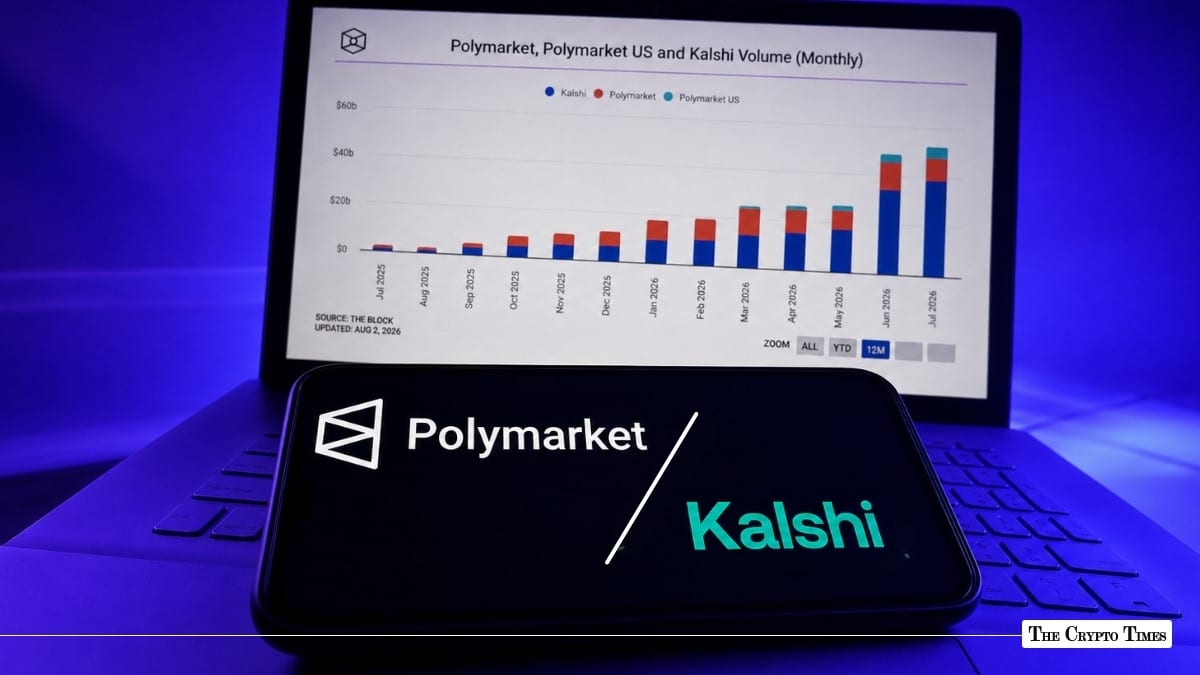
Prediction markets recorded a combined $50.6 billion in trading volume during July, marking a new monthly high across Polymarket, Polymarket US, and Kalshi, according to market data published on August 3.
The milestone was achieved despite weaker activity on Polymarket’s international platform, as strong growth in the regulated U.S. market and continued dominance by Kalshi pushed overall trading to a record.
The combined July volume reached $50.59 billion, up 7.8% from the revised June total of $46.95 billion. Kalshi remained the largest prediction market by far, processing $37.7 billion, or roughly 74.5% of total trading. Polymarket’s international platform generated $7.9 billion, while Polymarket US contributed $5 billion.
US market growth
The largest relative increase came from Polymarket US, where trading volume jumped 54% month-on-month. By contrast, Polymarket’s offshore platform fell 26%, leaving the combined volume of the two Polymarket businesses at $12.9 billion, down from roughly $14 billion in June.
The shift follows Polymarket US expanding access to eligible American users after removing its app waitlist in May. The exchange operates through QCX, a Commodity Futures Trading Commission (CFTC)-designated contract market, placing it under the same federal regulatory framework as Kalshi.
Market analysts note that reported figures represent taker notional trading volume, rather than net exchange revenue or customer deposits. Because traders routinely buy and sell the same contract prior to settlement, elevated trading volume signifies deeper order book liquidity and rapid contract turnover rather than $50.6 billion in new deposits or platform earnings.
FIFA World Cup catalyzes volume
The FIFA World Cup, which ran from June 11 to July 19, served as one of the single largest drivers behind July’s record activity. The tournament generated a large number of frequently settling prediction contracts, boosting trading across sports markets.
Kalshi’s market for the Spain vs. Argentina World Cup final alone recorded approximately $1.89 billion after Spain won 1-0. According to Chainalysis, the 2026 FIFA World Cup generated $20 billion in on-chain prediction market volume since January 2026, with nearly 400,000 wallets participating. During the main tournament period, blockchain-based prediction markets experienced $5.7 billion in activity, as users placed trades on match outcomes and other events.
Despite monthly volume hitting a record, open interest across Kalshi, Polymarket and Polymarket US fell from around $2 billion at the start of July to roughly $1.2 billion by the end of the month. The contraction in open interest reflects widespread contract settlement following the World Cup final, indicating that traders realized profits or exited positions as the tournament concluded.
Evolving regulatory landscape
The record trading month comes as prediction market operators continue facing legal scrutiny in the United States.
The State of New York filed a lawsuit against Kalshi on July 31, accusing the prediction market platform of operating an unlicensed gambling business. The state is seeking to stop certain Kalshi contracts, review customer betting activity, and impose fines. The allegations are still under review and have not been proven in court.
Meanwhile, a federal judge in Minnesota temporarily blocked the state’s prediction market ban before it could take effect on August 1. The court ruled that Kalshi and Polymarket US had a strong chance of proving that federally regulated derivatives may not be restricted by state laws. The legal battle remains ongoing as courts establish where federal commodities oversight ends and state gaming regulation begins.
Also Read: Polymarket Upgrades Crypto Markets With TWAP Pricing Model