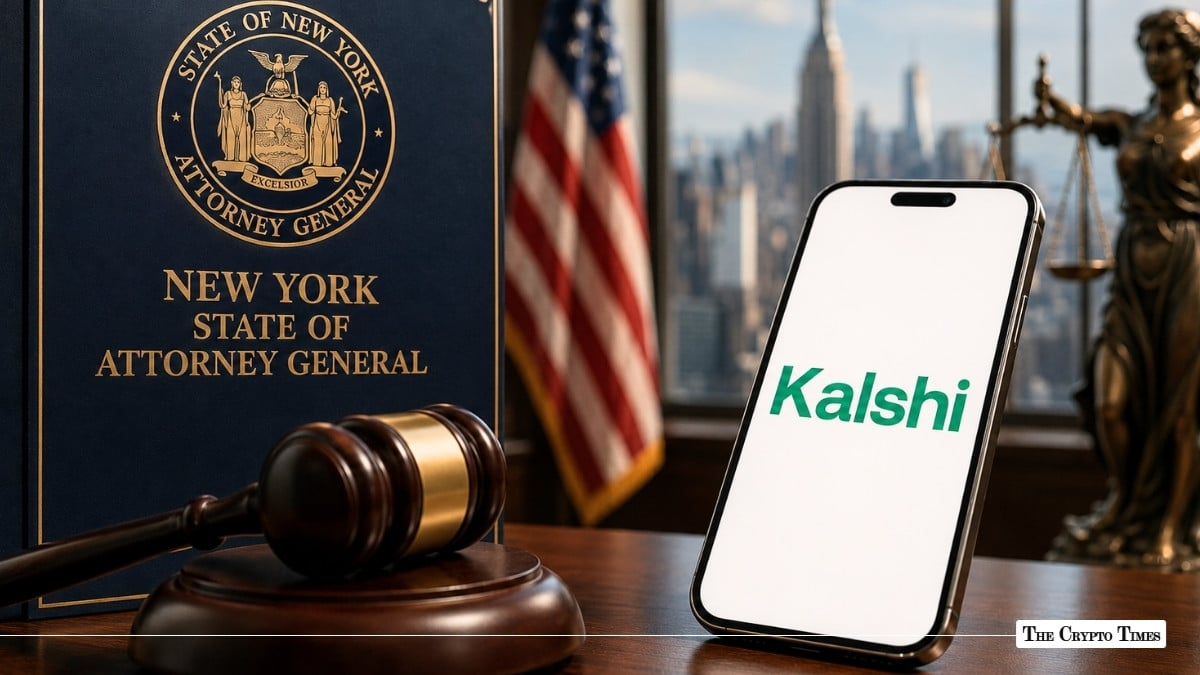
New York has sued prediction-market operator Kalshi, alleging it runs an unlicensed, illegal gambling business in the state and asking a court to shut it down and impose fines worth three times the company’s gains.
Governor Kathy Hochul and Attorney General Letitia James announced the action on July 31, filing a verified petition in New York Supreme Court in Manhattan under the state’s business-fraud statute, Executive Law § 63(12).
What New York Is Asking For
The petition asks the court to permanently bar Kalshi from operating an unlicensed gambling business in New York, to order a full accounting of bets placed and money lost by customers, and to direct restitution and disgorgement. It also seeks a penalty of three times Kalshi’s gains under Penal Law § 80.10 and a separate penalty of $100,000 for each unauthorized offer to provide sports wagering under the Racing Law.
Those figures matter against the scale the state cites: the petition points to Kalshi’s own reported $22 billion valuation and $178 billion in annualized transaction volume. Kalshi has not been found liable, and every characterization in the filing is an allegation the court has yet to test.
“No company is above the law,” Hochul said in the announcement. James framed the case in consumer-protection terms, saying prediction markets like Kalshi are gambling platforms “plain and simple,” regardless of how they describe themselves. Kalshi has not been found liable; the state’s characterizations are allegations a court has yet to weigh.
The Case Against Kalshi
New York’s theory is that Kalshi’s contracts are wagers, plain and simple: a bettor stakes money on an uncertain future event outside their control, to be paid if the outcome lands.
On that basis, the state alleges Kalshi needed, and never obtained, a license from the New York State Gaming Commission, sidestepping the roughly 51% tax rate that licensed mobile sportsbooks pay, revenue the state directs to schools and problem-gambling programs. The eight counts range across the New York Constitution, three Penal Law gambling provisions, and the Racing Law.
The filing is unusually concrete because investigators built it from the inside. According to the petition, OAG staff placed real wagers from New York-based accounts — four “Yes” contracts on a UConn–Michigan basketball game for $1.14 in April, and 10 on the winner of Big Brother in July.
The state also flags that Kalshi offered betting on games involving New York college teams, such as Siena against Duke, which is prohibited even for licensed operators, and that it permits users aged 18 to 20 despite New York’s 21-and-over rule for sports betting.
A Federal Law Turned Against a Federally Regulated Platform
The sharpest wrinkle sits in the eighth count. Alongside the state statutes, New York accuses Kalshi of violating the federal Interstate Wire Act, which bars using wire communications to transmit bets across state lines. Invoking a federal criminal statute cuts directly against Kalshi’s central defense—that its CFTC registration places its event contracts under exclusive federal authority, beyond the reach of state gambling law.
Days After Kalshi Lost Its Emergency Shield
The petition landed at the end of a fast-moving week. On July 29, a Second Circuit judge denied Kalshi’s request for emergency relief from New York’s enforcement and referred its injunction motion to a three-judge panel, leaving the company without a temporary shield as a penalty pause, one New York had granted back in October 2025, ran out. Two days later, the state moved from defense to offense.
That parallel federal case began in October 2025, when Kalshi sued New York officials to block the Gaming Commission’s cease-and-desist. A district judge denied Kalshi’s injunction on July 7, finding federal commodities law does not preempt New York’s gambling statutes — the ruling Kalshi is now appealing.
New York’s Widening Front, With Crypto Exchanges in It
Kalshi is not alone in New York’s sights. In April, James sued Coinbase and Gemini on the same theory—that their prediction-market products amount to unlicensed gambling—pulling two of the largest U.S. crypto exchanges into the fight. When New York sued Coinbase, the exchange removed the case to federal court within a day, invoking the same federal-question argument Kalshi now presses. The Commodity Futures Trading Commission has backed the platforms and sued several states, New York among them, to assert federal jurisdiction.
Kalshi’s Federal Defense
Kalshi has consistently argued that its status as a CFTC-registered designated contract market since 2020 places its event contracts under exclusive federal oversight, making them regulated derivatives rather than gambling. That argument is the crux of both its federal appeal and any defense it mounts in New York. The company had not publicly responded to the state’s July 31 filing at the time of writing; The Crypto Times has reached out for comment.
For readers tracking the broader fight, our state-by-state guide to where Kalshi stands maps the wins, losses, and open cases across more than a dozen jurisdictions.