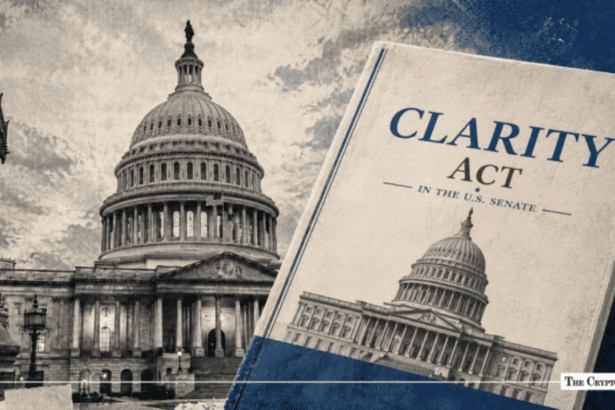
The CLARITY Act text released before Tuesday’s vote makes the ethics ban permanent and removes the investment carve-out that let officials hold digital assets. It also appears to remove the explicit criminal-law protection developers had in earlier drafts.
That second finding cuts against how the sponsors have described the changes. Senator Cynthia Lummis said the text shields developers from money transmission registration and establishes a strong civil safe harbor, which is accurate—but the criminal exemption present in July and on September 10 is not in this version.
Alex Thorn, head of firmwide research at Galaxy Digital, set out the comparison in a thread on September 14, ahead of the cloture motion at 2:15 p.m. ET on Tuesday.
The Ethics Sunset Is Gone
Earlier drafts terminated the entire ban at noon on January 20, 2029, and carried a clause wiping liability for conduct during the ban window once that date passed. Thorn says section 30105 and the severability section are both deleted, making the ban permanent.
The prohibition is also broader. Previous text covered issuing or sponsoring a digital asset for compensation while allowing officials to hold digital assets as investments. The new version adds a third prohibition barring covered individuals from maintaining a significant financial interest at all.
The threshold for what counts has fallen sharply. Where it previously meant 20% by vote or value in an entity deriving more than half its revenue from digital asset issuance in a calendar year, it now means $15,000 of equity in an entity that took a plurality of its revenue from issuance in any of the last three years.
Coverage extends to officials-elect—anyone certified as president, vice president, or member of Congress but not yet sworn in—and their spouses, requiring divestiture or a blind trust with three days’ notice to the ethics office. Penalties move from the lesser of 10% or $500,000 to the greater of 20% or $500,000.
What State Attorneys General Actually Get
The September 10 draft was explicit that there would be no state attorney general enforcement, no private right of action, and only Justice Department enforcement. That was the arrangement Senator Angela Alsobrooks called an unserious offer in July.
The new text gives state attorneys general standing where a violation harms residents, with harm defined to include financial harm above $100. Thorn describes this as a significant Democratic ask being met, while noting two limits: the remedy is injunctive relief, and the Office of Government Ethics can clear officials in a way that avoids state attorney general action.
The BRCA Change Runs the Other Way
The July and September 10 drafts each cited 18 U.S.C. 1960 twice, which Thorn says provided clear criminal-law exemptions. This draft cites it zero times.
The safe harbor now anchors instead to the FinCEN money transmitter regulation at 31 CFR 1010.100(ff)(5) and two Bank Secrecy Act financial institution categories. Also removed is a carve-out that preserved section 1960(b)(1)(C) against anyone acting with specific intent to move funds they knew were criminal proceeds, replaced by a general savings clause tied to conduct outside the scope of the safe harbor.
Thorn reads this as a setback for BRCA supporters. Earlier drafts stated that non-controlling developers are not engaged in money transmitting as defined in 1960; the replacements are regulatory rather than criminal. His summary is that civil and registration protections got broader while the explicit criminal shield was removed, with new exposure in the state licensing prong, since the rules of construction now expressly preserve state money transmitter classification.
The Stablecoin Circuit Breaker, Specified
The core prohibition on exchange-paid stablecoin interest is untouched. What is new is a community bank trigger.
If the Treasury finds within 18 months that deposits at banks below $10 billion migrated to stablecoins because of the section, it must write tougher rules banning yield. That is the circuit breaker the sponsors described, with the threshold and timeframe attached.
Most of the Bill Did Not Move
Thorn counts 85 of 101 sections as byte-identical to prior drafts, including self-custody escheat preemption, keep-your-coins, insider trading, the DeFi rulemaking, the temporary hold authority, title IX, and the GENIUS corrections.
The movement is concentrated in ethics, state enforcement, and BRCA—which he reads as a reasonable indication of where the marginal votes are. The combined banking and agriculture draft came out in July and sat for roughly two months, followed by two revisions in three days.
On that basis Galaxy has raised its estimate of passage in 2026 from 10% to 25%. The Crypto Times reported the earlier 10% figure earlier this month. Galaxy is an interested party in digital asset legislation, and the estimate is its own.
The Calendar Problem
Thorn describes the schedule as a major obstacle regardless of Tuesday’s outcome. Republicans are calling this their best and final offer, and it remains a partisan draft; whether it brings Democrats onto the bill was unclear as of Monday morning.
Even if sixty votes are secured, he expects floor action that could move the outcome either way. And if the Senate passes it before members leave Washington in October, the House would be in session only this week before breaking—meaning it would have to re-pass the Senate version during the lame duck session after the election, which he describes as possible but historically rare.
Also Read: Trump Agrees to CLARITY Ethics Terms as Final Text Adds State AG Enforcement