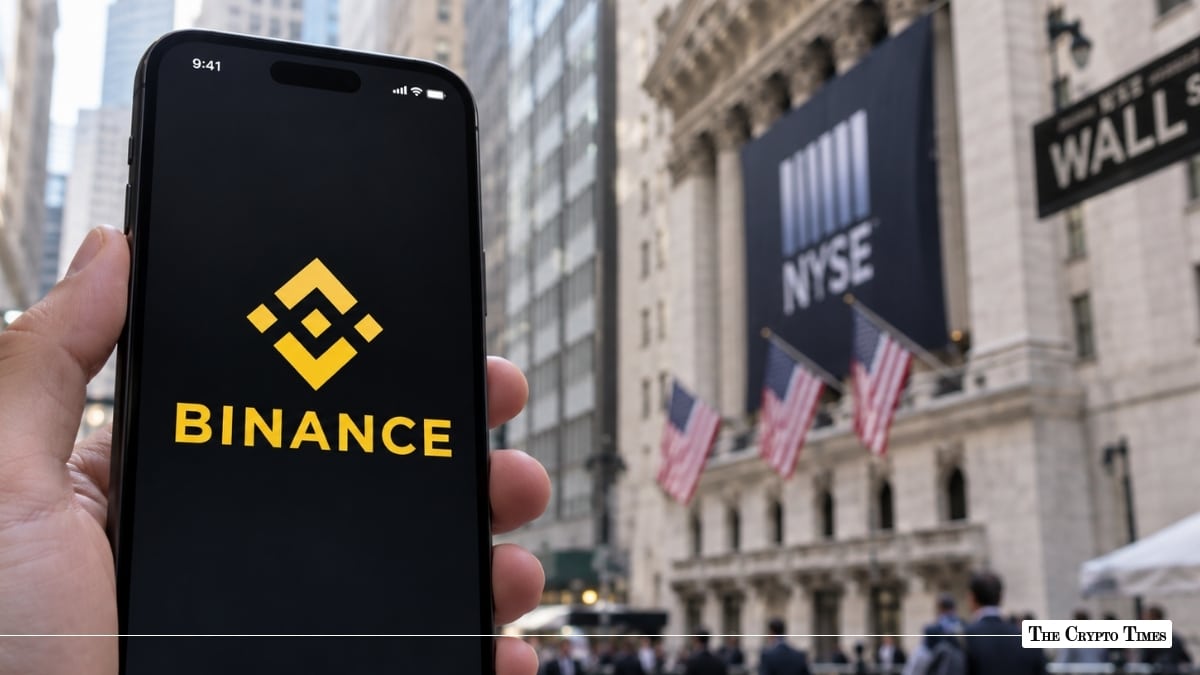
Binance has published a leadership blog arguing that centralised trading platforms will soon need to serve software agents in the same way they currently serve human customers, sharpening the case for the developer layer it rolled out over the summer without adding any new product, licence or market to the company footprint.
The essay reads as a positioning statement rather than a regulatory filing, a supervisory notice or a product launch, and it does not name a fresh jurisdiction the exchange plans to enter, alter the scope of who controls user funds, or shift responsibility for what an authorised agent chooses to do away from the account holder in whose name it operates.
Agent OS Sits at the Centre of the Argument
The blog anchors its argument to Binance Agent OS, the developer platform the exchange introduced on August 20, 2026, and which Crypto Times covered at launch. The system lets compatible artificial intelligence (AI) applications plug into the exchange through a shared connection standard.
Once authorised by an account holder, tools including OpenAI’s ChatGPT and Codex, Anthropic’s Claude Code and the AI-native code editor Cursor can retrieve market data, inspect balances and place orders under limits the user has configured, according to Binance’s own product explainer.
The exchange routes those interactions through a Model Context Protocol (MCP) server, an open specification Anthropic released in November 2024 that has since become a common way to expose external tools to language models.
Sub-Accounts as the Ring-Fence
Under the design, each connected agent is assigned to what Binance calls an “agentic” sub-account. Funds and activity are ring-fenced from the user’s main balance, and the integration deliberately excludes withdrawals to external wallets, meaning an agent cannot move assets off the platform even if it has been granted trading rights.
“Instead of total freedom, we put the power in users’ hands to give them the granular access control of what they can do through the agent,” Jeff Li, Binance’s vice president of product, said, adding that the control layer sits at the account level to protect user funds. Li also acknowledged a structural blind spot: because an agent’s reasoning happens on the user’s device or inside an outside AI application, the exchange can log the orders that reach its systems but cannot inspect the logic that produced them.
Supported scopes at launch cover market data, account reads, and trading across spot, convert and futures products, as set out in Binance’s Agentic Wallet developer documentation.
On-chain functionality is available through separate application programming interfaces (APIs), while machine payments continue to sit on the exchange’s x402 rail. There is no public, independent audit in the source material that quantifies how much of Binance’s flow is being generated by agents, how often they trade, or how frequently users override them. Binance did not publish those figures alongside the leadership post.
A Category Already Crowded With Competing Rails
The essay does not exist in isolation. Coinbase open-sourced x402 in 2025, a payment pattern that repurposes the HyperText Transfer Protocol (HTTP) 402 “Payment Required” status code so that software can settle for an application programming interface (API) call in stablecoins without a manual checkout flow.
Blockchain analytics firm Chainalysis reported in June that agentic payments routed through x402 on the Base network passed 100 million transactions in roughly three quarters, with the share of transfers worth more than one United States dollar climbing from around 49% in early 2025 to 95% by early 2026 as speculative micropayment activity gave way to more substantial transfers. Crypto Times previously reported the milestone.
OKX has since launched a marketplace in which agents can take on tasks and settle in stablecoins, a rollout Crypto Times also covered. BNB Chain has published its own agentic stack notes on identity, reputation and machine payments, and World Liberty Financial has shipped an AgentPay software development kit (SDK) aimed at Ethereum Virtual Machine (EVM) agents and its United States dollar-pegged stablecoin USD1.
Across these venues, the design pattern is broadly consistent: isolate the agent, cap what it can spend, keep withdrawals human-gated, and settle on crypto rails because bank clearing systems were not built for high-frequency machine-to-machine payments. Binance’s essay frames that pattern as core exchange infrastructure rather than an add-on. That framing is the company’s position, not an independent finding.
The European Gap the Blog Does Not Close
The essay does not address Binance’s largest recent constraint. The exchange halted most retail services across the European Union (EU) from July 1, 2026, after withdrawing an application filed in Greece for authorisation under the Markets in Crypto-Assets Regulation (MiCA), the single-licence framework whose transitional period expired at the end of June 2026 and that requires any crypto-asset service provider serving EU residents to hold approval from a national regulator inside the bloc.
The wind-down and Binance’s stated intention to refile through another member state, with France flagged as a possibility, were reported by Crypto Times at the time, alongside co-founder Changpeng Zhao’s own comments on the setback. Rivals Coinbase and OKX already hold MiCA authorisations and have been positioned to absorb displaced flow. A leadership essay on agents does not resolve any part of that regulatory gap.
Kazakhstan Memoranda Are Not Licences
In Central Asia, the National Bank of Kazakhstan (NBK) signed a memorandum of understanding (MoU) with a Binance group entity in early September that contemplates the creation of a local Binance company, an application for a first-category payment organisation licence, and the build-out of a regional settlement hub for clients across the Commonwealth of Independent States (CIS) and Eastern Europe.
Reporting from Times of Central Asia sets out the structure of the deal, which would give the exchange direct access to the regulator’s payment and financial infrastructure without a bank intermediary if the licence is granted.
Separate memoranda have covered the Astana International Financial Centre (AIFC) and Kazakhstan’s Ministry of Artificial Intelligence and Digital Development, including discussions of a local stablecoin. Crypto Times has tracked those arrangements as they were signed. None of the memoranda is by itself a licence. Transaction volumes, product scope and a go-live date have not been disclosed.
Binance also holds Financial Services Regulatory Authority (FSRA) authorisation inside the Abu Dhabi Global Market (ADGM) free zone in the United Arab Emirates (UAE), and a trading-facility licence in the AIFC, but neither of those permissions automatically extends to agent-operated accounts or machine-to-machine payments.
No financial regulator has yet published a common “know your agent” rule that would treat an autonomous model as a customer in its own right. Until such rules exist, liability under existing Know Your Customer (KYC), Anti-Money Laundering (AML), travel-rule and market-abuse regimes sits with the account holder and the venue, regardless of who or what pressed the button.
The Leadership Picture Behind the Essay
The leadership picture behind the essay has shifted since the AI-agent thesis first began to circulate inside the exchange. Zhao stepped down as chief executive officer (CEO) in November 2023 as part of Binance’s United States settlement, later served a four-month sentence in a federal facility, and received a US presidential pardon in October 2025.
Richard Teng and co-founder Yi He now serve as co-CEOs, an arrangement The Crypto Times reported on when Yi’s title was formalised, and Zhao remains the controlling shareholder in public filings. The essay does not disturb that ownership picture or the compliance monitors and private litigation that continue to sit behind the brand, including a United Kingdom (UK) investor claim reported earlier in 2026.
Open Questions the Post Leaves Unanswered
Several structural questions the leadership post does not answer will define whether this direction hardens into a supervised market or remains a positioning exercise. It is not yet clear who bears responsibility if an authorised agent drains a sub-account inside approved scopes, or through a prompt-injection attack that Binance’s disclosed risk controls did not contemplate.
Nor is it settled how venues would prove to a regulator that a given order was machine-initiated rather than human-initiated, how bank rails will be brought into scope for agents that need fiat settlement, and how MiCA, forthcoming United States market-structure legislation, and the payments licensing regimes taking shape across Asia will eventually classify a non-human counterparty.
Until those points are written into rules, or examined by an independent auditor with access to the flow data, the leadership post is best read as an articulation of product direction rather than evidence that agentic finance is already a scaled, supervised segment of the market.
Also Read: FCA Explores New Rules for Tokenized Gold in UK Markets