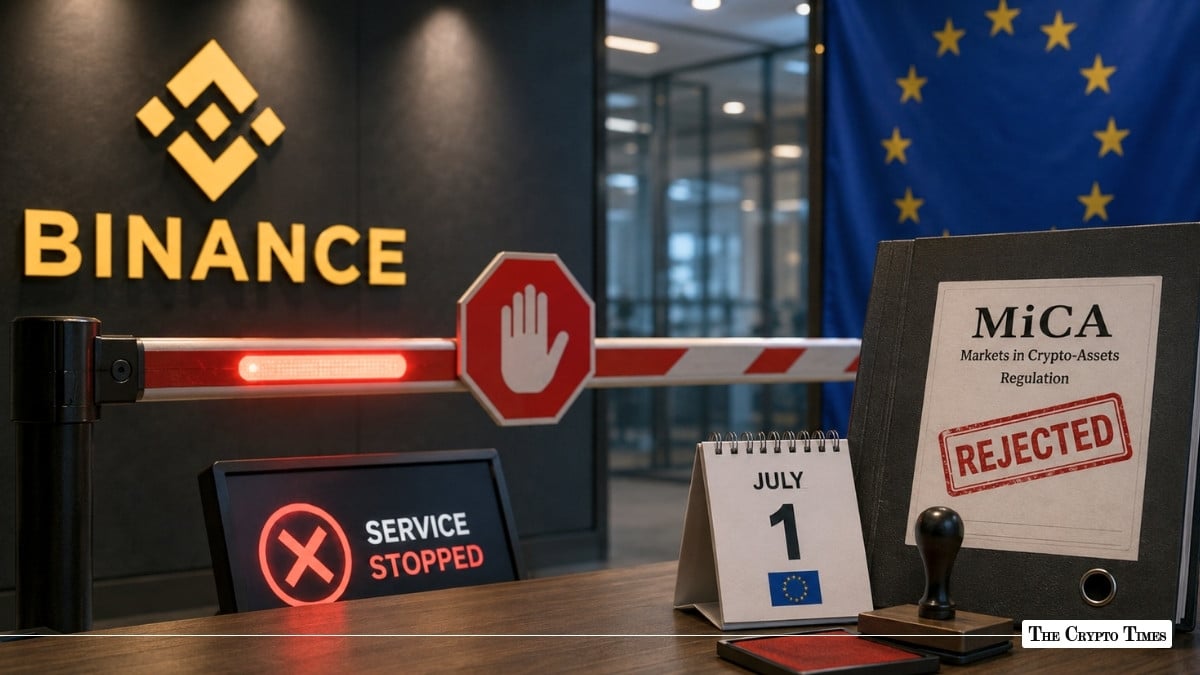
Binance will halt crypto services for customers across the European Union from July 1 after failing to secure a license under the bloc’s Markets in Crypto-Assets (MiCA) regime, a significant setback for an exchange that has spent years trying to rebuild itself as a compliant operator.
A deadline the world’s biggest exchange couldn’t meet
From July 1, every crypto firm serving the EU must hold a MiCA license from a member-state regulator or be locked out of the 27-nation market. A single national license can then be “passported” across the bloc. Binance had bet on Greece as its gateway, submitting an application in January through a local entity and pursuing the approval for what it says was roughly 18 months.
That plan collapsed. On June 24, Binance withdrew its Greek application, one week after Reuters reported that the Hellenic Capital Market Commission was poised to reject it. The exchange framed the move as a prudent choice, saying it received no formal decision before the deadline and “took the prudent decision to withdraw the Greek application and pursue authorization in another EU member state.” In effect, it pulled the bid before it could be formally refused.
Binance maintains its application was sound, saying its submission was “deemed complete and compliant” and reviewed at the level of the EU’s markets regulator, ESMA.
Why Greece balked: Money laundering and the CZ question
The rejection reportedly turned on the exchange’s past, not its paperwork. According to people familiar with the process, Greek regulators, whose review was tracked alongside counterparts in Ireland and Latvia, raised concerns in several areas, in particular Binance’s anti-money-laundering controls and whether Co-Founder Changpeng Zhao could pass the “fit and proper” test that MiCA applies to an applicant’s management and ownership.
That baggage is well documented. In 2023, Binance pleaded guilty in the United States to anti-money-laundering and sanctions violations and paid more than $4.3 billion, one of the largest corporate penalties in US history.
Zhao stepped down as chief executive, pleaded guilty to a criminal charge, served four months in prison, and was pardoned by President Donald Trump in October 2025. He retains his roughly 90% stake in the exchange. The EU has separately been an uncomfortable jurisdiction.
French authorities opened a judicial investigation last year into whether Binance facilitated money laundering tied to drug trafficking and tax fraud, allegations the company denied, and Binance has been effectively shut out of the UK since 2021. To Greek assessors weighing whether the exchange’s controls would hold, that history was the heavier consideration.
Additionally, a viral thread also connected the withdrawal to the October 10, 2025 flash crash, where database connection saturation on Binance saw Ethena’s USDe crash to $0.62 on-platform while holding peg elsewhere. Critics suggested this infrastructure collapse permanently strained relations with Athens regulators ahead of the July 1 licensing deadline.
What it means for EU customers
Customers in markets including Poland, Italy, Spain, and France, where Binance held local registrations that MiCA now renders void, received emails this week explaining how to withdraw their funds after the company told them it “will not be granted a MiCA license by 30 June 2026.”
Binance has sought to calm nerves around that message. Binance said user assets “remain safe and secure” and accessible at all times, that it is communicating directly with affected users, and pointedly that it is “not telling users to withdraw their funds by July 1.” Gillian Lynch, the exchange’s head of Europe and the UK, told Reuters flatly that “Binance is not leaving Europe.” In practice, EU users face a service suspension rather than a loss of access to their holdings — though staying on an unauthorized platform means forfeiting the consumer protections MiCA is designed to guarantee.
According to Danny Sanders, CCO Of Trezor, “On July 1, hundreds of thousands of European crypto holders will wake up as regulatory refugees. Their exchange was hit by a regulatory restriction, and now it can no longer legally serve them, so the shutters come down.”
He further said, “Only around 200 firms got a MiCA licence out of more than 3,000 that were operating in Europe, so this keeps happening through the year.”
A pivot to France, with no guarantees
Binance now plans to apply through France, where it already holds a pre-MiCA digital-asset registration with the AMF that could ease the process. Co-chief executive Richard Teng said the company remains “dedicated to securing our MiCA license” and expects to obtain one “in the coming months.”
The path is far from clean. Any French license would almost certainly land well after July 1, leaving a gap during which Binance cannot legally serve EU clients. And France has been openly skeptical of the passporting model, with regulators last year signaling they could move to block firms that secured approval in more permissive states. France’s AMF declined to comment. With Irish and Latvian regulators reportedly sharing Greece’s reservations, a willing home may prove harder to find than Binance’s confident messaging suggests.
Rivals pounce as the compliance gap widens
The setback is unfolding against a backdrop of competitors consolidating exactly the access Binance has lost. More than 200 firms now hold full CASP licenses across the bloc, among them Coinbase, which has built a MiCA hub in Luxembourg, along with OKX via Malta; Kraken via Ireland; and others, including Bybit and eToro. The contrast is stark: as Binance scrambles for any route to stay in the market, its rivals are positioned to absorb displaced users.
Some have not been subtle about it. Bitpanda founder Eric Demuth used the moment to argue that “the EU values regulation and consumer protection” while inviting traders to his Austrian exchange, and OKX founder Star Xu, who has run a months-long campaign accusing Binance of playing a “regulatory arbitrage game,” promoted his own platform’s compliance credentials. Both have their own glass houses: OKX’s US affiliate pleaded guilty last year and paid roughly $504 million over unlicensed money transmission. But the underlying point lands regardless of the messenger.
For an exchange that has spent years and billions trying to convince regulators it has changed, being unable to win a single EU approval before the deadline is the kind of verdict no compliance department can spin.
Also Read: Three Stories, One Pattern: Why Binance Is Having Its Worst Week Since the Pardon