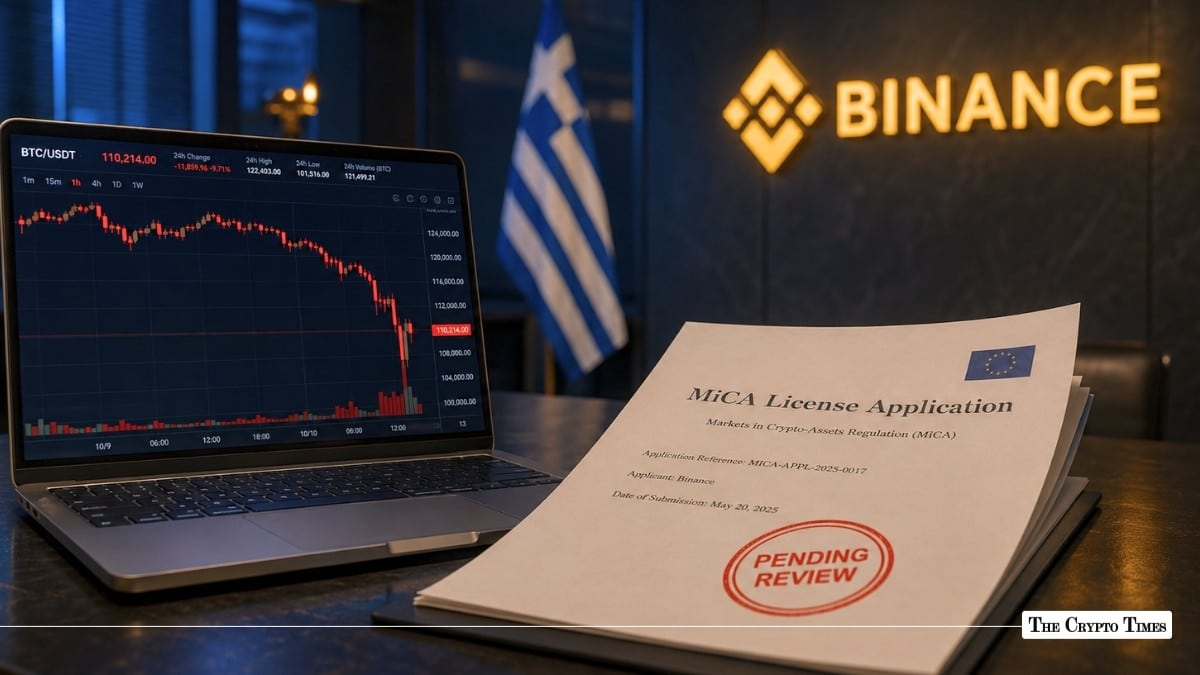
Binance’s struggle to stay in Europe has collided with one of the ugliest days in crypto’s history, at least in the court of public opinion. As the world’s largest exchange confronts the collapse of its Markets in Crypto-Assets (MiCA) licence bid in Greece, just ahead of the EU’s July 1 deadline, a viral X thread is connecting the two events and asking a pointed question: is Binance being shut out of Europe because of the October 10, 2025 crash?
The thread comes from veteran trader Craig “Trader” Cobb, and was amplified by a notable signal-booster: OKX’s Star Xu, Binance’s most vocal exchange rival, reposted it.
The claim
Cobb’s argument is blunt. He noted that the biggest exchange in the world could not secure approval from a single EU regulator before the deadline, and told readers that if that alone isn’t damning, they should “go back to October 10.” He recapped the carnage, roughly $19 billion gone, 1.6 million traders liquidated, and zeroes in on the detail he says matters most: Ethena’s USDe dropped to 62 cents on Binance while it sat at a dollar everywhere else. “People got wiped on a number that wasn’t real anywhere but there,” he wrote.
He went on to fault Binance for a platform that stalled when it mattered most, for paying out compensation he pegged at $328 million while simultaneously insisting its systems weren’t to blame, and signed off: “karma bites Binance.”
What actually happened on October 10
The factual spine of Cobb’s thread checks out. On October 10, 2025, a 100% US tariff threat against China triggered a cross-market risk-off that cascaded into the most violent deleveraging crypto has ever seen: about $19 billion in liquidations and 1.6 million accounts wiped in 24 hours, an event many times larger than the FTX collapse or the 2020 crash.
The part that put Binance at the center was structural. Its Unified Account system let traders post assets like USDe, wBETH, and BNSOL as collateral, but valued that collateral using Binance’s own internal spot prices rather than robust external oracles. When USDe was sold heavily on Binance, its price on that venue alone plunged to roughly $0.62–$0.65, even as it held near $1 on other exchanges, in DeFi pools, and on Ethena’s own rails. Binance’s margin engine marked down collateral to that unreal price, force-liquidating thousands of positions that would have stayed solvent under cross-venue pricing, a reflexive loop that dumped more of the same collateral into thin books.
Compounding it, users reported the interface freezing and APIs failing precisely when they needed to add margin or close positions. Binance later compensated users who were liquidated during the specific depeg window, while maintaining that macro shock and excess leverage, not its systems, caused the crash.
Why it raises regulatory questions
Whatever the ultimate cause, October 10 exposed exactly the kind of risk-infrastructure weakness regulators are paid to worry about: a design in which a single venue’s pricing quirk could mark an asset at a value that existed nowhere else and trigger mass forced selling.
Critics seized on it: Uphold’s head of research called it “Luna 2,” and OKX’s Star Xu has built a months-long campaign arguing that real compliance is about governance and risk culture, not headcount. For a MiCA assessor weighing whether an applicant’s controls will hold under stress, an episode like that is, at minimum, an uncomfortable data point.
But did Greece actually cite it? The honest answer
Here is where the karma narrative outruns the evidence. There is no public indication that Greece’s Hellenic Capital Market Commission named the October 10 crash as a reason for rejecting Binance; the regulator has not disclosed its rationale, and wider reporting on the likely rejection did not attribute it to that event.
MiCA authorization turns on a broad assessment of governance, anti-money-laundering controls, capital, and fit-and-proper management, and Binance’s heaviest baggage on those fronts long predates last October: its 2023 guilty plea and $4.3 billion settlement with US authorities over money-laundering and sanctions failures, after which founder Changpeng Zhao stepped down.
In other words, October 10 may have reinforced a perception, but it is not established as the cause. Cobb’s “karma” framing is commentary, not a regulatory finding.
Binance’s side
Binance has rejected the premise on multiple fronts. It disputed that its application was deficient, said it has worked with regulators for some 18 months and met MiCA standards, pointed to a compliance team of roughly 1,500, and said it will now pursue authorization through another EU member state.
On October 10 specifically, it has consistently attributed the crash to external macro shocks meeting record leverage and evaporating liquidity, not to internal design flaws, and Ethena, for its part, said USDe’s underlying mechanism stayed intact and that the depeg was localized to Binance’s pricing path.
Why it matters
Strip away the question of causation and a practical lesson remains, one Cobb himself stresses: the exchange holding your money matters as much as the trade, and users should keep only what they actively trade on any platform, with the rest in cold storage.
Binance’s exit from the EU’s regulated perimeter, alongside Coinbase cementing its licensed hub in Luxembourg, is redrawing the map of where Europeans can legally trade. Whether October 10 sank the Greek bid or merely darkened the backdrop, the episode hardened a perception regulators increasingly act on: that an exchange’s risk plumbing is not a footnote to the trade. It is the trade.
Also Read: Coinbase Taps 450M Users With Luxembourg MiCA Hub as Binance Loses EU Bid