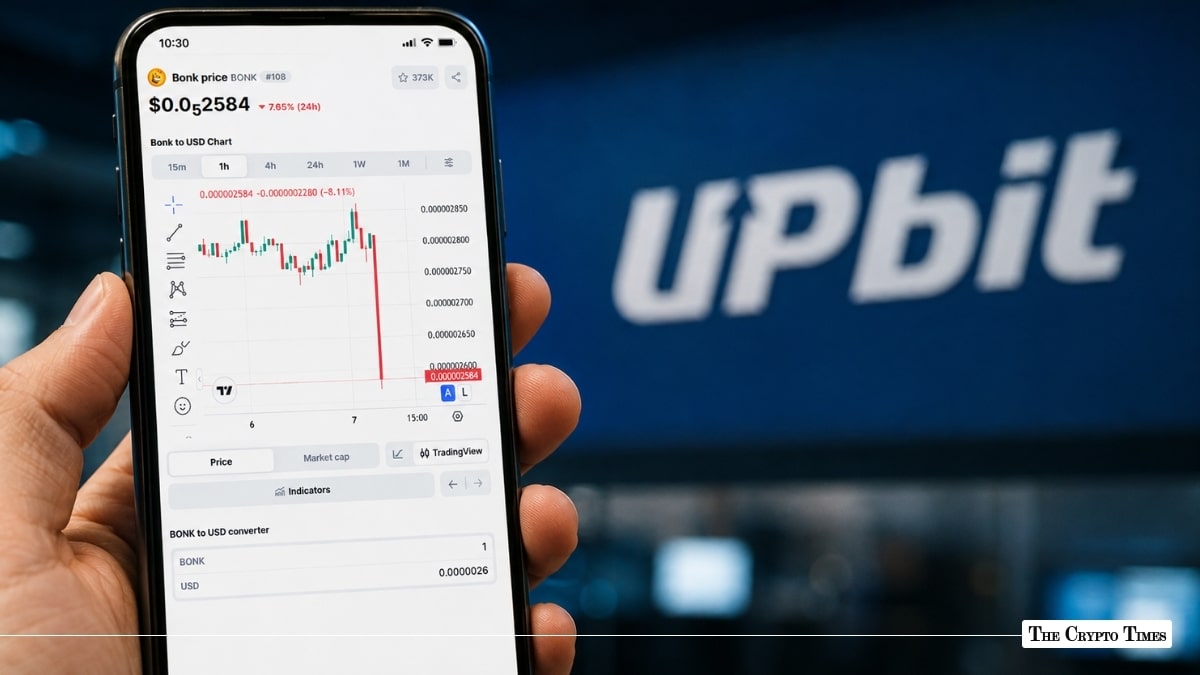
South Korea’s largest cryptocurrency exchange, Upbit, has confirmed that it will terminate trading support for Bonk (BONK), one of the most recognizable memecoins in the Solana ecosystem. The notice was posted on August 7, 2026, and sets the delisting for September 7 at 15:00 KST.
Any open buy or sell orders on the affected pairs will be cancelled at the point of closure, and the exchange will no longer support airdrops, wallet upgrades, or hard forks tied to the asset.
Why Upbit Is Removing BONK
In its official communication, Upbit said the decision followed a comprehensive review carried out under its Digital Asset Trading Support Termination Policy. The exchange pointed to two categories of concern that it said the project had failed to resolve.
The first was a series of security incidents affecting the asset, the wallets managed by the issuer or operator, and the distributed ledger on which the token is issued and stored. The second was the failure of the issuer or operator to disclose material information about the asset on time through appropriate electronic channels.
Upbit noted that BONK had originally been designated an investment warning asset on July 7, 2026, and that the grounds for that warning had not been addressed to the exchange’s satisfaction during the subsequent review.
The Security Incidents Behind the Review
The Upbit decision follows a difficult run for BONK across 2026. In March, the Bonk.fun launchpad suffered a domain hijack in which attackers took control of the official website and planted a wallet-drainer script. Users who interacted with the compromised interface signed malicious transactions, and at least one trader reported losses of around $273,000.
Then on July 6, 2026, BonkDAO was hit by a governance attack that drained roughly $20 million worth of BONK from its treasury. The attacker did not exploit a smart contract vulnerability. Instead, they quietly accumulated voting power through exchange wallets over several days, submitted a proposal titled “Sowellian BonkDAO,” and let the DAO’s own on-chain vote authorise the transfer of 4.4 trillion BONK to an address linked to Bybit. On-chain analysts later estimated the attacker spent about $4 million to acquire the voting majority.
Upbit, Bithumb, and Kraken suspended BONK deposits and withdrawals in the immediate aftermath, and the token slid roughly 8 to 9% within hours. Recovery of the drained funds has not been confirmed, and BonkDAO has said it is working with law enforcement, the Solana Foundation and cross-chain bridges to trace the flows.
Timeline of the Compliance Action
South Korea’s exchange regime, shaped by the Virtual Asset User Protection Act, requires listed venues to conduct periodic reviews of their assets and to designate an investment warning label on tokens that show unresolved risks. That designation typically precedes a full delisting when the underlying issues are not addressed.
For BONK, the sequence played out over roughly a month. Upbit, Bithumb and Coinone placed the token on a delisting watchlist shortly after the July 6 attack. The warning designation was formalised on July 7, and the review period that followed produced the August 7 termination notice. The exchange’s decision to cite both unresolved security incidents and insufficient disclosure suggests that BonkDAO’s post-attack communication, and its response on treasury security and voting reforms, were not judged sufficient to lift the warning.
BONK’s Place in Memecoin History
BONK is one of the original memecoins on Solana and, in many respects, the token that revived memecoin culture on the network. It launched on Christmas Day 2022 in the aftermath of the FTX collapse, at a moment when SOL was trading in the single digits and morale across the ecosystem was at a low. 50% of its 100 trillion supply was airdropped to Solana wallet holders, NFT collectors, developers, and artists.
That distribution model, deliberately structured as a rebuke to what the anonymous creators called “predatory VC tokenomics,” placed BONK in the same lineage as the dog-themed tokens that shaped memecoin culture before it, from Dogecoin as the original meme asset in 2013 to Shiba Inu on Ethereum in 2020.
The token became the unofficial mascot of Solana’s 2023 and 2024 recovery, and its community was the foundation that later launched LetsBonk.fun, the Solana memecoin launchpad that briefly overtook Pump.fun in market share in mid-2025.
Over time, BONK positioned itself less as a pure meme asset and more as an ecosystem token, with more than 400 integrations across DeFi, gaming, and NFT platforms on Solana, and a burn mechanism tied to protocol revenue.
Price Reaction and All-Time High Context
BONK’s all-time high of roughly $0.00005898 was set on November 20, 2024, during the peak of the last memecoin cycle. At the time of the Upbit notice, the token is trading near $0.0000025, with a market capitalization of about $227 million and a 24-hour trading volume of roughly $56 million, an increase of more than 158% as holders reacted to the delisting.
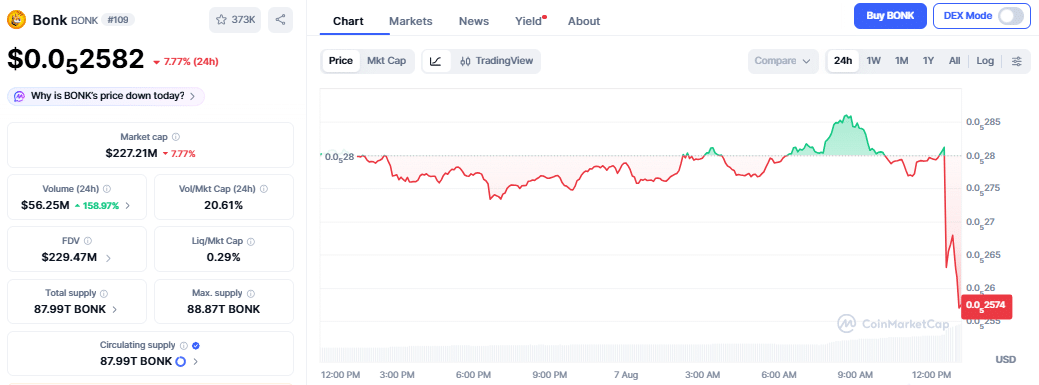
Reference tickers show a sharp drawdown into the announcement, taking BONK to its lowest level since late 2023. Circulating supply stands at 87.99 trillion out of a maximum of 88.87 trillion. The token is now more than 95% below its all-time high.
What This Means for BONK and the Broader Memecoin Sector
An Upbit delisting rarely determines whether a token survives at the global level. BONK will continue to trade on Binance, Coinbase, Bybit, Kraken and other venues, along with the full range of Solana DEXs. But losing access to one of the deepest retail order books in crypto has knock-on effects on liquidity, sentiment and how compliance teams at other exchanges view the asset.
The broader read is that South Korea’s exchange regime is now functioning as a meaningful gate for memecoin projects that lean on retail flow from Korean markets. For BONK specifically, the near-term question is whether BonkDAO can produce a credible response on treasury security, execution timelocks, quorum requirements, and disclosure standards before September 7.
For the memecoin sector, the delisting sits as another data point for how quickly a token can move from ecosystem mascot to investment warning asset once security incidents accumulate faster than the project can resolve them.
Also Read: XRP Steals the Spotlight on Upbit, Outpacing Bitcoin and Ethereum