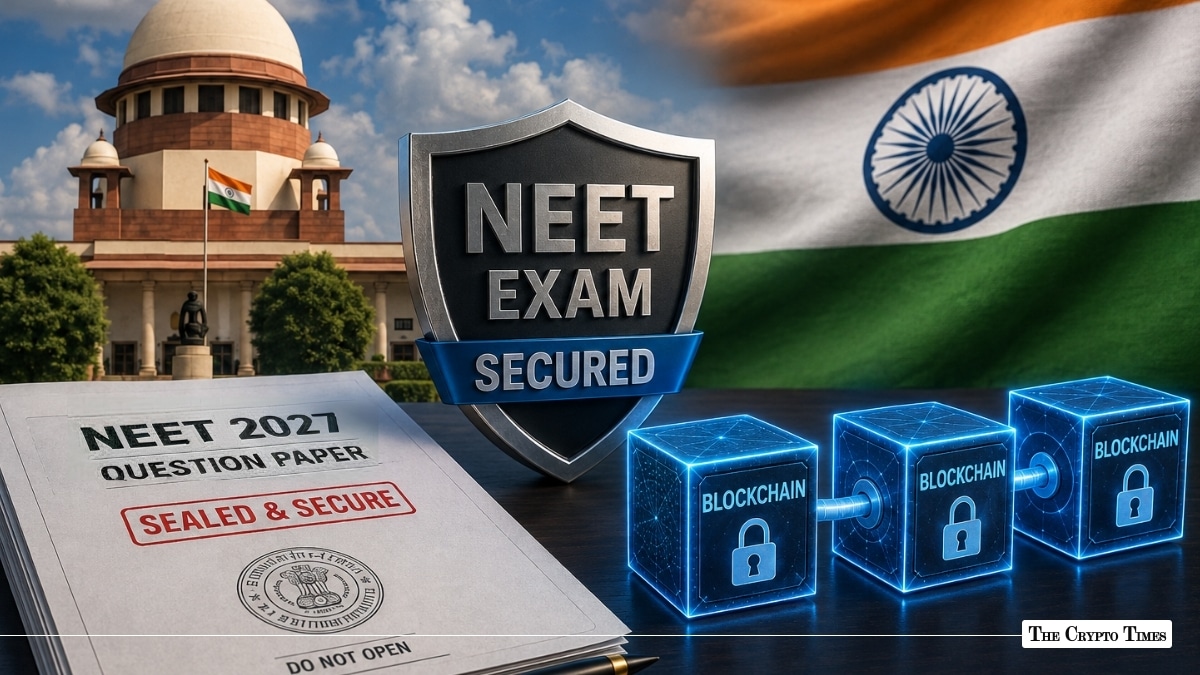
India’s central government has told the Supreme Court that it is overhauling the security of the country’s largest medical-entrance examination, and that blockchain is part of the plan. In a compliance affidavit responding to the fallout from the NEET-UG 2026 paper leak, the Ministry of Education outlined a multi-layered security architecture that includes blockchain-based record management, AI-powered monitoring, air-gapped systems, and stricter access controls, with a task force directed to report within three months specifically on “leveraging AI and Blockchain to secure examination conduction.”
For a country whose government remains cautious about cryptocurrency as an asset, the move is a notable example of the state embracing the underlying technology for public-sector use. But it also invites a practical question that tends to get lost in announcements: in a system whose failures have mostly been physical and human, what can a blockchain actually secure?
What the Centre Told the Supreme Court
According to the affidavit, filed by an Under Secretary in the Department of Higher Education before a bench of Justices P.S. Narasimha and Alok Aradhe, in response to the court’s May 29, 2026 order, the National Testing Agency (NTA) has implemented what officials described as a “fortress” model: a 10-stage security protocol spanning the exam’s lifecycle.
Alongside the blockchain component, the measures reported include using air-gapped, or offline, AI systems for the initial drafting of papers at the translation stage, followed by limited human verification; assigning every question paper and OMR answer sheet a unique serial number tied to a specific candidate; and housing papers in six layers of tamper-evident packaging, including steel trunks with one-time-use locks. The affidavit also pointed to the Public Examinations (Prevention of Unfair Means) Amendment Act, 2026, which it said provides for up to 10 years’ imprisonment and fines of up to ₹1 crore, and noted that a phased shift to computer-based testing is under active consideration. The government said the affidavit does not comment on the merits of the ongoing CBI investigation into the alleged 2026 leak.
Background: Why the Overhaul
The reforms follow years of controversy around NEET, an exam taken by roughly 22 lakh (2.2 million) students competing for medical-college seats. The NTA cancelled the exam held on May 3, 2026 after paper-leak allegations emerged, and conducted a re-examination on June 21. That echoed the far larger scandal around NEET-UG 2024, when investigators uncovered leaks concentrated in Patna and Hazaribagh, the arrest of organized “solver gangs,” and security lapses that included confidential materials being moved in unsecured local transport. The Supreme Court declined to cancel the 2024 exam, finding the leak was not systemic, but directed a series of reforms and has since been hearing petitions seeking to replace the NTA with a more autonomous body.
Critically, those past breaches share a common thread: they happened in the physical world, through theft, transport failures, and human collusion, rather than through the digital tampering of records. That distinction is central to understanding where blockchain fits.
Where Blockchain Fits and Where It Doesn’t
Blockchain is, at its core, a tamper-evident digital ledger: once information is recorded, it is extremely difficult to alter without leaving a trace, and every entry can carry a timestamp and a record of who added it. Applied to an examination system, that makes it genuinely useful for a specific set of problems. It can create an immutable audit trail of who accessed sensitive files and when, harden the chain-of-custody record as papers move through the system, and make it far harder to quietly alter results, OMR data, or logs after the fact. In a system criticised for weak institutional memory and accountability, those are real gains.
What blockchain does not do is prevent a physical question paper from being stolen from a trunk, photographed by an insider, or memorized by a solver — the failure modes behind most of NEET’s actual leaks. A leak of that kind occurs before or outside the digital record the blockchain protects; the ledger might faithfully and permanently record that a breach occurred, but it cannot stop the breach itself. In that sense, blockchain is better understood as an accountability and integrity layer than as a lock on the exam. Its value in this rollout will depend heavily on implementation details that are not yet public, what exactly is recorded on-chain, who controls the network, and how it connects to the physical controls like the serialised papers and tamper-evident packaging that do more to address the leak problem directly.
A Piece of India’s Broader Blockchain Push
The NEET plan fits a wider pattern in which India has been far more receptive to blockchain as a government tool than to crypto as an investment. While the country maintains a demanding tax regime on crypto trading, a 30% tax on gains and a 1% tax deducted at source, and regulators have remained wary of digital assets, the public sector has steadily adopted distributed-ledger technology, from national frameworks for blockchain services to its use in academic credential verification and record-keeping. Bringing it into high-stakes examinations is a logical, if ambitious, extension of that approach, and one of the most consequential use cases yet given the stakes for millions of students.
What Remains to be Seen
Adding blockchain to NEET’s security architecture is a meaningful step, but a bounded one. It strengthens the parts of the problem that are about records, trust, and accountability, while leaving the harder, physical challenge of preventing leaks to the other nine layers of the government’s “fortress.”
Whether the overall overhaul succeeds will turn less on the presence of blockchain in the announcement than on execution, and, for now, the task force’s detailed recommendations remain three months away. For observers of India’s evolving relationship with the technology, though, its appearance at the center of a reform this visible is itself the story.
Also Read: India’s UPI Fees on ₹2,000+ Payments? RBI’s Digital Rupee Stays Free