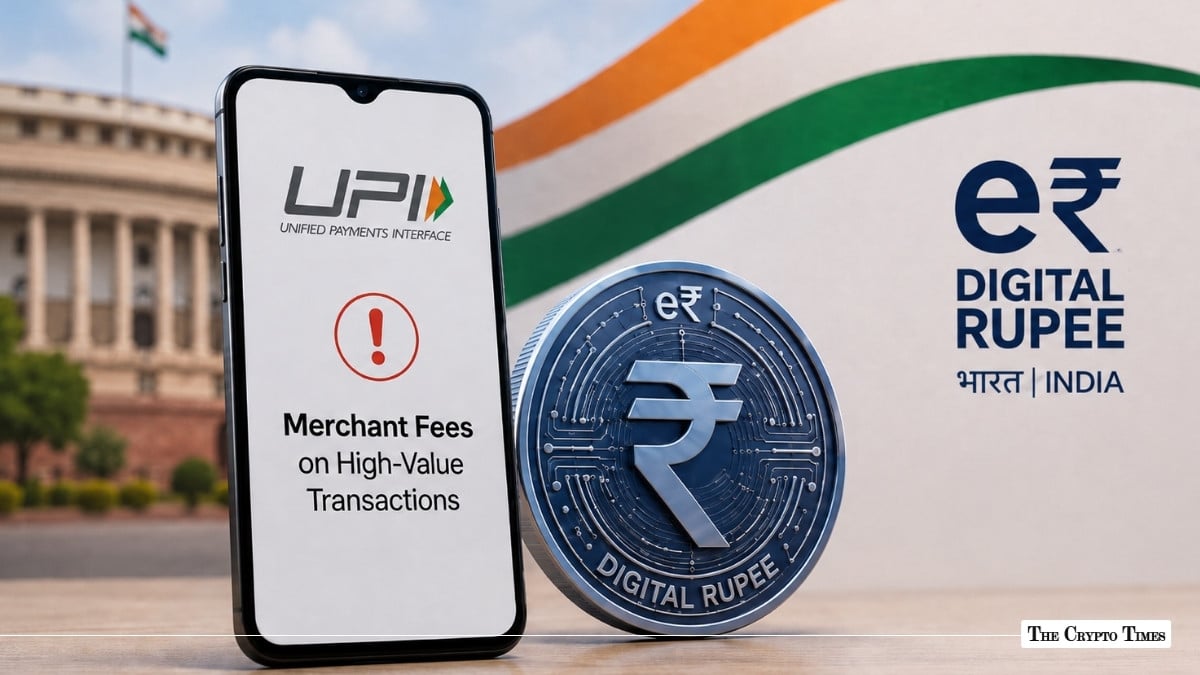
For six years, using UPI has meant one simple thing: scan, pay, and never pay a fee. That may change for some payments now, and the fight over it has already turned political. It has also drawn attention to a subtle difference: the RBI’s own digital rupee, a Central Bank Digital Currency (CBDC) running as a pilot since 2022, still incurs no fees.
On August 4, Finance Minister Nirmala Sitharaman introduced the Taxation and Other Laws (Amendment) Bill, 2026 in the Lok Sabha. It changes Section 10A of the Payment and Settlement Systems Act, 2007, the rule that has banned merchant fees on UPI and RuPay debit card payments since January 2020. This fee is called the MDR, or Merchant Discount Rate, and it is what a shop pays the bank for accepting a digital payment.
The bill does not add any fee right now. What it does is remove the rule that made fees impossible. After this, the government can decide later, on its own, which payment types stay free and which do not. In simple terms, charging a fee on UPI is no longer against the law. The government has yet to decide whether to actually do it.
According to a Reuters report, one idea being discussed is a fee of 0.3% to 0.5% on payments above ₹2,000 made to bigger shops and businesses (those earning more than ₹1.5 crore a year). Smaller payments and money you send to friends or family are expected to stay free. Payments above ₹2,000 are only about 4% of the total number of transactions, but they make up nearly two-thirds of the total money moved, which is why the discussion has centred on this group.
The politics started at once
The opposition wasted no time. In a sharply worded post on X, the Congress said, “Modi has made a plan to cut into your pocket,” warning that a fee could soon apply to UPI payments above ₹2,000. The party said people are already troubled by inflation and accused the Prime Minister of trying to squeeze money out of ordinary people with one new plan after another. Its post ended with a blunt jab, saying Modi’s mantra was to let the fleecing go on no matter the cost to people.
The government has not accepted that framing. It points out that the bill only creates the power to charge fees and does not impose any, and that small users and everyday payments are meant to stay free.
Payment companies, for their part, have argued for years that a fully free system leaves them little money to spend on technology and safety even as UPI keeps growing. UPI handled 23.6 billion payments worth ₹29.9 trillion in July alone. A March 2026 report by a Parliamentary committee said keeping UPI completely free was not financially workable for the companies running it.
Where the digital rupee fits in
While the debate is about UPI fees, there is another kind of digital money that currently charges no fees, and no fee proposal applies to it. That is the e-rupee, the RBI’s digital currency.
The RBI’s official FAQ page, last updated on April 29, 2026, states that there are no charges or fees for using the e-rupee or its wallet. It is not covered by the fee debate because it is not a system that moves money between bank accounts. It is money itself, in digital form.
What the e-rupee is
It started as a pilot in late 2022. There are two types. One is for banks, used for settlements between them, which started on November 1, 2022. The other is for the public, which started on December 1, 2022. Almost four years later, it is still a pilot and has not been fully launched across the country.
As per the RBI’s FAQ, 19 banks now offer e-rupee wallets, including SBI, HDFC, Kotak, Canara, and Bank of Maharashtra, and some non-bank apps have joined in too.
Here is the simple difference between UPI and the e-rupee. UPI works like a messenger that moves money from your bank account to the shop’s bank account. The e-rupee is different. It is money issued by the RBI that sits in your phone wallet, the way a note sits in your pocket. It gives no interest, the payment is final and instant, and it can scan the same UPI QR codes already in use at shops.
As The Crypto Times explained in its report on how UPI left crypto behind, banks like SBI, HDFC, and Canara built this link so that a shopkeeper does not notice a difference when a customer pays with e-rupee.
This is also where India’s digital money splits into two paths. UPI and the e-rupee are both government-run systems, supervised by the RBI. That is the opposite of private crypto, which runs without any central authority. The RBI has backed its own systems while staying openly doubtful about private crypto and stablecoins, arguing that a CBDC can do much of what crypto does with fewer risks.
The adoption problem
Very few people actually use the e-rupee. As previously reported when a Finance Committee chairman called the project weak, the e-rupee has crossed 150 million payments in total but has only about 10 million users, a small number next to the hundreds of millions who use UPI every day. The amount of e-rupee in use actually fell over the last year.
Read: India Routes $80B Welfare Through e-Rupee to Find the CBDC a Use Case
To increase its use, the RBI has started sending some government benefits through its CBDC. Using a feature called programmability, the money can be locked for a fixed purpose, such as food subsidies, in states like Gujarat, Puducherry, and Chandigarh. The same feature has drawn concern from some people. When money can be set to expire or to be spent only in certain places, critics say it can be used to control how people spend rather than only to make paying easier.
The RBI has moved slowly. Governor Sanjay Malhotra has said more than once that the e-rupee is not a replacement for cash for now, and that getting the technology right matters more than pushing people to switch. The RBI is testing the CBDC for offline use in areas with weak internet and is preparing cross-border trials with Singapore and the UAE. There is still no date for a full national launch.
What happens next
For now, nothing changes at the shop counter. No fee has been fixed, no date has been set, and any actual fee would need a separate government order even after this bill becomes law. UPI stays free for regular users and small shops. Malhotra has also said digital payments carry real costs and must stay affordable at the same time, which is the balance at the centre of this debate.
The question being raised is whether the possibility of fees on big UPI payments will lead anyone to try the fee-free e-rupee, which has been in pilot for over three and a half years. A fee that applies only to large payments to big businesses may not change much for small shopkeepers, and the e-rupee still has very few users. Whether the comparison changes anything is what participants and users will be watching in the coming months.
Also Read: Binance Helps India Bust ₹226 Cr Crypto Network Linked to Terror Financing