For three and a half years, India’s Central Bank Digital Currency (CBDC) has had the same problem every other major CBDC project has faced: no one wanted to use it. The Reserve Bank of India (RBI) now appears to have found its answer: if citizens won’t choose the digital rupee, route it through the payment channels they cannot opt out of.
Launched in December 2022, the e-rupee briefly crossed 1 million daily transactions in late 2023 — but that number was manufactured by banks paying portions of employee salaries in CBDC to hit RBI targets. By mid-2024, daily retail transactions had crashed to roughly 100,000. UPI, by comparison, processes more transactions in a single afternoon than the e-rupee has seen in its lifetime.
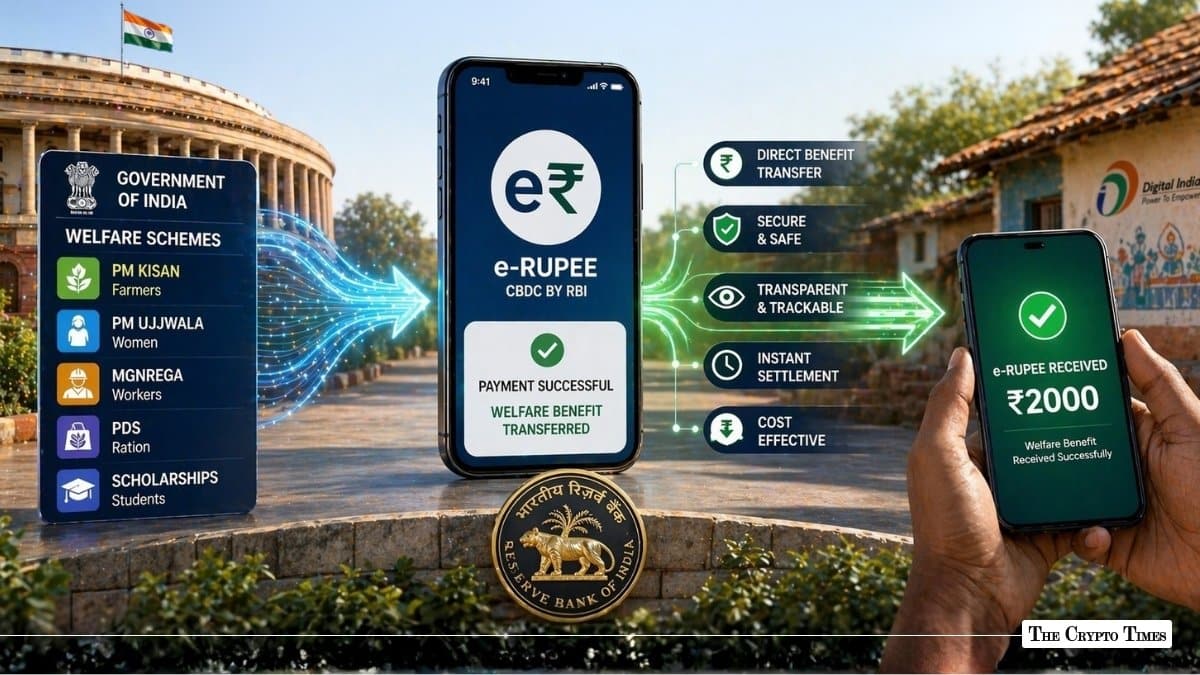
Reuters reported on April 23 that the RBI, alongside the World Bank, the Maharashtra government, and Punjab National Bank, is now running approximately 10 pilots routing parts of India’s roughly $80 billion welfare system through the e-rupee. The system, concentrated in Maharashtra and Gujarat, are targeting agricultural subsidies and food benefits where welfare leakage has been a persistent problem and the beneficiary has no choice but to accept whatever delivery mechanism the government offers.
How the Pilots Work
In Maharashtra’s Phulenagar village, Samadhan Sonawane installed a drip irrigation system on his small onion farm using programmable digital rupees issued directly by the RBI. The system costs ₹1,03,000 — more than twice the ₹50,000 he earns in a five-month growing season. Under the pilot, 80% is transferred directly into a digital wallet holding e-rupees spendable only at approved vendors. Nearly 1,400 farmers in the district have applied.
Two features make the CBDC version structurally different from the existing direct benefit transfer model. There is no reimbursement lag — the farmer doesn’t pay upfront and wait for a refund. And the programmable restriction means the tokens cannot be diverted to other household expenses or converted to cash.
The Gujarat pilot is larger. Launched in February by Union Home Minister Amit Shah, it aims to onboard all 7.5 million households eligible for subsidized food grains by June. Beneficiaries receive programmable e-rupee coupons that they redeem at Fair Price Shops. Fair Price Shop owners get paid instantly. Every transaction generates an auditable digital record.
The Adoption Problem Dressed Up as Delivery
The honest framing is that the welfare pilots solve two problems at once: one that exists, and one the RBI has been careful not to advertise.
The real problem of welfare leakage is genuine. India’s subsidy architecture has historically struggled with ghost beneficiaries, duplicate registrations, diverted payments, and delayed reimbursements. Programmable money addresses all four. The CBDC cannot be withdrawn as cash, cannot be spent at unauthorized vendors, and every rupee is traceable from issuance to settlement.
The second problem is the one the RBI would rather not discuss. RBI Governor Sanjay Malhotra has publicly conceded that the e-Rupee is “not a substitute for cash for now.” CBDC wallets are still not available through UPI-based PhonePe or Google Pay. Commercial banks have complied with RBI directives in form but have shown little organic enthusiasm. In that context, welfare delivery is not just a use case for the CBDC, it is the only channel where the RBI can guarantee adoption, because the beneficiary has no alternative.
The Programmability Trade-Off
Programmable money is powerful precisely because it is, by design, fully traceable and conditional. That is the feature being marketed to solve welfare leakage. It is also what has drawn the most criticism in every jurisdiction where CBDCs have been deployed.
Every e-rupee subsidy transaction links a beneficiary to a purchase, a vendor, a location, and a timestamp. For anti-fraud enforcement, that’s a feature. For broader rollout, it becomes a real-time map of how citizens spend public benefits — especially as crypto-assets, CBDCs, and specified electronic money products have already been brought under India’s FATCA/CRS reporting framework with retroactive effect from January 1, 2026.
The Gujarat pilot’s June deadline will be the first real stress test. If the infrastructure handles 7.5 million households reliably and the programmable restrictions measurably reduce diversion, expansion to other states becomes hard to argue against. If not, India will have spent considerable political capital pushing a product its own ecosystem has never wanted.
Either way, the question the e-rupee rollout has never answered is getting louder: is a CBDC that can only scale through welfare mandates actually a success?
Also Read: Why India’s Crypto Market is Getting Older, Slower, & Smarter: CoinSwitch Report