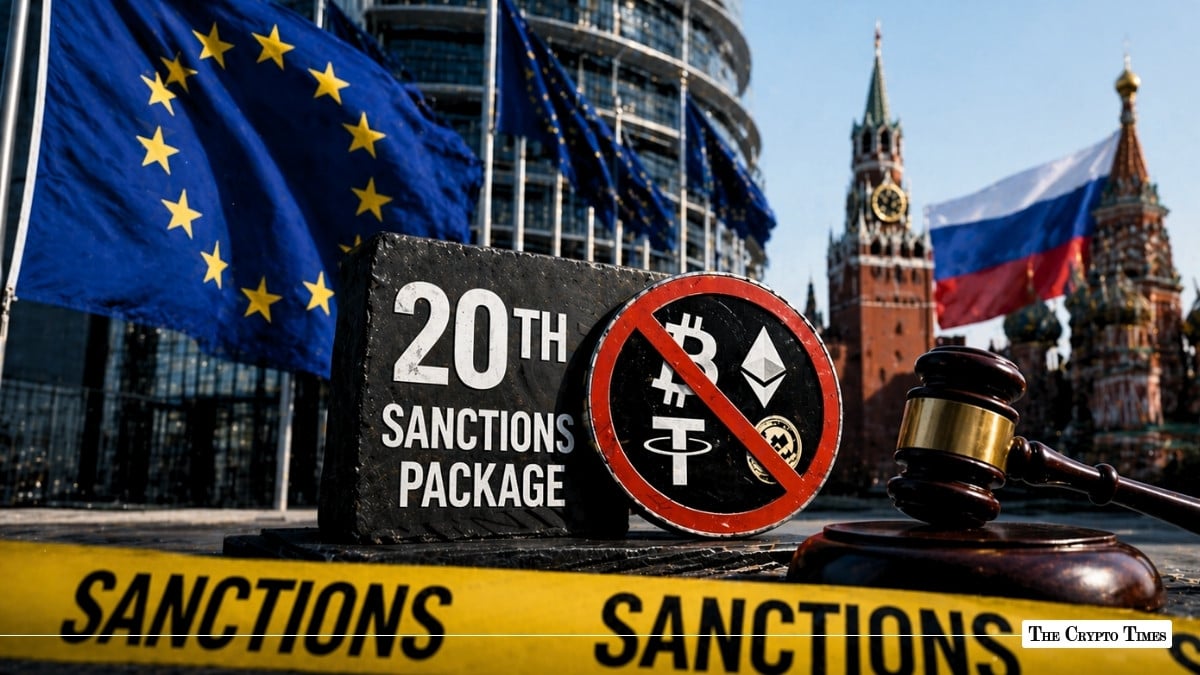
Brussels has moved decisively against what has become Russia’s most effective sanctions-evasion rail. On April 23, the Council of the EU adopted its 20th sanctions package since the 2022 invasion. For the first time, it treats Russia’s crypto ecosystem as a single, sectoral problem rather than a series of individual entities to be designated one at a time.
The package imposes a total sectoral ban on any EU person carrying out exchanges with any crypto asset service provider (CASP) established in Russia—as well as any decentralized platform based in the country that allows the transfer and exchange of crypto assets. A parallel framework under the Belarus sanctions regime imposes an equivalent blanket ban on Belarus-based providers. Both measures take effect on May 24, 2026.
EU foreign policy chief Kaja Kallas said the bloc had “finally broken the deadlock,” referring to months of internal disputes. Hungary and Slovakia dropped their vetoes this week, unlocking both the sanctions package and a stalled €90 billion loan to Ukraine.
The Shift From Entity-by-Entity to Sectoral
For three years, the EU’s crypto sanctions approach mirrored the US model: designate individual actors, freeze their wallets, block their exchanges. The problem, documented by blockchain analytics firm TRM Labs and others, is that each designated entity has been quickly replaced by a rebranded successor. When Garantex was seized by the DOJ in March 2025, its former employees launched Grinex within weeks. When Grinex itself halted operations after a $13M hack in April 2026, other providers stepped in.
The 20th package’s sectoral approach is an attempt to end that cycle. Rather than designating specific exchanges, the EU is prohibiting EU persons from transacting with any Russia-based crypto provider, regardless of name, structure, or successor status. Industry analysts describe this as a categorical shift: any EU nexus with a Russian-established crypto exchange is now prohibited by default.
The package also expands Annex LIII — the EU’s list of banned crypto-assets — adding RUBx and the digital rouble to the already-listed A7A5 stablecoin. The digital rouble ban is explicitly preemptive, designed to close a circumvention channel before Russia’s planned mass CBDC rollout in September 2026.
Targeting the Third-Country Workaround
Russia’s crypto-enabled sanctions evasion has never been purely domestic. The A7A5 stablecoin—heavily utilized by Russian operators—was registered under the laws of Kyrgyzstan, traded primarily on offshore platforms, and processed billions in transfers before facing US and EU designations. Its appearance as a platinum sponsor at TOKEN2049 Singapore in October 2025 highlighted the regulatory arbitrage sanctioned Russian crypto was exploiting in Asia.
The 20th package now targets platforms like Meer, the Kyrgyz exchange where significant amounts of A7A5 are traded. It also activates the EU’s “anti-circumvention” tool for the first time, blocking exports of critical EU goods to Kyrgyzstan, where they have been used to undermine sanctions. Additionally, several banks across Kyrgyzstan, Laos, and Azerbaijan face new transaction bans for assisting Russia’s financial messaging network.
What It Means for the Crypto Industry
Practical compliance impact for EU-facing exchanges, custodians, and DeFi protocols is significant. Starting May 24, every MiCA-licensed European CASP will need to screen counterparties not just for sanctioned individuals but for any platform with Russian or Belarusian establishment. DeFi protocols accessible from Russia face a more complex question: the language covers “any platform that allows for the transfer and exchange of crypto assets” based in Russia, a broad formulation that sanctions experts expect will be tested in court.
For the broader industry, the package consolidates a trend. The US has used OFAC designations, the UK has used its own sanctions regime, and now the EU has moved to a sectoral framework. All three major Western jurisdictions now treat Russian crypto infrastructure as systemically sanctioned rather than individually designated.
Russia’s response has been to accelerate its own crypto-payments infrastructure — including the use of Bitcoin, Ethereum, and Tether to settle oil exports to China and India. The EU’s 20th package closes one door. The open question is which door opens next.