India’s Parliamentary Standing Committee on Finance has, for the first time, put on record that the country cannot keep governing its rapidly expanding crypto industry through tax circulars and anti-money laundering notices alone.
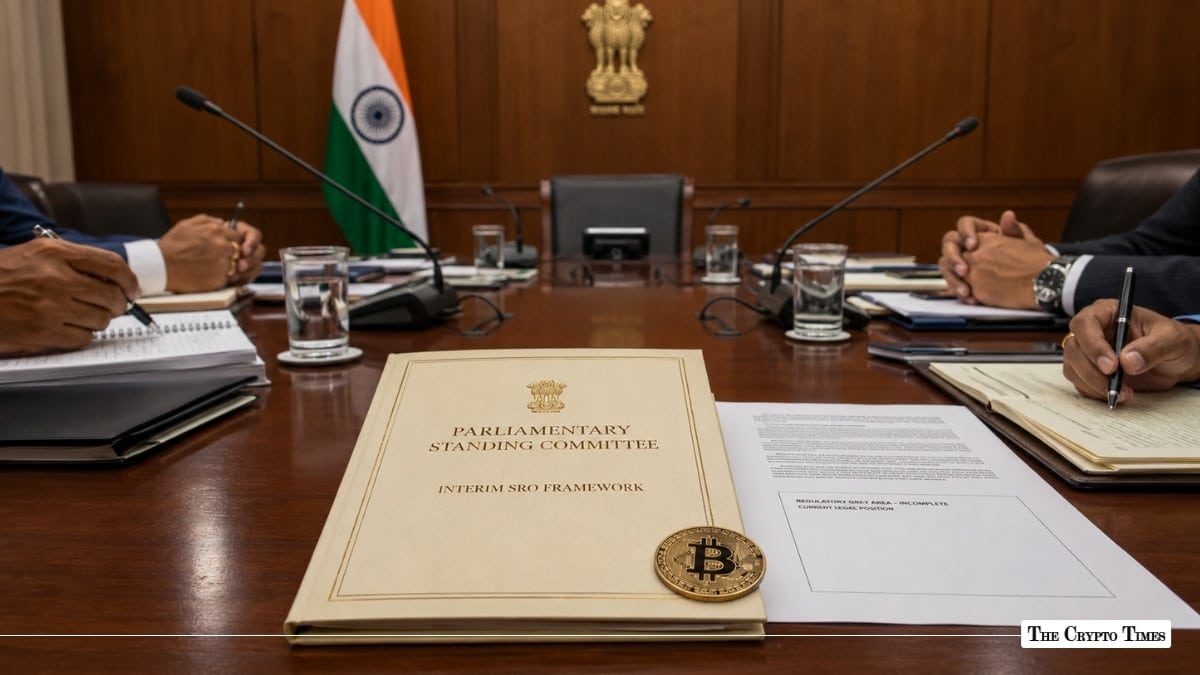
In a landmark 36th Report on the Securities Markets Code, 2025, tabled in Parliament on July 23, the panel has recommended an interim regulatory framework for cryptocurrencies and Virtual Digital Assets (VDAs) through recognized Self-Regulatory Organisations (SROs), operating under the oversight of a designated statutory regulator such as SEBI or the Reserve Bank of India.
The report, chaired by BJP MP Bhartruhari Mahtab, stops short of pulling crypto into the proposed securities law directly. Instead, it argues that India needs a phased, industry-led model of oversight while a broader legislative regime is negotiated across ministries and regulators. It is the clearest signal so far that lawmakers no longer view continued regulatory ambiguity as an acceptable status quo.
What the committee has actually recommended
The panel’s central proposal is an SRO-led interim framework, benchmarked to prudential norms familiar to India’s wider financial system. Any recognized SRO, the committee said, must set minimum standards on governance, transparency, disclosures, investor protection, grievance redressal, compliance, and codes of conduct, all while operating under the supervision of a statutory regulator. In effect, the industry would run the day-to-day rulebook, but a Central regulator would sit above it.
The report also asks the Ministry of Finance to fix a problem India has ducked for years, which is the absence of clear legal definitions for different categories of digital assets. The committee has recommended that VDAs be broken up into distinct legal buckets, because not every crypto asset behaves like every other. Some may qualify as securities. Some may be derivatives. Others may need an entirely new regulatory category, particularly those tied to payments, utility functions, or on-chain infrastructure.
Alongside the SRO proposal, the panel wants the Finance Ministry to clarify three specific questions before the Securities Markets Code is finalized:
- Whether crypto investment products will be covered under the proposed Securities Markets Code.
- Whether exchanges offering tokenized securities would fall within the legislation’s scope.
- Whether additional enabling provisions are needed so that regulators can effectively oversee tokenised financial products, including real-world assets (RWAs), a segment that is scaling rapidly across global markets.
Before arriving at these recommendations, the committee studied the regulatory playbooks used in the United Kingdom, Singapore, the United States, and the European Union, and concluded that India should not wait for a single comprehensive law. Instead, it should move in stages, starting with SRO-led oversight.
The consultations that shaped the report
The recommendations follow months of parliamentary hearings that brought in a wide cross-section of the ecosystem. In its earlier sittings, the panel met major crypto exchanges, including Binance, WazirX, ZebPay, CoinDCX, CoinSwitch, and Coinbase, along with the International Financial Services Centres Authority (IFSCA) and several government ministries.
In a later round, lawmakers invited senior officials from the RBI and the Institute of Chartered Accountants of India (ICAI) to explain their views on financial stability, taxation, and accounting standards for VDAs. The Financial Intelligence Unit (FIU), the Central Board of Direct Taxes (CBDT), the Department of Revenue, the Ministry of Corporate Affairs, and eventually the Department of Economic Affairs were all part of the process. The final report reflects that composite feedback.
The committee’s 7th sitting on May 20 is the one that reportedly hardened the panel’s stance. That session produced the finding that thousands of crores were quietly leaving the country through crypto rails every year, a data point that has hung over the deliberations ever since.
The government’s official position: Still unregulated
Despite the political weight of the recommendations, the committee’s report is careful to record that the Union Government’s formal position has not changed. Virtual digital assets remain outside India’s statutory regulatory perimeter, and are covered only for narrow purposes.
“The position of the Central Government regarding crypto-assets, including Virtual Digital Assets, is that such assets are presently unregulated in India, except for the limited purposes of taxation, prevention of money laundering and reporting,” the report notes, quoting the Ministry of Finance.
The Ministry has also told the panel that any comprehensive regime for VDAs would need serious domestic coordination between regulators, as well as international cooperation, given how borderless the asset class is. On that basis, lawmakers have concluded that folding cryptocurrencies directly into the Securities Markets Code at this stage would be premature.
The RBI’s hard line remains the loudest voice in the room
The report also has to reconcile positions that pull in sharply different directions. In its own appearance before the committee, the Reserve Bank of India, represented by Deputy Governor Rohit Jain and Executive Director P. Vasudevan, rejected any move to grant crypto legal status.
Instead of a conventional rulebook, the central bank pushed a containment strategy, arguing for a ring-fencing of the formal financial system, in which banks and other regulated entities would be barred from dealing in private crypto and privately issued stablecoins, and such assets would be blocked from use in payments and settlements.
The RBI’s argument to the panel was that conventional regulation would legitimize speculative products and give retail investors a false sense of safety. It also kept prohibition on the table as a stated policy option.
However, the RBI drew a clear distinction between private cryptocurrencies and tokenized government securities. Its restrictions, in other words, are aimed at speculation, not at the underlying blockchain rails, and it wants room for tokenized sovereign instruments to keep developing on regulated infrastructure. That distinction now sits at the heart of India’s tokenization debate.
The ICAI, in contrast, backed a comprehensive VDA law covering issuance, trading, and custody, arguing that blockchain-based systems and stablecoins could make cross-border payments faster and cheaper. SEBI, meanwhile, has signaled openness to regulating tokens classified as securities, feeding into a proposed multi-regulator model that would split oversight between SEBI, the RBI, and the Finance Ministry.
India’s crypto reality, in numbers
The pressure on Parliament to act is easy to see once the numbers are laid out. India ranks first in global grassroots crypto adoption for the third consecutive year, with an estimated 119 million users. An OECD study pegged the country’s annual crypto transaction value at roughly $340 billion, which is equal to about 9% of GDP.
Yet by exchanges’ own figures presented to Parliament, close to 90% of Indian trading volume has migrated offshore, beyond the reach of the domestic tax authorities the current regime was designed to serve. That is precisely the capital flight the government has said it wants to prevent, and it is one of the reasons the committee refused to endorse the RBI’s isolation-only view.
The stress on the enforcement system is also visible in a series of parallel developments. In recent weeks, the Enforcement Directorate has stepped up action against crypto firms, including raids on Bengaluru-based crypto companies in a ₹2,500 crore FEMA probe. The National Investigation Agency has separately flagged how crypto, Telegram, and VPNs are being used in emerging terror financing patterns. These are exactly the concerns the RBI has cited, but they are also the reasons the committee has said an SRO framework can no longer wait.
Tax regime unchanged, and that is the sting for investors
For India’s retail crypto users, the immediate takeaway is that the report is a study with recommendations, not law. Nothing changes on the ground yet. The tax regime remains as heavy as it was: a flat 30% tax on gains under Section 115BBH, a 1% TDS on transfers under Section 194S, no offset for losses, and 18% GST on platform fees. For top-bracket earners, the effective burden can cross 42%. Budget 2026 left this framework untouched.
Even the RBI’s containment proposal, read precisely, does not criminalize ownership. Trading remains legal for individuals. What the central bank wants to wall off is the interface between crypto and the formal banking, payments, and settlements system, along with private stablecoin rails.
What comes next
The 36th report does not, by itself, change any law. The government retains the final call on whether and how to legislate. But it does three things that matter.
First, it puts the interim SRO route on the official table, giving the industry a formal basis to organize itself under regulatory supervision rather than continue in legal grey territory. Second, it forces the Finance Ministry to answer overdue questions about how tokenized securities and crypto investment products will be treated under the Securities Markets Code, 2025.
Third, it acknowledges, in Parliament, that the current tax-but-do-not-recognise approach is not a durable policy for a country that sits at the top of the global adoption tables while watching 90% of its trading flow leave through the back door.
For Indian exchanges, tokenization platforms, and RWA issuers, the direction of travel now points, cautiously, toward regulated oversight. For millions of Indian investors, the more immediate question is when, and in what form, the government converts the committee’s recommendations into rules that can actually be relied upon.
That answer will come in the next set of budget and legislative decisions, and it is one Parliament, having now spoken clearly, will find harder to keep postponing.
Also Read: India’s ED Nabs Dubai Man Running Crypto-Hawala Pipeline for Brazil, Thailand Cartels